This article provides general information to support better planning. Individual medical decisions and fitness for travel require assessment by qualified treating professionals.
Medical value travel, often abbreviated MVT, describes travel across borders to access healthcare and related services. In India, the term is commonly used in discussions of medical tourism, international patient services and the systems that help people plan care away from their home country. It is not the name of a particular medical procedure, visa or hospital package.
A patient might travel for a specialist opinion, planned surgery, ongoing treatment or another medically indicated service. The wider medical value travel ecosystem can also include wellness-related journeys, although the distinction between clinical treatment and general wellness matters. A hospital is responsible for the clinical service it provides; airlines, immigration authorities, insurers and other organisations each have separate roles.
For families, the value of understanding the term is practical. A treatment decision is only one part of the journey. Medical records, hospital selection, travel readiness, expenses, accommodation and follow-up all affect how the experience is organised. This guide explains the meaning of medical value travel in India, how it differs from other terms, and what patients should verify before making a commitment. For the broader care-planning pathway, explore Carehorizon's treatment in India information.
Medical Value Travel: A Simple Definition
In practical terms, medical value travel is a journey undertaken to receive healthcare away from one's usual country of residence, together with the services and arrangements that make that care possible. Industry and policy publications may use the expression differently, so it is better understood as a category than as a legally fixed entitlement.
The Government of India's Press Information Bureau described medical value travel in May 2026 as an ecosystem encompassing medical and wellness tourism. It distinguished medical tourism, concerned with curative interventions, from wellness tourism, concerned with preventive and holistic wellbeing.
For a patient seeking a clinical intervention, the central issue remains medical suitability. An attractive travel package or the use of the term MVT does not replace diagnosis, informed consent or professional treatment standards.
Is Medical Value Travel the Same as Medical Tourism?
The two expressions overlap substantially. Medical tourism commonly refers to travelling to another country for medical care. The CDC Yellow Book uses this straightforward definition and discusses the financial, cultural and access-related reasons patients may seek treatment abroad.
Medical value travel is often used by Indian government and industry organisations as a wider term that highlights the full healthcare journey. In some reports it is effectively used as a synonym for medical tourism; in others it expressly includes wellness and related services.
Neither phrase guarantees that a service is clinically necessary, accredited, medically safe or covered by insurance. Those questions must be answered separately for the individual patient.
Where Does Wellness Tourism Fit?
Wellness travel can focus on preventive, restorative or lifestyle-related experiences rather than diagnosis or treatment of an illness. India's policy language may place wellness tourism alongside clinical medical tourism under the broader medical value travel umbrella.
The difference matters because an activity marketed for wellbeing does not automatically have the evidence, professional oversight or regulatory requirements applicable to a hospital treatment. Equally, travelling for a surgical procedure should not be presented as an opportunity to undertake ordinary leisure activities during recovery.
The CDC advises medical travellers that typical vacation activities can interfere with postoperative healing. Patients should follow their own treating clinician's restrictions rather than combine recovery with a fixed sightseeing plan.
Why the Term 'Value' Needs Careful Interpretation
Value should not be read as a promise that every treatment in India is cheaper, faster or clinically superior. A meaningful evaluation considers the appropriateness of care, the qualifications and facilities involved, transparency of costs, travel burden and arrangements for complications and follow-up.
A lower quoted hospital price may become less attractive if a patient needs prolonged accommodation, additional clinical services or difficult cross-border follow-up. Conversely, a more expensive option may include services that another estimate excludes.
Patients should define value around their own clinical priorities and verified options rather than rely on promotional rankings or general savings claims.
Why Do People Travel to India for Healthcare?
People may seek a particular specialist, another medical opinion, treatment not readily accessible at home or an option that appears financially feasible. Some patients have family connections or language preferences that influence their choice of destination.
India has both public and private healthcare institutions and a range of clinical specialties. The availability, capability and appropriateness of a service must be checked at the exact hospital and campus; they cannot be inferred from India-wide descriptions.
The Government of India's policy materials discuss medical value travel as part of a broader international healthcare strategy, but such national positioning should not be confused with evidence about an individual provider or patient's expected outcome.
Who May Be an International Medical Traveller?
International patients may include foreign nationals travelling specifically for treatment, people working or living abroad, or families coordinating care across countries. Some may already have a diagnosis and treatment recommendation; others may travel for specialist assessment.
The individual situation affects visa requirements, medical records, insurance, ability to travel and the care needed after returning home.
The international patients overview explains common administrative considerations for people planning care in India.
What Kinds of Medical Care May Be Involved?
Depending on clinical need and hospital capabilities, international treatment journeys may involve consultations, diagnostics, cardiac care, cancer treatment, orthopaedic surgery, neurological care or other specialised services.
The appropriateness of a particular treatment cannot be established by listing a specialty. Each patient's records should be reviewed by appropriately qualified clinicians, and an in-person assessment may change the initial plan.
Carehorizon's treatment areas information can help families frame enquiries about the relevant department without implying that every listed service is available at every facility.
Medical Value Travel Is More Than a Hospital Appointment
A consultation slot is one milestone in a longer sequence. Before travel, a patient may need to obtain records, identify suitable clinicians, discuss medical fitness for the journey, secure the appropriate visa and understand the likely costs.
After arrival, there may be new investigations, treatment decisions, admission procedures, discharge instructions and time for recovery before flying home.
Thinking about the entire sequence helps the family avoid making commitments that depend on unconfirmed clinical decisions.
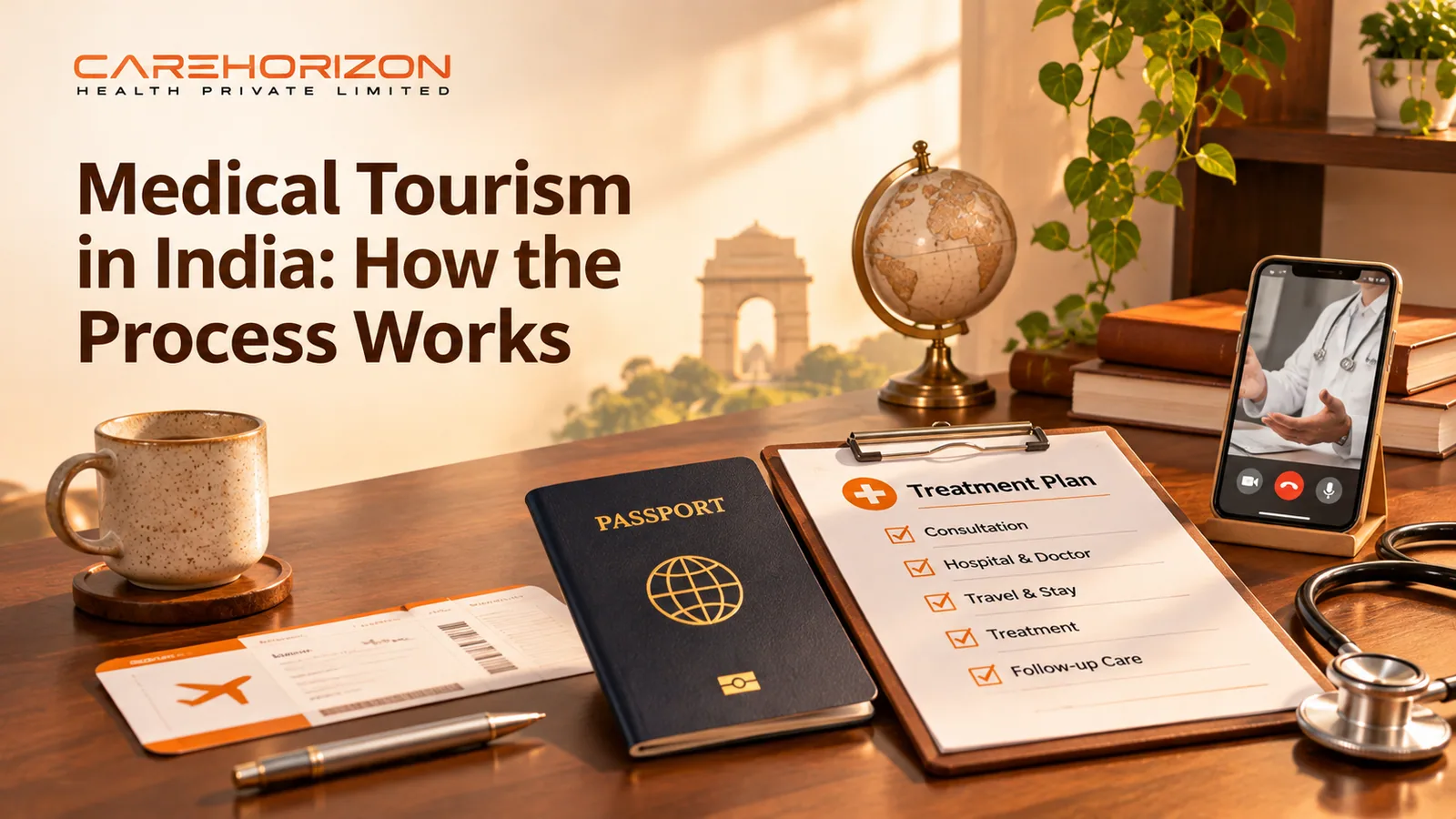
The Typical Patient Journey, Step by Step
A common pathway begins with a medical enquiry and collection of relevant records, followed by appropriate specialist review and hospital communication. The next stage involves evaluating the proposed treatment, anticipated costs and whether travel is medically suitable.
Administrative planning may then include visa documents, airline arrangements, accommodation, payment and ground transport. In India, the responsible hospital conducts the necessary clinical assessment and delivers care according to its own processes.
Before departure, the patient should receive relevant records and an individualised follow-up plan. The exact order and duration vary, especially when treatment is urgent or the diagnosis is still under investigation.
Stage 1: Clarify the Medical Question
The family should know what decision they want a hospital to help make. Is the diagnosis uncertain? Is another opinion needed? Has a clinician recommended surgery? Is there a complex condition requiring several specialists?
A clear question prevents the journey from being planned around an unverified assumption. In some cases, remote records review may determine that further local assessment is needed before international travel.
The guide to obtaining a second opinion in another Indian city offers a framework for preparing focused clinical questions.
Stage 2: Prepare Relevant Medical Records
Hospitals may request current medical summaries, relevant investigations, imaging, pathology, prescriptions and prior discharge records. The required details depend on the specialty and reason for treatment.
Organise the documents chronologically and make it clear which findings are confirmed and which are preliminary. Share records through secure, hospital-approved methods and with appropriate patient authorisation.
The guide to organising medical records for specialist review explains how to build a usable submission package.
Stage 3: Evaluate Hospital Suitability
Ask whether the named hospital campus has the relevant clinicians, diagnostic resources, anaesthesia, critical care and postoperative support where appropriate. Verify professional credentials and claimed institutional accreditation through primary sources.
A hospital's reputation, online photographs or quoted price cannot establish suitability for a particular complex case. The clinical team may still need further assessment before agreeing to treatment.
The hospital selection checklist describes practical questions about services, credentials, risks and patient communication.
Stage 4: Understand the Proposed Treatment
An initial treatment plan may be based on records reviewed from abroad. It can help the patient decide whether to travel but may change following examination or additional tests.
Ask what the recommendation is based on, what alternatives exist, what remains uncertain and whether informed consent or further investigations will be needed after arrival.
A provisional recommendation is not a guarantee that the hospital will perform a particular intervention on the originally expected date.
Stage 5: Review the Treatment Estimate
A written hospital estimate should identify the proposed scope, assumptions, included services, exclusions and conditions under which charges might change. The hospital should issue its own pricing information.
Medical travel costs can also include flights, accommodation, visas, accompanying family members and follow-up. Comparing only the hospital's headline amount can be misleading.
The guide to understanding hospital treatment estimates shows how to ask for a clearer financial breakdown.
Stage 6: Check Insurance or Sponsorship
International health insurance, ordinary travel insurance and employer sponsorship arrangements have different limits and conditions. A policy covering unexpected illness abroad may not pay for a trip undertaken specifically for planned surgery.
Ask the actual insurer whether India and the proposed treatment are covered, whether a hospital is in network and whether preauthorisation or a guarantee-of-payment letter is required.
Patients may need to pay the hospital first and claim reimbursement later. Confirm this before assuming that an insurance card entitles the holder to cashless admission.
Stage 7: Verify Entry and Visa Requirements
India has different visa categories and eligibility conditions. The appropriate permission depends on nationality, travel purpose and current government rules.
The official e-Visa portal explains available categories and applicable medical documentation for eligible applicants. An appointment or hospital letter does not itself grant entry permission.
The medical visa guide provides related administrative planning questions.
Stage 8: Assess Medical Fitness for Travel
A patient may need a clinician's assessment before flying, especially after recent surgery, when medically unstable or when special assistance or equipment is required. The airline may have separate medical acceptance requirements.
Medical clearance should be specific to the proposed journey and the patient's current condition. It cannot be inferred simply from an appointment confirmation.
The fitness-to-fly guide explains the clinical considerations and carrier-related processes.
Stage 9: Plan Travel and Accommodation
Flight connections, mobility limitations, appointment dates, the actual hospital location and accommodation flexibility can all affect the practical experience.
Some patients travel independently while others need a family attendant, airport assistance or a clinically assessed medical escort. These are different types of support.
The guide to staying near the hospital helps families evaluate location, accessibility, cancellation terms and recovery arrangements.
Stage 10: Arrival, Registration and Clinical Reassessment
On arrival, the hospital may undertake registration, examination and further investigations. These may confirm the earlier recommendation or change the proposed treatment.
Patients should know which doctor is responsible for explaining clinical decisions and which administrative contact handles admission and billing.
The arrival guide offers practical steps for navigating the journey from the airport to the hospital.
Stage 11: Treatment and Recovery
The treating hospital provides the clinical care and determines medical discharge readiness. Recovery can involve medicines, wound review, rehabilitation or other monitoring based on the procedure and the patient's health.
Families should plan for uncertainty rather than assume that every patient can fly home immediately after discharge.
The after-discharge recovery guide explains why the time between hospital discharge and return travel can require separate arrangements.
Stage 12: Handover to Care at Home
Before leaving India, obtain the discharge summary, significant investigations, treatment details, medication list and written follow-up instructions.
An appropriate local clinician should be identified to continue care and assess complications. Remote discussions with the Indian specialist may be useful where available and legally appropriate, but do not replace all in-person care.
The guide to continuing care with your doctor at home outlines how to organise the cross-border handover.
What Is a Medical Value Travel Facilitator?
The National Accreditation Board for Hospitals & Healthcare Providers, or NABH, describes a medical value travel facilitator as an agency involved in managing and coordinating activities related to patients and their treatment while travelling abroad.
In practice, such organisations may help with enquiries, records, hospital appointments, accommodation or other administrative arrangements. The exact service scope varies and should be stated in writing.
A facilitator does not become a treating clinician simply by coordinating medical travel. Clinical decisions belong to qualified professionals at the responsible healthcare institution.
What Does NABH's Facilitator Programme Cover?
NABH offers a Medical Value Travel Facilitator Empanelment Programme intended to support ethical and transparent administrative processes and coordination with healthcare institutions.
Its publicly described programme addresses operational readiness, documentation, patient handling and responsibilities. NABH's published second-edition standards were applied to new applications beginning January 2025 under its implementation plan.
Empanelment of a facilitator is not the same as hospital accreditation or professional medical registration. Any claimed current status should be independently checked through NABH.
Is NABH Empanelment Mandatory for Every Facilitator?
Do not assume that every business using the label medical value travel facilitator has been empanelled. NABH presents a defined empanelment pathway with eligibility and assessment processes.
Whether another licence or regulatory permission applies depends on the specific services an organisation actually provides and the law governing those activities. Neither a commercial website nor the use of MVT in a business name proves an organisation's credentials.
Ask for the exact legal entity name, the credential claimed, the issuing body and the current verification status.
Hospital Accreditation and Facilitator Empanelment Are Different
Hospital accreditation assesses aspects of a healthcare institution's systems and services under its programme standards. Facilitator empanelment concerns organisations coordinating medical travel activities.
One should not be used as evidence of the other. A facilitator's claim that it works with an accredited hospital should be checked with the named hospital, and hospital accreditation does not establish that every doctor or procedure has a guaranteed outcome.
Patients should verify both the clinical provider and any intermediary separately.
Hospital International Patient Desk Versus Independent Facilitator
A hospital's international patient team typically coordinates services within that institution, such as receiving records, arranging appointments, issuing estimates and explaining admission procedures.
An independent facilitator may work across several providers or assist with travel-related administration outside the hospital. Its actual network, fees and responsibilities should be disclosed.
Families may choose to communicate directly with a hospital, use a facilitator, or combine an official hospital contact with limited outside logistical support.
Why Some Patients Use a Medical Travel Coordinator
The logistical work can be significant when a patient is unwell, family members live in different countries, or several hospital departments must be contacted. A coordinator may help consolidate information and keep track of pending confirmations.
Its value lies in clear responsibilities, accurate communication and practical follow-through, not in promising special medical treatment or guaranteed access.
The how-we-work page explains Carehorizon's approach to coordinating the journey around clinical care.
What a Facilitator Should Not Promise
A facilitator should not promise a cure, guarantee a procedure before the treating team decides it is appropriate, issue visas, override airline medical requirements or claim to determine an insurer's coverage.
Likewise, it should not represent provisional hospital estimates as fixed final prices or conceal material relationships that could affect hospital recommendations.
A useful test is whether the organisation can identify which decisions belong to it and which belong to doctors, hospitals, insurers, financial providers and government authorities.
Medical Value Travel and Patient Safety
Medical tourism entails potential complications like any healthcare intervention, with added issues from travel, postoperative activity, infection risks and fragmented follow-up. The CDC Yellow Book advises travellers to understand the risks and arrange care after returning home.
Patients should evaluate the specific provider, likely complications, clinical records, availability of emergency resources and capacity for continuing care. A safe medical journey requires more than comfortable accommodation.
No hospital or travel coordinator can guarantee an absence of complications or a particular clinical result.
How to Compare Hospital Options Responsibly
Begin with the diagnosis and required expertise. Compare actual clinical resources, specialist availability, ability to manage complications, patient communication and follow-up rather than just advertised prices or rankings.
Ask whether the named specialist will assess the case and which parts of the care pathway may be performed at another site. Use official hospital channels and verify claimed credentials.
For a structured approach, consult the guide to questions before choosing a hospital.
Understanding the Complete Cost of Medical Value Travel
The hospital estimate is one part of the total budget. There may also be expenses for flights, visas, accommodation, meals, attendant travel, local transport and international payment fees.
A changed diagnosis, additional tests or longer recovery can affect both medical and non-medical costs. Families should separate supplier quotations rather than accept an unexplained all-inclusive amount.
The guide to managing money and payments during treatment provides related questions about invoices, deposits and currency conversion.
Why Lower Cost Should Not Be the Only Reason
Costs vary by institution and clinical plan. A cheaper initial estimate may exclude devices, follow-up or other important services; a larger estimate may include items that would otherwise be billed separately.
Patients should compare like-for-like services and consult qualified clinicians about whether the proposed treatment is suitable. Medical decisions should not be delegated to a travel quotation.
Do not rely on unverified universal claims about the percentage saved by seeking care in India. Obtain case-specific written estimates.
Visa Assistance Is Administrative, Not Immigration Approval
Hospitals and coordinators may help explain which letters or documents are requested for an eligible visa application, but the relevant Indian government authority decides the application.
The patient should check nationality-specific eligibility, entry conditions and stay restrictions using official sources before travelling.
Avoid websites that mimic official immigration portals or promise guaranteed approval in exchange for unusual payments.
Insurance Coverage Is Not Automatic
Some international health insurance policies cover planned treatment in India, while other travel insurance products mainly cover unexpected medical events during a trip. Network arrangements, preauthorisation and exclusions are critical.
Even eligible patients may need to pay the hospital and seek reimbursement rather than receive cashless services.
Ask the insurer and the hospital's billing or insurance team for case-specific written confirmation before relying on any proposed arrangement.
When a Medical Escort Might Be Needed
A patient may be able to travel independently, with family assistance or with clinically indicated professional support. The appropriate option depends on health status, mobility, monitoring needs and airline requirements rather than age alone.
A medical escort is not interchangeable with a family attendant, and ordinary airline assistance is not the same as a clinical service.
The guide comparing air ambulance and a commercial flight with medical escort explains key distinctions.
What If the Treatment Plan Changes After Arrival?
New examination findings, updated imaging or additional tests may lead the specialist to recommend another procedure, delay treatment or decide that surgery is not indicated.
The doctor should explain why the recommendation has changed and what alternatives are available. The hospital should clarify the revised estimate and any change in consent or admission requirements.
Travel plans should remain flexible enough that flight bookings do not determine medical decisions.
Returning Home Is Part of the Plan
Patients should not assume the end of hospital admission means they are ready to fly. Fitness for the intended route may require clinical review, and airlines have their own medical acceptance requirements.
A local doctor should be available for follow-up and urgent assessment as appropriate. The CDC recommends sharing medical records from overseas treatment with subsequent healthcare professionals.
The guide to returning home after treatment in India covers travel readiness and documentation for the return journey.
Medical Value Travel for Older Patients
Older patients may have mobility needs, multiple medicines or chronic health conditions, but age alone does not establish medical fitness or the need for an escort.
Ask the treating clinician to review the entire proposed journey and the actual treatment plan. Consider practical assistance, accessible accommodation, medication availability and appropriate follow-up.
The patient's preferences and informed decisions should remain central even when family members are coordinating the trip.
Medical Value Travel for Multispecialty Care
A patient with a complex condition may require several specialists to assess the diagnosis and proposed treatment. A clear lead clinician and coordinated review can help ensure that separate opinions become a coherent plan.
Families should distinguish the hospital's clinical coordination from the administrative work of booking appointments or organising documents.
The treatment areas overview can help frame questions across specialties.
What Does a Good Written Service Agreement Include?
If using an independent facilitator, ask for the exact scope of work: hospital communication, records transfer, appointment scheduling, visa-related documentation support, accommodation, ground transfers or other services.
The agreement should identify fees, payment recipients, third-party dependencies, cancellation terms, privacy practices and limits of responsibility.
Clear terms make it easier to distinguish administrative coordination from clinical obligations and to understand which organisation handles a particular problem.
Questions to Ask Before Selecting a Facilitator
What is the legal name of the organisation? Which hospitals and specialties can it actually approach? Does it have commercial relationships that influence recommendations, and will those be disclosed?
Which services are included in its fee? Who receives hospital payments? How are sensitive records handled? Who will respond if appointments, treatment or travel plans change?
What happens if the patient declines a hospital recommendation or decides not to travel? The answers should be documented rather than assumed.
A Practical Patient Decision Checklist
Clinical decision: Is the diagnosis clear, has a qualified specialist reviewed the records, and have reasonable options been explained? Facility decision: Can the specific hospital campus provide the necessary care and manage foreseeable complications?
Financial decision: Are the hospital estimate, exclusions, deposits and other travel expenses understood? Travel decision: Is the patient medically suited to the journey and eligible for required entry and airline arrangements?
Continuity decision: Who will care for the patient after discharge and after returning home? If these questions are not answered, the family may need further information before committing.
Example: Travelling for a Second Opinion
A patient has received an initial diagnosis and wants an additional specialist review in India. The family sends the relevant records, checks the proposed consultant's credentials and confirms whether an in-person appointment is needed.
The patient may decide to continue treatment at home after reviewing the opinion. Medical value travel does not require a procedure to take place simply because the patient has travelled.
This fictional example shows why a clear clinical question is the most useful starting point.
Example: Planned Surgery and Recovery
A patient receives a preliminary surgical recommendation and an indicative hospital estimate. The family checks visa requirements, travel fitness, local accommodation and who will provide support after discharge.
On arrival, additional tests may confirm or change the plan. The patient discusses the decision with the clinical team and organises a return flight based on medically appropriate recovery rather than a guaranteed package duration.
This hypothetical situation illustrates the practical links between healthcare, finance and logistics.
Example: Family Coordinating Treatment From Abroad
Relatives living in different countries may be planning treatment for a parent. With the patient's consent, they can help organise records, appointments and administrative updates.
A coordinator may help track outstanding items while the hospital's clinicians make medical recommendations. The family should identify a local doctor for continuing care and keep sensitive patient information appropriately protected.
The case is illustrative and does not mean every family requires a third-party facilitator.
How Carehorizon Health Fits Into Medical Value Travel
Carehorizon Health Private Limited coordinates the practical journey around clinical care. Depending on the enquiry, that may include helping families organise medical records, communicate with hospital departments and align appointments and travel arrangements with the proposed care pathway.
The treating hospital and qualified clinicians remain responsible for diagnosis, consent and treatment. Government authorities decide entry permission; airlines determine their acceptance rules; insurers decide coverage; and financial providers govern their own transactions. Carehorizon does not guarantee a clinical result, a visa or a hospital price. Read more about how Carehorizon works.
For an international patient enquiry, contact Carehorizon through its enquiry page, call +91 6292041222 or email care@carehorizonhealth.com. Urgent illness needs appropriate local medical assessment rather than waiting for international scheduling.
Frequently Asked Questions
What does medical value travel mean?
It refers broadly to crossing borders to obtain healthcare and related services. In India the expression is often used alongside medical tourism and may include a wider wellness-travel ecosystem.
Is medical value travel the same as medical tourism?
The terms overlap. Medical tourism ordinarily emphasises travel for medical care, while some Indian policy and industry usage of medical value travel also includes wellness services.
Why is India associated with medical value travel?
India is discussed as a destination for international healthcare and wellness travel, but patients must still assess the actual hospital, specialist, treatment and overall costs.
Do medical value travel patients need a visa?
Appropriate entry permission depends on nationality, purpose and current Indian rules. Use official government guidance for the individual case.
What does a medical value travel facilitator do?
It may organise hospital communication, appointments, documents and selected travel logistics according to a written service scope. It does not replace a doctor.
Is NABH facilitator empanelment the same as hospital accreditation?
No. They assess different kinds of organisations under distinct programmes. Verify any claimed credential independently.
Can a facilitator guarantee surgery or recovery results?
No. Qualified clinicians decide treatment suitability and no provider can responsibly guarantee a specific medical outcome.
Is medical value travel always less expensive?
No. Compare complete, case-specific hospital estimates with flights, accommodation, fees, recovery and follow-up costs.
Can an international patient use insurance in India?
Sometimes, depending on the policy, hospital network and authorisation. Planned treatment and routine travel coverage have different conditions.
What should happen after the patient returns home?
The patient should have relevant discharge records and a plan for appropriate local follow-up, with remote specialist input where available and clinically suitable.
Official References and Further Reading
- Government of India Press Information Bureau — Medical and Wellness Tourism in India (2 May 2026): https://www.pib.gov.in/PressNoteDetails.aspx?ModuleId=3&NoteId=158426&lang=1®=1
- National Accreditation Board for Hospitals & Healthcare Providers — Medical Value Travel Facilitator Empanelment Programme: https://nabh.co/programmes/medical-value-travel-facilitator-mvtf-empanelment-programme/
- NABH — Medical Value Travel Facilitator Programme Overview: https://portal.nabh.co/MVTF.aspx
- NABH — Second Edition MVTF Standards Implementation Notice: https://portal.nabh.co/Announcement/IMPLEMENTATION%20PLAN%20OF%202nd%20EDITION%20OF%20NABH%20MVTF%20STANDARDS.pdf
- CDC Yellow Book 2026 — Medical Tourism: https://www.cdc.gov/yellow-book/hcp/health-care-abroad/medical-tourism.html
- NABH — Accreditation, Certification and Empanelment Programmes: https://nabh.co/accreditations-certifications-and-empanelments/
Medical and publication disclaimer: This article is for general information only, not a medical recommendation, endorsement of any provider, guarantee of treatment results, price quotation, visa determination, insurance approval or fitness-to-fly certificate. Clinical care belongs to qualified healthcare professionals, and administrative arrangements depend on each provider's agreement. Seek urgent local medical care for emergencies. Internal Carehorizon URLs were taken from the supplied site inventory and should be checked for live availability before publication.
Carehorizon Health coordinates medical travel, patient transfers and related arrangements. The information here is educational; it does not diagnose, prescribe, guarantee an outcome or replace advice from your treating medical team. Service availability, costs and travel requirements are confirmed case by case.