This article provides general information to support better planning. Individual medical decisions and fitness for travel require assessment by qualified treating professionals.
Seeking treatment in another country is rarely a simple decision. A patient may want a specialist opinion, a planned operation, cancer treatment, rehabilitation or continuing care closer to family. Once India becomes a possible destination, practical questions arrive quickly: Which hospital should review the case? How can the family compare treatment plans? What documents are needed for a medical visa? What will the hospital estimate actually cover? And who will coordinate travel, accommodation and care after discharge?
India has hospitals and specialists across different cities, but the right choice depends on the patient's condition, the exact service needed and the capabilities of the particular treating institution. International patients should not assume that an entire city, hospital group or specialty offers the same level of care. Individual credentials, facility accreditation, clinical assessments, costs and recovery arrangements all deserve verification.
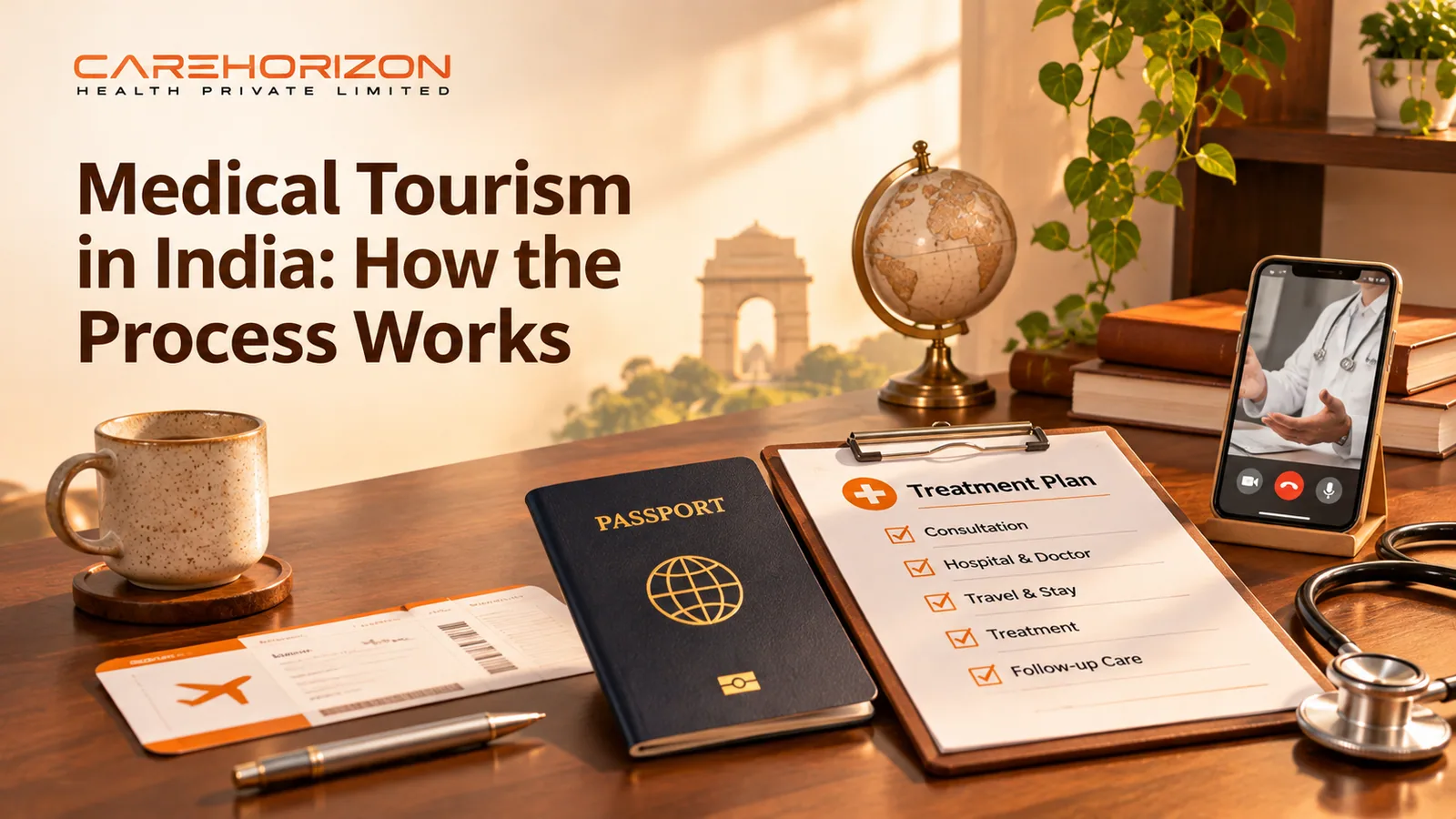
This guide follows the patient journey from the first remote medical review to returning home after treatment. It explains what families can organise themselves, what decisions belong to doctors and hospitals, and where a medical travel coordinator can help with logistics. For an overview of Carehorizon's coordination role, see its treatment-in-India service information.
What Does Medical Treatment in India for International Patients Involve?
It means a person living abroad travels to India to receive medical assessment, treatment or follow-up from an Indian healthcare provider. Some visits are planned weeks ahead; others involve time-sensitive referrals after an illness or injury. The patient's nationality, medical condition, care needs and length of stay all influence the arrangements.
The term 'medical tourism' is common in search results, but it can understate the complexity of a serious illness. Patients travelling for surgery, oncology, cardiac care or intensive rehabilitation need continuity of care rather than a tourism package. Travel and accommodation should be organised around the treatment plan, not the other way around.
The most reliable planning begins with a medical opinion and a suitable receiving hospital. Flight tickets, accommodation and sightseeing decisions should follow the clinical recommendation and any recovery restrictions.
Step 1: Define the Treatment Goal Before Choosing a City
Ask the current treating doctor to explain the diagnosis, what treatment is being considered, what is still uncertain and whether a second opinion would help. Some patients seek confirmation of a proposed operation; others require a procedure or specialist service unavailable at home.
It is useful to distinguish an initial consultation from an agreed treatment plan. A hospital may recommend fresh imaging, laboratory testing or in-person evaluation before deciding whether a procedure is appropriate. An email expressing willingness to review records is not an admission guarantee.
If the patient has a rapidly worsening condition, the priority remains appropriate local emergency care. Do not delay time-sensitive treatment solely to organise travel abroad.
Step 2: Gather Medical Records for Specialist Review
Create a coherent record package with the diagnosis, current symptoms, relevant history, previous procedures, medication list, allergies, available imaging, pathology, laboratory results and the most recent treating physician's summary. Add the specific questions the patient wants answered.
For oncology cases, pathology reports and relevant imaging may be essential; a surgical referral may need operative notes and current functional status. The receiving specialist should identify what is necessary for the actual case. Avoid ordering unnecessary new tests solely to make a large file.
Use secure sharing channels and keep original reports available. If documents are in a language the receiving team cannot read, ask the hospital what translation and certification it requires. The guide to organising medical records for specialist review gives a practical approach.
Step 3: Seek a Meaningful Medical Opinion, Not Just a Price
A serious referral should invite a clinician to evaluate the diagnosis and possible options. The specialist may agree with an existing plan, suggest further investigation or recommend a different approach. Neither the lowest package price nor an attractive hospital brochure can substitute for professional assessment.
Ask who will review the medical records, what information is missing, whether the proposed treatment is established for the patient's condition and what alternatives exist. Where a treatment carries substantial risks, ask how these will be explained and how the decision will be documented.
A preliminary remote opinion may change after examination or new findings in India. Families should understand that distinction before committing to non-refundable travel.
How to Choose a Hospital in India
A useful hospital shortlist starts with the particular clinical need: relevant specialist services, appropriate diagnostic and intensive-care capabilities, rehabilitation if required, and a safe pathway for complications. The hospital should be able to explain how it will manage the full episode of care.
Check current accreditation status through the accrediting body's official directory and review the scope of accreditation rather than treating a logo as a blanket guarantee. The National Accreditation Board for Hospitals & Healthcare Providers (NABH) publishes information about its programmes and accredited organisations. Accreditation can inform diligence, but it does not guarantee an outcome.
Compare hospitals on medically relevant factors first, then practical access, communication, estimated cost and support for international patients. The guide to questions before choosing a hospital offers a structured discussion aid.
How to Evaluate the Treating Specialist
Families should verify the clinician's identity, relevant qualification, specialty registration where applicable, current hospital affiliation and experience with the proposed type of care. The treating institution should explain who makes the clinical decision and who will provide care if the named doctor is unavailable.
Avoid treating online star ratings, testimonials or social media mentions as evidence of medical competence. For complex treatment, ask the team to explain the recommended approach, foreseeable risks and reasonable alternatives in language the patient understands.
A second opinion from an appropriately qualified specialist can be valuable when the diagnosis or treatment plan is uncertain. The guide to obtaining a second opinion in another Indian city provides related questions.
Treatment Areas International Patients May Enquire About
Common enquiries include cardiac assessment and surgery, cancer care, orthopaedics and joint replacement, neurological and spinal conditions, kidney care, rehabilitation and other specialist services. The availability and suitability of any intervention must be confirmed by the particular hospital.
For example, a patient with a heart condition may need a cardiac surgeon, interventional cardiologist or advanced heart-failure service. A patient with cancer may need multidisciplinary review, pathology confirmation and a staged course of therapy. A person considering joint replacement may need a rehabilitation plan as well as surgery.
Do not assume every hospital provides every form of specialist treatment or that a particular procedure is appropriate before evaluation. Carehorizon's treatment areas overview can help frame the discussion, without replacing hospital-level verification.
Step 4: Understand the Hospital's Proposed Plan
Request the expected diagnosis or working diagnosis, proposed investigations, recommended procedure or therapy, estimated admission period and a practical outline of recovery. Ask whether the recommendation is provisional until the physician examines the patient.
Clarify whether the plan involves more than one appointment or hospital visit, such as repeated chemotherapy sessions, staged surgery, pathology review or specialist follow-up. A short admission estimate can misrepresent a much longer treatment journey.
It is also important to ask who will explain informed consent, risks and alternative approaches. Consent should be based on a clinical discussion with the treating team, not a medical travel sales conversation.
Step 5: Compare Hospital Treatment Estimates Properly
Two hospital estimates may differ because they cover different investigations, room categories, procedures, surgeon fees, devices, medicines, intensive-care days or rehabilitation. An apparently cheaper figure may omit services that another estimate includes.
Ask for a written itemisation or a clear list of inclusions, exclusions and assumptions. Clarify how extra ICU days, complications, implants, blood products, additional investigations, medications and longer stays will be handled. No honest estimate can guarantee that every patient's final bill will match the preliminary projection.
Hospital treatment cost is separate from international flights, medical escorts, accommodation and some after-discharge expenses unless the documents explicitly state otherwise. The guide to understanding treatment estimates in India provides a comparison framework.
Budget for the Entire Stay, Not Only the Procedure
A realistic family budget may include pre-admission consultations, hospital charges, medicines, tests, extra days, travel, local transport, hotel or serviced accommodation, meals, attendant expenses, rehabilitation and post-discharge reviews. The relevant mix depends on condition and planned treatment.
Ask which amounts are confirmed, which are provisional and when deposits or balances are payable. For an international patient, payment currency and bank transfer methods should be clarified with the hospital rather than inferred from a website's price range.
Financial planning should include a reasonable contingency for a longer stay or changed plan, without presenting an invented universal percentage as medically necessary.
Step 6: Check Medical Visa Eligibility and Current Requirements
Foreign nationals generally need an appropriate basis for entering India. The official Indian Visa Online portal describes regular visa and e-Visa pathways. Eligible patients may be able to apply for an e-Medical visa, while eligible accompanying caregivers may use the corresponding e-Medical Attendant category.
The Government of India's e-Visa instructions list a hospital letter from India among the supporting documents for e-Medical applications. They also set nationality, passport and designated entry-point requirements. The appropriate category must be verified for the individual traveller; not every nationality or travel document qualifies for e-Visa.
Medical visa rules can change, and a hospital invitation letter does not itself grant entry. Consult the official portal or the relevant Indian mission, especially for urgent travel or unusual documentation. Carehorizon's medical visa page provides a planning overview.
What Should the Indian Hospital Letter Contain?
For e-Medical applications, current government instructions call for a letter from the Indian hospital on its letterhead that includes relevant patient identification and the proposed or tentative admission or treatment date. The hospital should prepare the document based on the actual referral and the visa type.
Check that the patient's name, nationality and passport details match their travel documents. Ask the hospital to correct discrepancies rather than submitting inconsistent identification.
Other application requirements may include an appropriate passport, photograph and valid supporting documents. Follow the official online instructions rather than a third-party checklist copied from a previous year.
Medical Attendants and Family Visas
Many patients prefer to travel with a spouse, parent, adult child or another trusted caregiver. The family should check the relevant entry category and documentation for every person, rather than assuming a patient's medical visa automatically covers relatives.
The official e-Visa information describes the e-Medical Attendant category and its rules for attendants accompanying an eligible medical visa holder. These rules are specific to the scheme and should be confirmed against the application and current entry requirements.
Ask the hospital what role an attendant can play during admission and recovery. A hospital may have separate visiting, overnight stay and patient-assistance policies. The guide for attendants in India covers practical responsibilities during treatment.
Understand Entry Airports and Arrival Requirements
The official e-Visa programme restricts arrival to designated immigration checkpoints, and the permitted list may change. A traveller should not purchase an itinerary assuming that every international or regional airport accepts their visa category.
The Indian Visa Online portal also provides current arrival-document instructions, which may include an e-Arrival declaration. Such a declaration is not a substitute for an appropriate visa or other lawful entry status.
Patients travelling in a dedicated medical aircraft can have additional aviation and airport arrangements that must be coordinated by the operator. For ordinary scheduled passengers, check airline rules on documentation, special assistance and medical clearance.
Step 7: Confirm Fitness to Fly
Medical travel can carry risks when a person is unwell or recovering from a procedure. The treating physician should assess the intended flight, recent symptoms, oxygen or mobility needs, infection risks, prescribed medicines and potential problems during travel.
The CDC Yellow Book notes travel-associated risks for medical tourists, including complications after surgery and the possibility of blood clots during prolonged immobility. The correct timing for travel must be decided for the individual patient rather than inferred from a universal calendar rule.
The commercial airline may require a medical information form or special approval when assistance, oxygen or medical equipment is needed. A clinic's discharge note does not automatically mean the operating airline will accept the passenger.
Commercial Flight, Medical Escort or Air Ambulance?
A clinically stable patient may be able to travel as an ordinary airline passenger. Another person may need wheelchair support or a qualified medical escort. Selected patients who cannot sit upright may be considered for an approved commercial airline stretcher, subject to carrier approval.
A dedicated air ambulance may be considered for more intensive clinical support, when treating and transport professionals judge it suitable and the required aircraft, staff and equipment are confirmed. Not every unstable patient is safe to move by air.
For a comparison of the modes, see Carehorizon's air ambulance versus medical escort guide. The transport mode should be chosen on the basis of assessed clinical needs and actual operating constraints before comparing price.
Step 8: Coordinate Arrival and Airport Transfer
The patient may need ordinary airport assistance, a wheelchair-accessible vehicle or a medically equipped ambulance. The right arrangement depends on mobility, clinical requirements, airport procedures and the location of the receiving hospital.
A critically ill patient arriving by air ambulance may need bed-to-bed coordination between the aircraft team, a ground ambulance and the Indian hospital. The receiving department should be ready to assume care with current clinical records.
For a planned hospital admission, confirm the actual appointment time and whether any tests or registration procedures must occur before entering the ward. The international patients arrival guide explains these practical stages.
Choosing Accommodation Near the Hospital
For a short outpatient visit, a hotel near the treating facility may be practical. Longer or more complex treatment may require accommodation with lift access, appropriate hygiene arrangements, flexible dates and space for an attendant.
The patient may need to remain near the hospital for review appointments, wound checks, treatment sessions or rehabilitation. Location should therefore be selected around the actual clinical itinerary rather than tourism preferences.
Ask about cancellation terms, accessibility, food arrangements and the potential need to extend the stay. The guide to staying near an Indian hospital provides a useful checklist.
Communication and Language Support
Good clinical care depends on accurate communication about diagnosis, consent, medicines, procedures and follow-up instructions. A patient who is not comfortable with the treating team's language may need an appropriately qualified interpreter.
Do not rely on a child or an untrained companion to interpret sensitive or complex medical decisions when a suitable professional option is available. Translation of medical records also requires care because small differences in terminology can alter meaning.
Ask the hospital about interpretation arrangements, who can discuss treatment with the family and how written discharge instructions will be provided. See the guide to interpreters and language support.
What Happens During Admission in India?
The hospital may review the patient's identity, medical history, current examination, previous records and expected treatment. Additional tests or specialist consultations may be needed to confirm the plan.
The clinical team should explain the proposed treatment, alternatives, material risks and consent process. Families should ask who will provide updates, how urgent changes are communicated and what financial authorisations may be required during care.
International patients should keep copies of important invoices and clinical documents and know the hospital's appropriate contact for questions. A travel coordinator can support logistics but should not represent itself as directing medical decisions.
Infection Prevention and Other Medical Travel Risks
The CDC Yellow Book emphasises that medical travel can involve infection, complications of procedures, variation in healthcare standards and difficulties securing follow-up care after return. Such concerns can apply to cross-border treatment in any country and should be considered before committing.
Patients should discuss infection prevention, treatment alternatives, the management of complications and whether the chosen facility has suitable capabilities for their condition. Facility accreditation can be part of diligence, but does not replace individual evaluation.
After surgery or another intervention, avoid treating the recovery period as a holiday. Follow the treating team's guidance on mobility, exercise, wounds, medicines and travel, and seek urgent medical care if concerning symptoms develop.
Step 9: Plan Recovery and Rehabilitation Before Discharge
A successful procedure is not the end of the treatment pathway. A patient may require rehabilitation, wound care, laboratory monitoring, physiotherapy, further therapy sessions or several reviews before flying home.
Ask the treating team about expected milestones, warning signs, mobility limits, follow-up intervals and which services must be available after leaving the hospital. The actual plan should reflect the patient's response to treatment rather than an advertised recovery time.
The guide to after-discharge recovery and follow-up in India explains why accommodation and transport should remain flexible until clinical reassessment.
Step 10: Prepare for Safe Return Travel
Before departure from India, obtain the treating clinician's advice about flying and any airline clearance required. Recent surgery, persistent pain, oxygen needs, reduced mobility and an ongoing risk of complications may change the plan.
For some people, return travel can be arranged without medical staff; others may need a nurse or doctor escort, an airline stretcher or, in selected circumstances, a dedicated medical aircraft. Do not assume the level of support required on arrival will necessarily be the same on departure.
Airline policies, visa validity and follow-up appointments should be checked before confirming tickets. The returning-home guide for international patients provides additional practical considerations.
Continuity of Care After Returning Home
Request discharge records containing the final diagnosis, treatment performed, medications, important investigation results, complications, implant or device details when relevant, and recommended follow-up. Ask for copies of key imaging and pathology results in usable formats.
Identify a qualified local clinician who can review the patient after return. Some treatments require ongoing monitoring, further therapies or coordination between specialists in two countries. This should be planned before leaving India whenever feasible.
The CDC advises medical travellers to obtain usable records and discuss follow-up with home-country clinicians. Carehorizon's continuing-care guide addresses the practical transfer of information back to the patient's usual doctor.
Insurance and Payments for Treatment Abroad
The patient's home-country health insurance may or may not cover elective or planned care in India. Some insurance contracts have strict provider networks, preauthorisation conditions or exclusions for overseas treatment. Travel insurance and medical evacuation insurance can be separate benefits.
Before booking, obtain the actual policy wording and a written insurer response about planned care, complications, follow-up and repatriation. A hospital estimate or consultant's recommendation does not guarantee reimbursement.
Budget separately for flight cancellations, extra hotel days and changes to treatment. The guide to managing money during treatment in India covers payment-related questions for international patients.
Choosing a Medical Travel Coordinator
A coordinator can help organise records, communicate with hospital international-patient desks, align appointments and practical logistics, and keep the family informed about next steps. A good coordinator should distinguish what it can organise from clinical decisions that belong to doctors and hospitals.
Ask what is included in the coordination service, whether the hospital or patient pays any fee, what documents will be shared, and how potential conflicts of interest or referral arrangements are disclosed when relevant.
No coordinator should guarantee treatment outcomes or imply an exclusive hospital partnership without evidence. The family should be free to ask questions, seek another opinion and verify the institution's information directly.
Common Mistakes International Patients Can Avoid
Do not select a hospital solely on advertised price or reputation without checking the relevant specialist service, credentials and care plan. Do not assume the preliminary procedure estimate covers complications, rehabilitation or an extended stay.
Do not purchase non-refundable travel before checking medical readiness, appropriate entry documents and the proposed treatment schedule. A hospital invitation letter is not a visa, and a visa is not a clinical fitness-to-fly certificate.
Do not leave follow-up planning until the day of discharge. Arrange local continuity of care, records and return-flight assessment while sufficient time remains to adapt the itinerary.
Practical Checklist for International Patients
Before choosing a hospital: confirm the diagnosis and reason for travel, obtain an appropriate specialist review, ask about credentials and current facility accreditation, and request the proposed treatment plan in writing.
Before departure: compare estimates and exclusions, check the correct visa and designated entry point, obtain travel medical advice, arrange suitable flights and assistance, and confirm an attendant and accommodation plan.
During treatment: understand consent, expected investigations, fees, communication contacts and how complications would be managed. Keep important documents and update the family on changes.
Before returning home: obtain full medical records, check fitness to fly, confirm follow-up appointments and coordinate with a home-country clinician. These steps are planning aids rather than guarantees of an outcome.
How Carehorizon Health Supports the Patient Journey
Carehorizon Health coordinates the practical journey around clinical care. Depending on the enquiry, this may involve helping international patients organise medical records, identify relevant hospital contacts, align specialist reviews, understand travel arrangements and plan the practical stages around admission, accommodation and departure.
Hospitals and treating clinicians make clinical decisions, explain treatment and determine fitness for discharge and travel. Immigration authorities decide entry status, and airlines or authorised aviation operators control their respective transport requirements. For more on the scope of coordination, see how Carehorizon works.
For a planned treatment-in-India enquiry, contact Carehorizon through its enquiry page, call +91 6292041222 or email care@carehorizonhealth.com. If the patient needs emergency treatment, seek appropriate local medical care rather than waiting for overseas travel arrangements.
Frequently Asked Questions
Can international patients receive medical treatment in India?
Yes, subject to a hospital's clinical assessment, appropriate entry status and the patient's travel suitability. The treating institution must confirm that the requested service is appropriate and available.
How do I choose a hospital in India?
Start with the specific medical need, verify relevant specialists and facility capabilities, check current accreditation where applicable, and compare treatment plans and follow-up arrangements before cost alone.
Can I obtain a specialist opinion before travelling?
Many hospitals may review relevant records before an in-person consultation. Such an opinion may be provisional and can change after examination and investigations.
Do medical tourists need a medical visa?
The correct entry status depends on nationality and circumstances. Eligible foreign patients may apply through an e-Medical or regular visa process; verify current rules on the official Indian Visa Online portal.
What letter is needed for an e-Medical visa?
Official instructions describe a hospital letter on its letterhead with the relevant patient details and intended or tentative admission or treatment date. Confirm the exact current document checklist.
Can a family member accompany a patient?
Often, but each traveller's immigration status and documents need checking. The hospital also has its own attendant, visitor and accommodation policies.
How can I estimate the total treatment cost?
Request a written hospital estimate with exclusions, then budget for tests, possible changes, travel, accommodation, attendant needs and post-discharge care.
Can a critically ill international patient travel to India?
Some patients may be transferred with specialist medical support when clinicians judge it appropriate and a receiving hospital accepts them. Others may be unsuitable for travel until stabilised.
Does insurance pay for treatment in India?
Coverage depends on the policy, treatment purpose, provider network, approval requirements and exclusions. Ask the insurer for a written decision.
What should I arrange before returning home?
Obtain medical records, a follow-up plan, an appropriate fitness-to-fly review and arrangements for continuing care with a clinician in the home country.
Official References and Further Reading
- Government of India — Indian Visa Online, Official Visa and e-Visa Application Portal: https://indianvisaonline.gov.in/
- Government of India — e-Visa Instructions and e-Medical Visa Requirements: https://indianvisaonline.gov.in/evisa/
- National Accreditation Board for Hospitals & Healthcare Providers — Accreditation Programmes and Organisation Information: https://nabh.co/
- US Centers for Disease Control and Prevention — Yellow Book: Medical Tourism (2026 edition): https://www.cdc.gov/yellow-book/hcp/health-care-abroad/medical-tourism.html
- Government of India, Ministry of Tourism — Promotion and Development of Medical Tourism, Press Information Bureau, 9 February 2026: https://www.pib.gov.in/PressReleasePage.aspx?PRID=2225421
- World Health Organization — Continuity of Care and Integrated Health Services: https://www.who.int/teams/integrated-health-services
Medical, immigration, commercial and publication disclaimer: This article offers general information, not personal medical advice, a guaranteed clinical outcome, hospital endorsement, visa approval, treatment estimate or fitness-to-fly clearance. Verify current hospital credentials, visa rules and airline requirements with the responsible organisations. Treating clinicians and hospitals determine medical suitability and treatment; immigration authorities determine entry; carriers decide travel acceptance. Internal Carehorizon links were chosen from the supplied site inventory and must be checked for live availability before publication.
Carehorizon Health coordinates medical travel, patient transfers and related arrangements. The information here is educational; it does not diagnose, prescribe, guarantee an outcome or replace advice from your treating medical team. Service availability, costs and travel requirements are confirmed case by case.