This article provides general information to support better planning. Individual medical decisions and fitness for travel require assessment by qualified treating professionals.
Travelling to India for medical care can involve several independent decisions: choosing a hospital, confirming a specialist, sharing confidential records, arranging visas and paying for appointments or treatment. When those stages are handled remotely, an international patient may communicate with people they have never met and make significant payments before arriving. That creates opportunities for misrepresentation, impersonation and ordinary financial fraud.
Not every delayed reply, changing estimate or administrative mistake is a scam. Treatment plans can legitimately change after clinical assessment, hospital prices may depend on clinical complexity and visa applications can involve routine uncertainty. The important distinction is between explainable conditions disclosed by a real provider and claims that cannot be verified, conceal material facts or pressure patients to surrender money and information.
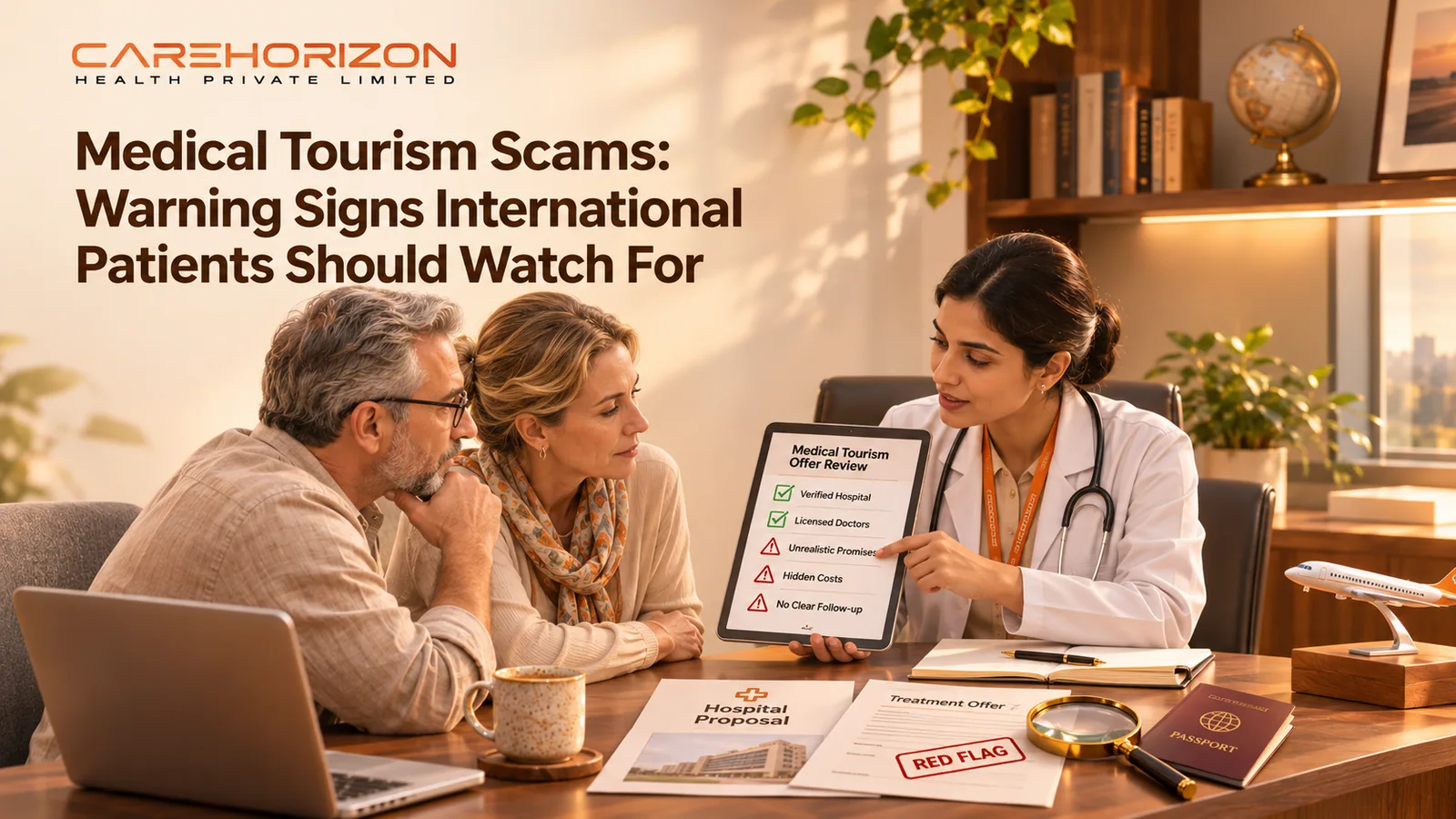
This guide examines medical tourism scams India-bound patients should understand, including fake hospital representatives, invented accreditation, false doctor affiliations, guaranteed-cure promises, unclear quotations, unsafe record sharing and fraudulent visa sites. It also shows how to verify providers without accusing a legitimate business based on a single red flag, and what to do if fraud is suspected. For the wider treatment pathway, see Carehorizon's international patients information.
Why Medical Travel Can Be Vulnerable to Misrepresentation
A medical traveller is making two decisions at once: whether the proposed healthcare is suitable and whether the arrangements for reaching that care are trustworthy. The clinical decision requires specialist judgement, while the logistical decision may involve hospital international desks, facilitators, travel providers, insurers and payment services.
This division can make responsibility unclear. A patient may receive a treatment description from a facilitator, a cost estimate from an administrator and a visa message from another contact. If nobody identifies which organisation is responsible for each statement, false promises become harder to spot.
The CDC Yellow Book advises medical tourists to investigate healthcare facilities, clinician qualifications, accreditation, procedure inclusions and follow-up arrangements. These checks are useful not only for medical quality but also for detecting misleading representations.
A Red Flag Is a Reason to Verify, Not Proof of a Scam
The presence of one concerning feature does not establish deliberate fraud. For example, a legitimate hospital may request a deposit, ask for additional reports or update a treatment quote after new findings. The critical questions are whether the request comes from an authorised source, whether the reason is documented and whether patients can independently confirm it.
Some legitimate services use third-party coordinators. That arrangement is not inherently problematic, but the patient should know the intermediary's identity, its authority to represent a hospital and whether the provider has confirmed the relevant arrangement.
Avoid publishing allegations against named organisations without verified evidence. A neutral, documented verification process is more reliable than relying on rumours or social-media accusations.
Warning Sign 1: A Hospital Representative Cannot Be Independently Verified
A person may introduce themselves as a hospital international patient manager, send a logo or quote from a personal messaging number, and claim that the hospital needs immediate payment. Those details alone do not establish employment or authority.
Find the hospital's official website independently, rather than clicking only the link in the message. Call or email the published switchboard or international patient department and ask whether the person, case reference and payment instructions are genuine.
Verify the exact hospital campus. Large healthcare groups may have multiple locations, and a true group name does not prove the representative is acting for the facility that would treat the patient.
Warning Sign 2: The Website or Email Domain Imitates a Real Hospital
Fraudsters can create domains that look similar to a legitimate hospital's address or copy design elements such as logos and photographs. Subtle changes in spelling, extra hyphens or unexpected domain endings deserve closer inspection.
A message appearing in a familiar email conversation is not conclusive proof of authenticity; compromised accounts and altered payment messages can occur. Check sensitive instructions through a second channel whose contact details you obtained independently.
Do not assume a website is genuine only because it looks professional, has a padlock symbol or appears in a sponsored search result. Those features do not independently verify the organisation behind it.
Warning Sign 3: The Doctor's Name or Affiliation Is Unclear
A hospital or intermediary may mention a senior specialist without confirming whether that clinician has reviewed the case, works at the quoted campus or will be available on the proposed date. In a misleading offer, an impressive biography can be used to encourage early payment.
Ask for the doctor's full name, specialty, professional registration where relevant and official hospital affiliation. Verify those details through the hospital and the appropriate medical registration resources.
A genuine clinician may delegate initial administrative communications, but clinical decisions should be attributable to a responsible qualified professional. The guide to questions before choosing a hospital provides a broader specialist-selection framework.
Warning Sign 4: Guaranteed Cure or Zero-Risk Surgery Claims
No responsible healthcare professional can promise a cure or the absence of complications for every individual. Claims of a guaranteed recovery, certain success or a procedure with no meaningful risks should prompt questions about medical accuracy.
Ask which clinical evidence supports the treatment recommendation, what alternatives exist, what the material risks are and whether a full examination is still necessary. A credible second opinion should explain uncertainty rather than make results sound inevitable.
The CDC notes that all medical and surgical procedures carry risk. International patients should not confuse reassuring communication with a legally or clinically meaningful guarantee.
Warning Sign 5: An Extremely Low Price Without a Defined Treatment Plan
A low quote is not inherently fraudulent, but a number provided without a diagnosis, procedure description, assumptions or medical review can be misleading. It may reflect a generic package rather than the care the patient actually needs.
Ask whether the figure includes surgeon and anaesthetist fees, investigations, medication, implants, ICU care, extra hospital days and follow-up. Confirm the hospital campus, currency, quote validity and financial terms.
A useful estimate should be tied to a case-specific clinical discussion. Carehorizon's guide to understanding hospital treatment estimates explains how inclusions and exclusions affect comparisons.
Warning Sign 6: Pressure to Pay Before Medical Review
Some providers legitimately charge consultation fees or deposits, but a demand for significant immediate payment before identifying the actual clinician, hospital or service scope is concerning.
Ask for the hospital's official invoice or payment request, the name of the legal payee and written terms. Check whether an initial consultation fee is separate from later treatment deposits and whether any amount is refundable.
An artificial countdown, threats that the price will vanish within minutes or refusal to allow independent verification are reasons to stop and investigate. Medical urgency should be assessed by the treating team, not a sales message.
Warning Sign 7: Payment to an Unrelated Personal Account
A payment instruction should identify who is receiving the money and what service it covers. A sudden request to send a hospital deposit to a personal account, unfamiliar wallet or a company unrelated to the quoted provider should be independently confirmed.
Some legitimate intermediaries may collect their own disclosed coordination fees, but they should not represent those as a hospital payment unless their authority and commercial role are documented. Ask the hospital directly whether the proposed payee is authorised.
Before transferring money, verify account details through a trusted contact route and retain invoices, payment confirmation and any bank transfer records. Do not rely solely on the account details sent in a new chat message.
Warning Sign 8: Hidden Facilitator Fees or Undisclosed Referral Interests
A medical facilitator may help coordinate hospital enquiries, travel and records. The patient should understand what the facilitator does, whether any separate service fee applies and whether the provider has a commercial relationship with a hospital.
A referral relationship is not by itself proof of wrongdoing. The concern arises when important financial interests or the true payee are concealed, or when the patient is falsely told that a particular hospital is the only suitable option.
Ask for an itemised explanation of facilitator charges, hospital charges and third-party travel costs. These responsibilities should remain distinguishable throughout the journey.
Warning Sign 9: An Accreditation Logo That Cannot Be Verified
Hospital websites may display NABH or JCI marks. These are relevant accreditation frameworks, but patients should verify the actual organisation and campus through the official accreditor directory rather than accept a copied logo.
Check the programme, name, location and current status. A hospital may hold another form of certification or an older accreditation; that should not automatically be described as current full hospital accreditation.
Accreditation does not guarantee a good treatment outcome. The guide to hospital selection encourages checking credentials and clinical capability alongside accreditation.
Warning Sign 10: Fake Government Visa Websites
This is a documented risk rather than a hypothetical concern. Indian embassies have warned that websites imitating official Indian visa portals may charge improper fees or obtain personal information. Some imitate the appearance of government pages to appear authoritative.
The Government of India's official e-Visa application service is available through indianvisaonline.gov.in. The government's own guidance cautions against unauthorised agents claiming express approval and advises applicants not to share personal information with unofficial websites.
A hospital or facilitator can help explain document requirements, but neither can grant an Indian visa or guarantee an immigration decision. Use the official government portal and verify requirements applicable to the traveller.
Warning Sign 11: Promises of Guaranteed or Express Medical Visa Approval
A genuine hospital may provide a support letter when an application category requires it. That letter does not guarantee visa approval, entry permission or a particular processing deadline.
Be cautious if someone claims to have special access to immigration authorities, promises an 'instant guaranteed medical visa' or requests large extra fees for an unauthorised express service.
The official Indian e-Visa guidance states that applications are submitted online and warns against intermediaries claiming speedy or express grant of e-Visas. The medical visa planning page explains the distinction between hospital documentation and government decisions.
Warning Sign 12: Requests for Excessive Personal Information
Hospitals may require medical records and certain identity documents for legitimate treatment and registration purposes. However, a requester should be able to explain what information is needed, who will receive it and the approved transmission method.
Avoid sharing full passport scans, payment card information or an unrestricted medical archive with a recipient whose identity has not been confirmed. A family member coordinating care should follow the patient's authorisation and applicable privacy requirements.
A secure clinical portal or verified submission method is preferable to an unknown public sharing link. The records preparation guide helps patients organise information without sending irrelevant sensitive material.
Warning Sign 13: Someone Asks for Passwords or One-Time Codes
A representative handling appointments or treatment estimates generally should not need the patient's bank password, card PIN or a one-time code used to authorise a financial transaction.
Fraudulent requests may be framed as a refund, payment verification, visa activation or hospital identity check. If the request involves access credentials or a security code, stop and contact the relevant bank or official service independently.
Do not use links in a suspicious message to reach customer support; obtain contact details directly from the service provider's verified website or app.
Warning Sign 14: A Quote That Changes Without Explanation
Medical cost estimates can legitimately change after new clinical findings, changes in treatment or additional investigations. The concern is not the existence of a revised quote but an inability or refusal to explain the change and its source.
Ask for the updated treatment plan, reason for the difference, new included and excluded charges and how previous deposits are handled. The treating team should discuss clinically important changes separately from billing.
Keep old and new versions so you can compare them. If a new fee is demanded by a different payee, verify the instruction directly with the hospital before paying.
Warning Sign 15: Hospital Admission or Surgery Presented as Guaranteed
An international enquiry might lead to a provisional appointment or preliminary treatment proposal. A hospital may still need in-person examination, additional tests, informed consent and capacity confirmation before admitting a patient or scheduling a procedure.
A representative who guarantees a surgery date regardless of clinical findings may be overstating the hospital's commitment. Ask what is confirmed, what remains conditional and who will make the final clinical decision.
The guide to planning treatment in India outlines how specialist review, appointments and travel arrangements relate to one another.
Warning Sign 16: No Clear Plan for Complications or Aftercare
A responsible hospital should discuss foreseeable risks, how unexpected problems are managed and what follow-up is planned. A marketing message focused entirely on an inexpensive procedure may ignore these important parts of care.
The CDC warns that overseas medical care can involve infection, blood-clot and postoperative risks and advises patients to arrange ongoing care. Ask who manages complications, whether additional treatment is billed separately and which records will be available at discharge.
The guide to after-discharge recovery in India provides practical questions about follow-up and returning home.
Warning Sign 17: Misleading Patient Reviews or Success Stories
Testimonials can describe personal experiences but do not prove that a facility is suitable for another patient's condition. Be cautious when review pages make sweeping claims of guaranteed cures, identical recovery times or uniformly perfect outcomes.
Online ratings may also be selective, outdated or impossible to attribute to a verified patient. A moving patient story is not a substitute for professional credentials and a clinically appropriate plan.
Use reviews to identify questions about communication, billing or logistics, then verify the important facts with official sources. Do not publish accusations of fabricated reviews without evidence.
Warning Sign 18: Pressure to Stop Discussing Care With Your Own Doctor
A medical travel promoter should not discourage the patient from consulting a trusted treating clinician at home or obtaining an independent second opinion when medically appropriate.
The original doctor can help assess urgency, explain records and determine whether travel is safe. They may also need to provide aftercare when the patient returns.
If a representative insists that an overseas package must be booked without any independent clinical discussion, treat that as a serious reason for further verification.
Warning Sign 19: The Facility Is Not the One You Thought You Selected
A patient may be shown photographs of a large hospital group but later receive an appointment address for a different clinic or branch. This may be an ordinary scheduling change, but it can materially affect clinical resources and accreditation.
Confirm the actual legal entity, campus address, department and clinician. If tests or procedures take place at multiple facilities, request an explanation of the transfer arrangements and costs.
A hospital logo does not mean that every campus has identical ICU services, specialist availability or accreditation status.
Warning Sign 20: The Travel Arrangement Is Medically Implausible
A patient recovering from major surgery or requiring oxygen may need a fit-to-fly assessment and possibly airline medical clearance. Be cautious of assurances that any patient can fly immediately after surgery or travel on a commercial airline regardless of condition.
The treating clinician decides the medical suitability of the proposed trip, and the airline or authorised operator applies its own requirements. Neither a facilitator nor a hospital receptionist can waive those independent decisions.
The fitness-to-fly guide explains why transport suitability must be examined separately from treatment booking.
How to Verify a Hospital Before Paying
First, find the hospital's official website independently and identify the exact campus. Use its published contacts to confirm the name of the representative, reference number, proposed specialist and treatment department.
Second, check claimed accreditation through the original accreditor's directory. For NABH, use the official Find a Healthcare Organisation resource; for JCI, use its directory of currently accredited international organisations.
Third, request a clinical opinion or appointment confirmation linked to the patient's case, a dated financial estimate and an explanation of what remains uncertain. Keep a copy of the correspondence.
How to Verify a Doctor's Role and Registration
Request the doctor's full name, relevant qualifications and medical registration information, as appropriate. For modern-medicine practitioners in India, relevant registration resources may include the National Medical Commission and State Medical Councils.
Confirm the current hospital affiliation through the hospital itself. A doctor can legitimately consult at multiple locations, but the patient should know who will evaluate and treat them at the relevant campus.
Professional registration does not independently establish the practitioner's case volume, availability or suitability for a highly specialised procedure. Those questions need separate attention.
How to Check Whether an Estimate Is Transparent
The quote should identify the hospital, patient or case reference, proposed treatment, room category and assumptions. Ask what is included for doctors' fees, investigations, medicines, devices, ICU care and follow-up.
Where a package is conditional on uncomplicated recovery, request the conditions and likely additional billing categories. Distinguish the hospital estimate from flight, lodging, visa and facilitator charges.
The guide to requesting a specialist review and treatment planning can help families compare more than a headline number.
How to Verify a Medical Facilitator
Ask for the facilitator's registered entity name, contact information, scope of services and written fee structure. Clarify whether it only coordinates enquiries or has authority to collect specific hospital payments.
Request confirmation from the hospital when the facilitator claims to act as an official partner or payment representative. Do not infer an exclusive affiliation from a logo placement or a shared photograph.
A legitimate coordinator can be useful, especially for records, appointments and travel logistics. The expectation should be clear accountability, not that the coordinator makes clinical decisions or guarantees treatment outcomes.
A Payment Safety Checklist for International Patients
Before paying, confirm the payee's legal or operating name, the service being purchased, the official invoice, payment method, currency, refund terms and a verified contact for payment queries.
For bank transfers, independently confirm account details through an established official contact route, particularly if instructions change. Save receipts and relevant messages. Avoid sharing passwords, PINs or transaction one-time codes.
If the payment is for a facilitator rather than the hospital, request a separate service invoice and do not describe the amount as a hospital deposit without documentary support.
Protecting Medical Records and Identity Documents
Create a focused clinical package rather than transmitting an unrestricted lifetime record. Use authorised channels and limit access to the receiving clinical team and people the patient has approved.
Keep passports and financial identity documents separate from broadly shared clinical folders. Ask why each document is necessary and when it will be used.
If you suspect data have gone to an impersonator, inform the affected hospital, your relevant financial institutions and appropriate authorities. The response should reflect the type of information exposed.
What to Do if You Suspect Fraud Before Paying
Stop the transaction and avoid sending further personal information. Preserve screenshots, email headers where available, URLs, invoices, payment requests and contact details.
Contact the hospital using an independently verified phone number or email address and ask whether the person and request are authorised. For a visa-related message, compare it with official Government of India guidance.
Seek advice from your bank or card issuer if account information may be compromised. Do not confront or accuse a named organisation publicly without confirming the relevant facts.
What to Do After a Suspicious Payment
Contact your bank or card provider immediately through a verified channel, explain what occurred and ask what protections or recall steps may be available. Preserve transaction references, dates, account details and messages.
For financial cybercrime involving India, the Government of India's cybercrime reporting portal and helpline 1930 provide reporting pathways. The appropriate police, financial institutions and authorities in the patient's own country may also need to be contacted.
Prompt reporting is important, but recovery of funds is not guaranteed. Do not pay a second stranger who promises to recover money for an upfront fee.
Where Can Patients Report Cyber Fraud in India?
The National Cyber Crime Reporting Portal at cybercrime.gov.in accepts reports under the Government of India's framework. The 1930 helpline is intended for cyber financial fraud reporting in India.
Reporting routes and applicability can depend on where the incident occurred, where the complainant is located and the type of offence. International patients should also contact relevant law enforcement and consumer authorities in their home jurisdiction.
Do not assume a private travel coordinator can investigate criminal conduct or reverse a bank transfer. Use the appropriate official authorities.
Where to Verify Visa Information Safely
Start from the Government of India's official visa site at indianvisaonline.gov.in. Check eligibility, category requirements, supporting documents and payment instructions there.
Indian diplomatic missions have issued advisories about imitation visa websites and unauthorised fee collection. Some fake pages closely mimic official government design, making URL verification important.
A hospital invitation letter supports an application where required but cannot substitute for a legitimate visa or guarantee entry. Avoid intermediaries who offer secret expedited approvals.
An Example: A Genuine Quote With a Clarification Gap
A family receives a hospital quotation that excludes some implants and makes admission length conditional on recovery. This is not necessarily a scam; medical estimates often have important clinical assumptions.
The family asks for an updated inclusions-and-exclusions explanation, verifies that the quote came from the hospital and confirms the proposed specialist's review. The hospital provides clarification and the family can make a more informed comparison.
This hypothetical example illustrates why a missing detail should trigger a question rather than an automatic allegation.
An Example: A Payment Request That Deserves Immediate Verification
A person using a hospital-style logo contacts an international patient through a messaging app and asks for a large 'booking fee' to be paid within an hour to an unrelated personal account. The sender refuses to identify the hospital billing department.
The sensible response is to stop payment and contact the hospital through its official site. Until the payee, person and service are verified, the request should be treated as suspicious.
This is an illustrative warning-sign scenario and not a description of an identified provider or actual incident.
An Example: An Unclear Visa Service
An applicant finds a website claiming to be the Indian government, with a familiar colour scheme and an offer of guaranteed approval for an extra charge. The site collects passport details and payment information.
Indian official guidance specifically warns of such imitation sites. Applicants should leave the site, use the official indianvisaonline.gov.in domain and consider appropriate protective steps if information or money has already been shared.
This example shows why official-source verification matters even when the website appears professionally designed.
Why a Trusted Home-Country Doctor Still Matters
Before medical travel, the current treating clinician can clarify the diagnosis, urgency and records needed for the receiving specialist. They can also advise whether the patient is medically suitable for international transport.
After overseas treatment, follow-up may be needed for wound care, medicines, rehabilitation or monitoring for complications. The CDC recommends planning continuity of care before travel and obtaining records for local clinicians.
The guide to continuing care with the doctor at home provides practical questions for this handover.
A Pre-Booking Verification Checklist
Provider identity: The exact hospital and campus have been verified through official channels. The proposed specialist's identity and involvement have been confirmed. Any intermediary's entity, role and fees are disclosed.
Medical basis: Relevant records have been reviewed; the treatment recommendation, uncertainties, alternatives and expected risks have been discussed by a qualified clinician. The plan includes complications and aftercare.
Financial basis: The quote states the clinical scope, currency, inclusions, exclusions, validity, payee and cancellation terms. All changed payment instructions are independently verified.
Travel basis: Visa information comes from official sources; medical travel readiness and airline requirements are addressed; accommodation, return travel and home-country follow-up are considered.
Questions to Ask Before Sharing Money or Records
Can I verify you through the hospital's published contact number? Which clinician has reviewed the case? Which exact facility will provide treatment, and is the proposed procedure confirmed or provisional?
Who issues the invoice, who receives payment and what is the refund policy? Which charges are excluded or conditional? Does your company charge a separate facilitation fee?
What secure system will receive the medical records? What is the lawful purpose of the identity documents? Can the hospital confirm any claimed affiliation, accreditation and visa support process?
How Carehorizon Health Approaches Coordination
Carehorizon Health coordinates the practical journey around clinical care. Depending on the enquiry, the work may involve helping patients organise records, clarify hospital contact requirements, communicate about appointments and plan travel-related logistics.
Clinical assessments and treatment decisions remain with qualified physicians and hospitals, while visa decisions belong to the relevant authorities and aviation acceptance to the operating provider. Carehorizon does not replace those responsibilities or guarantee outcomes. See the how-we-work page for the coordination approach.
For a planned enquiry, contact Carehorizon through its enquiry page, call +91 6292041222 or email care@carehorizonhealth.com. Independently verify all payment and medical instructions. For urgent symptoms, seek local medical attention immediately rather than waiting on an international intermediary.
Frequently Asked Questions
What are common medical tourism scams in India?
Risks can include impersonated hospital representatives, misleading clinical guarantees, fake visa sites, unauthorised payment requests and undisclosed fees. A warning sign merits verification rather than automatic accusation.
How can I check if a hospital in India is genuine?
Find the hospital's official site independently, confirm its legal or operating identity and campus, call the published contact and verify claimed accreditation through the issuing body.
How do I know whether a medical facilitator is trustworthy?
Ask for the entity name, actual scope of services, hospital relationship, fee structure and payment terms, and independently verify claimed affiliations.
Is a very low hospital price always a scam?
No. Prices legitimately vary. The concern is a quotation that lacks a case-specific clinical basis, transparent exclusions or verifiable payee information.
Can a hospital guarantee a cure or zero complications?
No responsible provider can guarantee an outcome for every patient. Ask a qualified clinician to explain realistic benefits, risks and alternatives.
How can I verify NABH or JCI accreditation?
Use the official accreditor directory and match the specific hospital name, campus and programme. An advertising logo alone is insufficient.
Are all websites offering Indian medical visas official?
No. Indian diplomatic missions have warned about imitation visa websites. Use the Government of India's official indianvisaonline.gov.in domain.
Should I transfer money to a facilitator's personal bank account?
Do not assume such a payment is authorised. Verify the legal payee, scope of the fee and hospital instructions through an independently obtained official contact route.
What should I do if I already paid a suspected fraudster?
Contact your bank or payment provider immediately, preserve evidence and report through the appropriate law-enforcement and cybercrime channels. In India, official reporting routes include cybercrime.gov.in and 1930.
Can medical travel fraud be prevented completely?
No process eliminates every risk. Independent verification of hospital contacts, clinical claims, accreditation, payment instructions, visa websites and secure record handling can reduce exposure.
Official References and Verification Resources
- CDC Yellow Book 2026 — Medical Tourism, Risks, Accreditation and Follow-up: https://www.cdc.gov/yellow-book/hcp/health-care-abroad/medical-tourism.html
- Government of India — Official e-Visa Website and Warning Against Unauthorised Agents: https://indianvisaonline.gov.in/evisa/
- Embassy of India, Kuwait — Advisory on Fake e-Visa Websites (November 2025): https://indembkwt.gov.in/advisory-fake-evisa.php
- NABH — Official Healthcare Organisation Directory: https://nabh.co/find-a-healthcare-organisation/
- Joint Commission International — Official Directory of Accredited International Organisations: https://www.jointcommission.org/en/about-us/recognizing-excellence/find-accredited-international-organizations
- Government of India — National Cyber Crime Reporting Portal: https://cybercrime.gov.in/
Medical, consumer-safety and publication disclaimer: This article is general educational guidance, not a finding that any named organisation is fraudulent, a medical recommendation, legal advice, financial recovery guarantee or official government determination. Verify individual claims through primary sources and avoid public allegations without reliable evidence. Clinical decisions belong to qualified treating professionals; hospital, payment, visa and aviation authorities have separate responsibilities. Contact competent authorities promptly if fraud is suspected. Carehorizon internal website links were selected from the supplied site inventory and must be verified live before publication.
Carehorizon Health coordinates medical travel, patient transfers and related arrangements. The information here is educational; it does not diagnose, prescribe, guarantee an outcome or replace advice from your treating medical team. Service availability, costs and travel requirements are confirmed case by case.