This article provides general information to support better planning. Individual medical decisions and fitness for travel require assessment by qualified treating professionals.
Planning treatment in another country involves much more than finding a hospital and buying a flight. A patient may need medical records reviewed, a specialist opinion, clarification of the proposed treatment, written cost estimates, the correct visa, suitable travel arrangements and a clear plan for follow-up after returning home. When these steps are handled in the wrong order, patients can arrive with unanswered clinical questions or unrealistic financial expectations.
An international patient journey in India is better understood as a series of decisions rather than a fixed itinerary. At some points, the hospital may be able to confirm the next action. At others, the patient must wait for clinical examination, additional tests or formal approval. The treatment itself belongs to qualified doctors and healthcare institutions; travel coordinators can help with administration but cannot promise outcomes.
This guide follows the journey from the family's first enquiry to discharge and continuity of care at home. It describes each stage, what should be confirmed before moving forward, which documents matter and how patients can protect their time, money and medical safety.
Stage 1: Define the Medical Question
Begin with the actual reason for seeking treatment abroad. Is the diagnosis uncertain? Is a second opinion needed? Has a physician proposed surgery? Is a specialist service unavailable locally?
A clear question helps the receiving hospital route the enquiry appropriately. Emergencies and rapidly worsening symptoms need suitable local clinical care rather than waiting for international arrangements.
Identify Who Is Making Decisions
The patient should understand who is their current treating clinician and who may become the responsible specialist in India. Relatives can assist with logistics when authorised.
The distinction matters: hospital coordinators can transmit documents or schedule consultations, but they cannot interpret investigations or determine the treatment required.
Prepare a Concise Medical Summary
Organise significant diagnoses, prior treatment, medication names and doses, allergies, recent investigations, imaging and relevant discharge summaries. Include dates so that the receiving specialist knows which evidence is current.
Send the material through a verified hospital communication channel with appropriate permission. The initial summary should be factual and should not omit significant findings merely to secure a particular treatment quote.
For a more detailed explanation, see organising medical records for specialist review.
Stage 2: Send Records for Hospital Review
Ask a suitable hospital or specialist department whether it can review the available records before travel. Identify the exact clinical question and the additional information needed.
A records-received message is not a medical opinion. Clarify whether a qualified clinician has reviewed the case and whether the response remains provisional pending examination.
For a more detailed explanation, see sending medical records to hospitals in India.
What the First Specialist Opinion Can Establish
A preliminary review may confirm that an in-person consultation is worth considering, recommend further tests or suggest a different type of clinician.
It may not establish a final diagnosis, operation date or expected outcome. Ask explicitly what the next medical decision will depend on.
When a Second Opinion Is Useful
Before a major intervention, a different qualified specialist may confirm the existing recommendation or explain reasonable alternatives. This can influence hospital and travel choices.
Another opinion should be sought in a manner consistent with clinical urgency. A patient should not delay necessary emergency care to complete an overseas comparison.
For a more detailed explanation, see getting a second medical opinion.
Stage 3: Verify the Hospital and Clinician
Confirm the official hospital name, exact campus, relevant department and doctor affiliation. Look for independently verifiable accreditation where claimed, remembering that accreditation does not guarantee outcomes.
Check whether the particular hospital campus has the diagnostic, surgical, critical-care or rehabilitation resources appropriate to the proposed case.
For a more detailed explanation, see questions to ask before choosing a hospital.
Compare Care Options Beyond the Headline Price
A famous facility or lower estimate should not automatically decide the destination. Compare the clinical recommendation, availability, follow-up resources, practical travel burden and likely total costs.
A procedure proposed by one hospital may not be identical to the procedure described in another's quote. Resolve the clinical differences before comparing prices.
Stage 4: Request a Written Clinical Plan
Where possible, ask the responsible clinician for a written summary of the working diagnosis, proposed next steps, outstanding tests and anticipated treatment sequence.
The document may remain provisional until assessment in India. Distinguish the medical plan from an appointment booking, visa letter or financial estimate.
Ask What Remains Uncertain
A preliminary plan may require pathology review, updated imaging, specialist consultation or preoperative assessment. Ask what could change the proposed treatment.
A family should know the decision point before buying inflexible tickets. Medical uncertainty should be documented, not concealed by a confident-looking itinerary.
Stage 5: Obtain a Hospital Estimate
Request a dated estimate showing the procedure or proposed services, expected room category, major inclusions, excluded charges and assumptions. Check how revisions are communicated.
Unexpected findings, complications or a change of procedure can affect final billing. An estimate is not a fixed universal price or promise of admission.
For a more detailed explanation, see understanding hospital estimates.
Plan the Complete Budget
Budget separately for hospital charges, appointments, tests, medicines, visa fees, flights, ground transport, accommodation, meals, attendant expenses and possible extra recovery days.
Where insurance is involved, verify reimbursement or cashless arrangements with the insurer and hospital. Insurance approval is independent of a hospital's preliminary quotation.
For a more detailed explanation, see managing payments during treatment.
Stage 6: Choose the Correct Visa Route
India provides regular visa applications through Indian missions and e-Medical applications for eligible travellers. The appropriate process depends on nationality, passport and travel purpose.
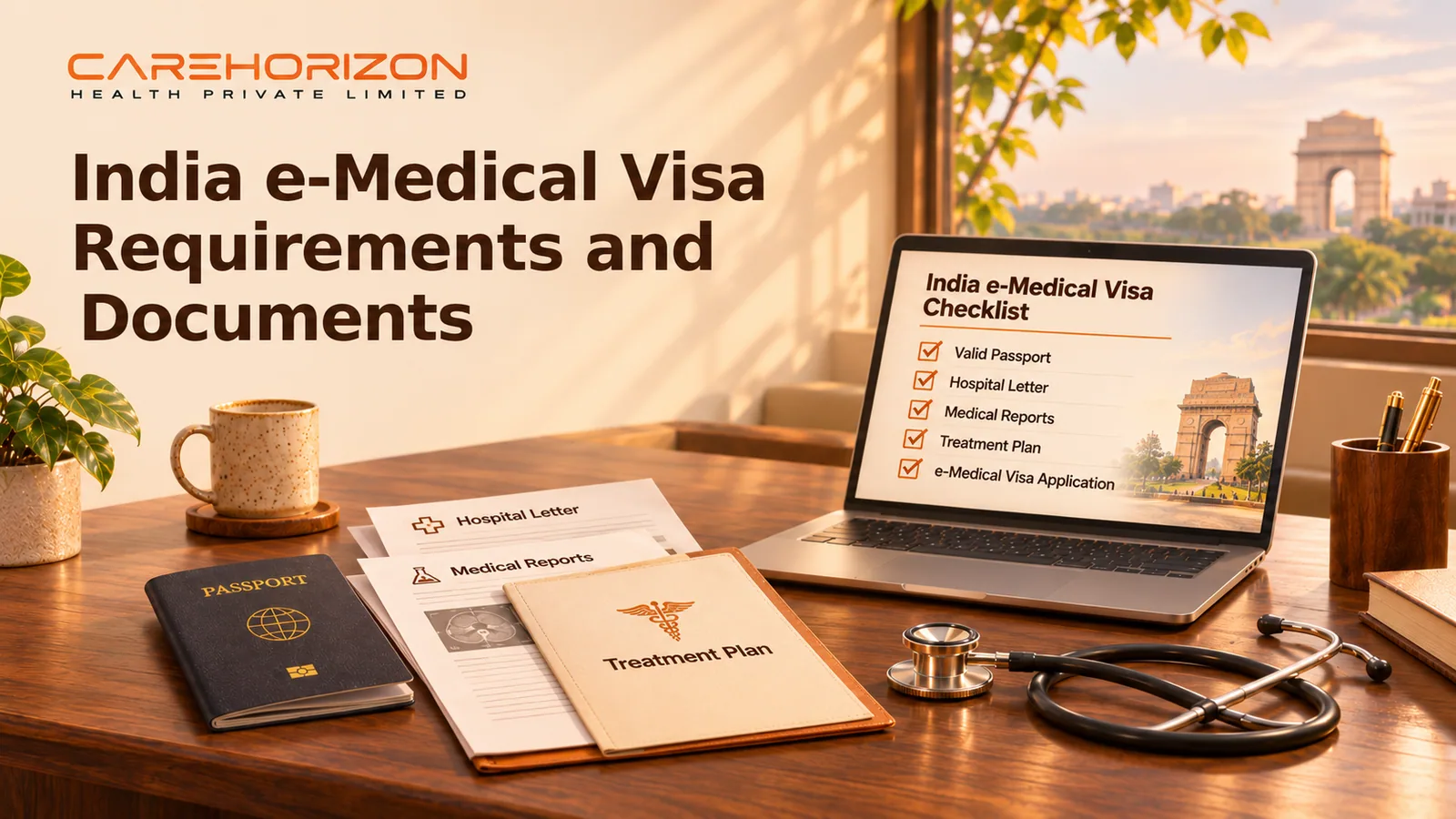
The official e-Visa portal requires a concerned Indian hospital letter with tentative treatment or admission date. A visa-support letter cannot guarantee an immigration decision or clinical treatment.
For a more detailed explanation, see medical visa information.
Understand Application Timing
The official e-Visa site describes a 120-day advance application window and a minimum four-day lead time for eligible e-Medical and attendant applicants.
This window is not a processing guarantee. Applicants should allow time for document corrections, nationality-specific procedures and hospital changes.
Patient Attendants Need Separate Permission
A spouse or adult child may accompany the patient if independently eligible under an appropriate visa route. The official electronic scheme states a maximum of two linked e-Medical Attendant Visas per principal e-Medical Visa.
This does not automatically approve any companion or establish a universal limit for every regular visa pathway. Check each applicant's own permission.
For a more detailed explanation, see a guide for attendants.
Do Not Confuse Visa Approval With Medical Acceptance
An approved visa addresses immigration status. It does not prove the hospital will admit the patient or that an airline considers them fit to travel.
Clinical assessment, airline carriage, hospital scheduling and immigration permission are separate decisions with different responsible organisations.
Stage 7: Plan Travel Around Clinical Readiness
Confirm that the intended journey is medically appropriate. Patients requiring oxygen, wheelchair assistance or a medically escorted transfer may need additional planning.
Ordinary passenger travel, a qualified medical escort and an air ambulance are different options. The treating clinician and operator should assess needs before bookings.
For a more detailed explanation, see fitness-to-fly considerations.
Confirm the Exact Arrival Route
Check the visa's permitted entry points, the operating airline, airport arrival location and the receiving hospital's campus address. Some travellers may face nationality-specific border or entry conditions.
Do not assume that every e-Visa is usable at a land crossing. Verify current official conditions for the actual passport and visa.
Accommodation and Local Transportation
Choose lodging for access to the actual hospital and recovery needs rather than only distance from a city centre. Consider stairs, lifts, accessible bathrooms and nearby family support.
A standard taxi may be suitable for an independent patient; people requiring clinical transport need an appropriate professional assessment. Transfer times should not be invented.
For a more detailed explanation, see accommodation near the hospital.
Stage 8: Arrive in India With Organised Documents
Carry the passport, approved visa or ETA, authentic hospital letter, appointment information, medical summary, prescriptions and important investigation reports. Keep original travel documents accessible.
The Indian Visa Online portal also describes an e-Arrival Card requirement for applicable travellers within 72 hours before arrival. Check the current official arrival instructions.
For a more detailed explanation, see arriving in India for treatment.
Hospital Registration and Initial Assessment
The receiving hospital may verify identity, review records, take a fresh history, examine the patient and order further investigations. This is when provisional recommendations may be confirmed or revised.
Ask who is the responsible clinician and how the patient will be informed about changes to the treatment plan and related expenses.
Consent and Treatment Alternatives
The patient should receive an understandable explanation of the proposed care, important risks, benefits and reasonable alternatives. Interpretation may be necessary when medical discussions occur in an unfamiliar language.
An international coordinator or relative should not substitute their own judgement for a qualified treating clinician's explanation or the patient's informed preferences.
Stage 9: Treatment and Hospital Communication
During an admission or procedure, identify the primary clinical contact and how updates are shared with authorised relatives. Ask how unexpected medical developments will be communicated.
The hospital is responsible for treatment and clinical records. Care coordination can help organise practical questions without promising outcomes or interfering with medical decisions.
If the Treatment Plan Changes After Arrival
Additional tests may lead to a different procedure, longer stay or recommendation against the original intervention. Request an explanation from the treating doctor and an updated hospital estimate.
Do not let earlier deposits or tickets pressure the patient into an inappropriate procedure. If a named hospital changes, verify any immigration implications with the relevant authority.
Stage 10: Prepare for Discharge Early
Before leaving the hospital, ask what medicines, follow-up visits, wound care, rehabilitation or activity restrictions will apply. Identify any investigations still pending.
The discharge decision is medical. It is not automatically a declaration that the patient is ready for a long commercial flight.
For a more detailed explanation, see after-discharge recovery and follow-up.
Discharge Records to Collect
Obtain the final discharge summary, operation or procedure details where relevant, major investigation results, updated prescription, follow-up plan and emergency warning guidance.
The CDC advises patients who receive care abroad to obtain copies of their medical records and provide them to subsequent healthcare professionals. Good records make continuity of care easier.
Hospital Bills and Insurance Documentation
Request itemised invoices, receipts, payment adjustments and insurer correspondence before leaving. Clarify the treatment components included in the final bill.
Keep hospital invoices separate from accommodation, travel and coordination fees. An issued receipt does not mean the insurer will reimburse a particular expense.
Stage 11: Recovery Before the Return Journey
A patient may need outpatient checks, rehabilitation or further medical monitoring before returning home. The treating team should advise on the appropriate timing and any travel precautions.
The CDC warns that strenuous tourism activities during postoperative recovery can interfere with healing. Do not treat recovery time as sightseeing time by default.
Assess Return-Flight Suitability
The medical team should discuss whether the patient can safely travel on the planned route. Airlines may have their own acceptance, oxygen, stretcher or escort requirements.
Neither a discharge paper nor an expiring visa by itself establishes medical fitness. Resolve these issues with the responsible professionals and authorities.
Stage 12: Continue Care After Returning Home
Identify a local clinician who can receive the Indian hospital's records, reconcile medicines and arrange appropriate tests or follow-up. Patients should explain the full overseas treatment history.
Remote review by an Indian clinician may be helpful when available and legally appropriate, but it cannot substitute for urgent in-person assessment when warning symptoms appear.
For a more detailed explanation, see continuing care with your doctor at home.
Know When to Seek Urgent Help
Concerning postoperative symptoms, deterioration or other acute illness require prompt medical evaluation. The treating team should provide case-specific warning signs and contact instructions.
Do not wait for an international coordinator to respond when emergency medical attention is needed.
A Single Journey Timeline for Families
Phase one covers enquiry and records; phase two covers clinical review and hospital choice; phase three covers the written estimate and visa; phase four covers safe arrival and hospital assessment.
Phase five covers treatment, discharge and recovery; phase six covers return-home handover. Every transition should have a clearly responsible person and a confirmed or provisional status.
What a Medical Travel Coordinator Can Do
A coordinator may help collect documents, request hospital responses, maintain an appointment calendar, clarify travel reservations and keep practical arrangements aligned as plans change.
A coordinator should explain fees and limitations. They cannot decide diagnosis, provide hospital guarantees, grant visas, approve insurance or certify fitness to fly.
How to Protect Patient Information
Medical reports and passports contain sensitive data. Share them only with verified hospitals and authorised people using suitable secure channels.
Keep an accurate record of what was transmitted and avoid unrestricted sharing links. Patients should know who can receive medical updates.
How to Recognise Misleading Promises
Be cautious of guaranteed surgery outcomes, fixed all-inclusive quotations without exclusions, unverifiable hospital relationships and agents offering special visa approvals for payment.
Confirm provider identity independently and distinguish the hospital's own statements from a third party's sales material.
Case Example: A Second Opinion Changes Travel
A fictional patient asks for a specialist review before travelling. The reviewing doctor needs another investigation and recommends deferring the planned admission until the clinical question is resolved.
The family keeps flights flexible rather than proceeding based on an unconfirmed procedure. This example shows a sensible administrative response, not clinical advice.
Case Example: Recovery Extends the Stay
A patient completes treatment but requires another review before long-distance travel. The family arranges suitable accommodation and checks immigration conditions.
The responsible doctor determines medical needs and government authorities decide any permitted change in stay. The example does not imply automatic visa extension.
Case Example: An Attendant Manages Practical Tasks
An eligible patient travels with an approved attendant who handles hospital contact details and local logistics with the patient's permission.
The attendant helps with day-to-day organisation but does not perform unqualified clinical procedures or automatically receive confidential records.
A Pre-Departure Checklist
Check the specialist response, hospital campus, authentic supporting letter, individual visa approvals, actual travel suitability, estimated budget, insurance and accommodation.
Carry a concise medical summary and emergency contacts. Label provisional items clearly, particularly admission date and expected return.
For a more detailed explanation, see documents to bring for treatment in India.
A Discharge and Return Checklist
Collect discharge and treatment records, updated medicines, follow-up appointments, itemised bills and medical guidance on return travel.
Ensure a clinician at home can receive the information. Keep contact routes for the overseas treating team and know when to seek local urgent care.
How Carehorizon Health Supports the Journey
Carehorizon Health Private Limited coordinates practical arrangements around clinical care, which may include organising medical records, communicating with hospital departments and aligning travel and accommodation enquiries.
Hospitals and qualified clinicians are responsible for care, admission and discharge. Immigration authorities decide visas, airlines decide carriage, and insurers determine coverage. Carehorizon does not guarantee hospital relationships, outcomes, admissions or visa approvals.
For a more detailed explanation, see how Carehorizon works.
Frequently Asked Questions
How does the international patient journey in India begin?
It usually begins with a defined clinical question, organised medical records and an enquiry to an appropriate specialist or hospital. Emergency needs require local assessment without delay.
Can I receive a hospital treatment plan before travelling?
Sometimes a clinician can issue a provisional opinion based on records, but the final plan may need examination and additional investigations after arrival.
Do I need a medical visa to visit India for planned treatment?
The appropriate visa route depends on the actual purpose and nationality. Eligible travellers can use e-Medical applications; others may need a regular or country-specific medical visa.
Should I pay the hospital before my visa is approved?
Ask the hospital about genuine deposit requirements and refund terms, and avoid unnecessary non-refundable commitments. Payment does not confer visa approval or guarantee admission.
Can a family member accompany an international patient?
Eligible companions may apply separately under an appropriate attendant route. Individual permissions and hospital visiting rules need confirmation.
How much does a full treatment journey cost?
Costs differ by clinical needs, hospital, investigations and travel. Obtain case-specific estimates and budget separately for accommodation, companions and follow-up.
Can the hospital change the operation after I arrive?
The responsible doctor may revise recommendations after new examinations or results. The patient should receive an explanation, alternatives and updated financial information.
When can I fly home after treatment?
The treating clinician must assess recovery and travel suitability; airlines may apply additional medical acceptance requirements. Discharge alone does not prove fitness to fly.
Which records should I take home after treatment in India?
Obtain a discharge summary, relevant procedure and test records, current prescriptions, follow-up instructions and itemised hospital bills.
What does Carehorizon do during the patient journey?
Carehorizon coordinates practical arrangements around clinical care. Doctors and hospitals make medical decisions, while immigration authorities, airlines and insurers control their own permissions.
Authoritative References and Further Reading
- Government of India — Indian Visa Online Official Portal: https://indianvisaonline.gov.in/
- Government of India — e-Medical Visa Eligibility and Hospital Letter: https://indianvisaonline.gov.in/evisa/
- CDC Yellow Book — Medical Tourism, Complications and Follow-Up: https://www.cdc.gov/yellow-book/hcp/health-care-abroad/medical-tourism.html
- CDC Yellow Book — Travellers with Chronic Illness: https://www.cdc.gov/yellow-book/hcp/travelers-with-additional-considerations/travelers-with-chronic-illnesses.html
- NABH — Find a Healthcare Organisation: https://nabh.co/find-a-healthcare-organisation/
- National Medical Commission — National Medical Register: https://nmr.nmc.org.in/search-doctor
For international treatment enquiries: Carehorizon Health | WhatsApp/Call +91 6292041222 | care@carehorizonhealth.com | https://carehorizonhealth.com/enquiry/
Medical, immigration, financial and publication disclaimer: This guide is general planning information, not a medical recommendation, hospital endorsement, guaranteed admission, treatment quote, insurance approval, visa grant or travel-clearance certificate. All clinical decisions, transfer suitability and discharge advice belong to qualified professionals. Immigration authorities decide entry permissions and airlines decide carriage. Indian medical visa conditions and hospital procedures may change; verify official guidance before travel. Internal Carehorizon links reflect the supplied site inventory and require live-page verification before publication.
Carehorizon Health coordinates medical travel, patient transfers and related arrangements. The information here is educational; it does not diagnose, prescribe, guarantee an outcome or replace advice from your treating medical team. Service availability, costs and travel requirements are confirmed case by case.