This article provides general information to support better planning. Individual medical decisions and fitness for travel require assessment by qualified treating professionals.
Preparing an India e-Medical Visa application is often less complicated when the documents are collected before opening the form. Patients normally need an eligible passport, a compliant digital photograph and an authentic letter from the Indian hospital. An unreadable passport scan or a mismatch between the hospital letter and passport can interfere with the application even when treatment has been discussed with a specialist.
This guide focuses on the actual medical visa requirements India-bound patients should check: eligibility, passport validity, accepted photo and PDF formats, content of the hospital letter, supporting information and separate medical attendant applications. It also explains the difference between mandatory uploads and documents useful for planning care, so families do not confuse a specialist opinion or hospital estimate with immigration permission.
All specifications below are based on India's official e-Visa guidance reviewed in November 2026. The live form and current government instructions take priority, especially where the website has inconsistent explanations or nationality-specific exceptions. For a broader comparison of electronic and regular medical visas, consult Carehorizon's medical visa information.
Quick Document Checklist
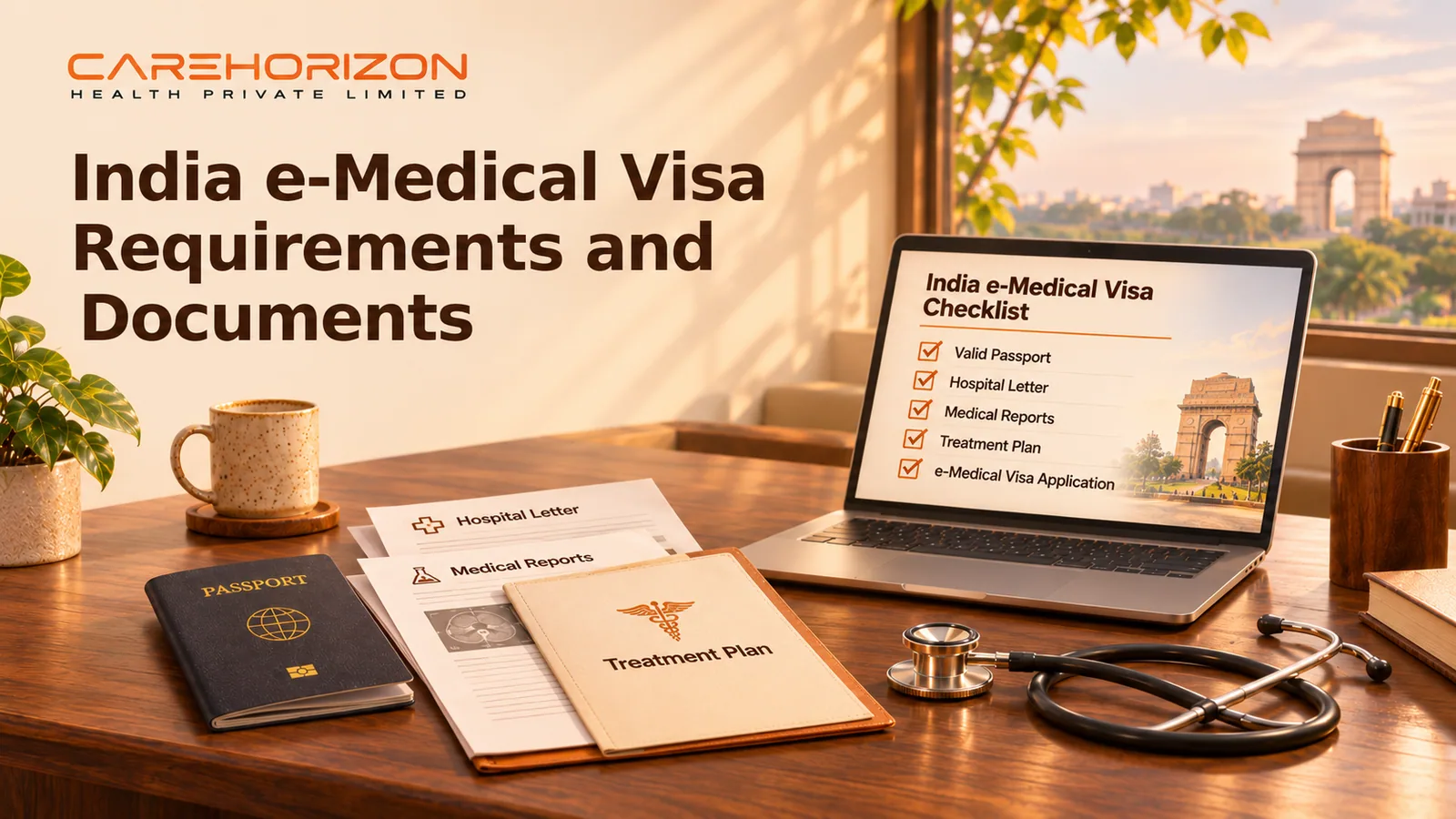
For an eligible e-Medical applicant, the core documents displayed by India's e-Visa portal are a scanned passport biographical page, a recent compliant facial photograph and a letter from the Indian hospital on its letterhead including the tentative admission or treatment date.
Prepare the patient's identifying details, reliable email, intended arrival information and a way to pay the official fee. The live application may request further personal details; nationality-specific or regular visa routes can impose additional documentation.
First Confirm e-Medical Eligibility
The government's e-Visa scheme is available only to qualifying passport holders and under stated exclusions. Before uploading documents, verify the applicant's nationality, passport type, intended treatment and applicable pathway.
Some applicants must use a regular visa or a separate government portal. Do not assume eligibility from the fact that an Indian hospital has accepted records for review.
e-Medical Visa Versus Regular Medical Visa
The e-Medical Visa is an electronic application route for eligible travellers. A regular medical visa uses consular procedures through the relevant Indian mission and can have different documents and approval conditions.
This article concentrates on the e-Medical upload checklist. Patients directed to a regular visa should follow their own embassy, high commission or consulate instructions instead of applying these e-Visa file specifications blindly.
For related preparation, read international patient guide.
Passport Requirement: Six Months of Validity
The official e-Visa guidance states that the applicant's passport must have at least six months of validity at the time of making the application. Check the actual expiry date, not only the date of the planned hospital visit.
A patient whose passport is near expiry should seek guidance on renewing it before submitting an application. Passport renewal can change the passport number used in a hospital letter.
Passport Requirement: Blank Pages
The e-Visa conditions also call for at least two blank passport pages for immigration stamping. Inspect the physical passport before submitting the form.
A digital scan does not demonstrate the condition of every physical page. Damaged passports or insufficient space may create travel problems regardless of hospital documentation.
Every Traveller Needs an Individual Passport
The government's instructions exclude applicants travelling as an endorsement on a parent or spouse's passport. Medical attendants submit individual applications and use their own travel documents.
Patients should not assume one family application grants permission to everyone travelling. Each person must match the rules for their own visa category.
What Is the Passport Biographical Page?
The biographical page is the passport page containing the photograph and details such as name, date of birth, nationality, passport number and expiry date. The official e-Visa instructions require a scan of that page.
Use the complete page with all important edges and text visible. Do not cover identification numbers, crop out the machine-readable area or upload an unrelated passport page.
Passport Scan: Official File Format and Size
The official e-Visa general instructions specify a PDF passport biographical-page upload between 10 KB and 300 KB. The live form controls the upload process and should be consulted immediately before submission.
A large image pasted into an oversized PDF may be rejected. Excessive compression can make numbers and letters unreadable. Check both file size and legibility rather than sacrificing clarity to meet a limit.
How to Make a Legible Passport PDF
Use a clear flat scan or photograph without glare, fingers, shadows or distortion. Ensure the name, issue and expiry dates and passport number remain readable at normal magnification.
If converting an image to PDF, confirm that the exported file contains the complete page and has not rotated or cropped its edges. Avoid editing the underlying personal information.
Photograph: JPEG Format and Size
The Indian e-Visa instructions specify a digital photograph in JPEG format, with a minimum file size of 10 KB and maximum of 1 MB. The photograph's height and width should be equal.
This is a digital upload specification rather than a general instruction to submit any printed passport photograph. Check the final saved image itself, not just the camera's original file.
Photograph: Face, Background and Composition
The official guidance calls for a front-facing photograph with eyes open, without spectacles, with the entire head visible from hair to chin and centred in the frame. A plain light-coloured or white background is required.
The official instructions also warn against shadows and borders. Do not use a highly filtered portrait, collage, angled selfie or photo where the face is obscured.
Avoid Overediting the Visa Photograph
An applicant may crop the photograph to the required square shape and adjust the file size, but should not change facial identity, remove significant features or create an artificial likeness.
Use a recent genuine photograph. If the image is blurry or shadowed, taking another picture is generally preferable to applying aggressive software enhancements.
The Indian Hospital Letter: Core Requirement
The official e-Medical Visa instructions require a copy of a letter from the concerned hospital in India on its letterhead, including the date or tentative date suggested for admission or treatment.
The portal FAQ specifies the applicant's name, nationality and passport number. Ask the hospital to ensure the letter contains these details accurately and is issued through its authorised channel.
Who Should Issue the Hospital Letter?
The intended Indian hospital should issue or authorise the relevant correspondence. An external medical travel coordinator can help request it but should not independently manufacture a hospital letter or substitute its own letterhead.
Confirm the exact hospital entity and campus. If a patient has spoken to more than one hospital, do not accidentally attach a letter from the wrong proposed treatment institution.
For related preparation, read medical visa planning page.
Hospital Letter and Tentative Clinical Dates
A patient may be seeking assessment before a definitive operation date is known. The hospital should accurately state the tentative date and intended purpose according to its own records and the applicable visa requirements.
Do not pressure the hospital to falsely certify that surgery is booked. A legitimate tentative clinical schedule may change after examination; the hospital and visa authority determine the appropriate documentation.
Hospital Letter: PDF Upload Specification
The government e-Visa file guidance specifies that additional business or medical-purpose documents should be in PDF format between 10 KB and 300 KB. Check the live e-Medical upload field for applicable requirements.
Scanned letterheads should be clear enough to verify names and dates. A compressed, illegible document may cause problems even when its file size appears acceptable.
Hospital Letter Is Not a Treatment Estimate
A hospital estimate explains provisional financial charges for specified medical services. The visa letter supports the immigration application with relevant patient and hospital information.
Some families receive both as part of one email. Save them as distinct documents and upload the file the e-Visa application requests, rather than assuming a package quote satisfies the hospital-letter requirement.
For related preparation, read understanding hospital estimates.
Hospital Letter Is Not a Specialist Opinion
A clinical opinion explains what a qualified doctor thinks about the diagnosis or treatment options. A visa-support letter may have a narrower administrative purpose.
If the receiving hospital has not yet confirmed surgery, ask what it can truthfully document for the application. Clinical recommendations and immigration documentation should remain consistent but are not identical.
For related preparation, read getting a second medical opinion.
Identity Consistency Across Documents
Check the passport name, nationality and number against the hospital letter and visa form. Small differences in spelling, spacing or digits deserve attention before submission.
If a hospital letter has an error, ask the hospital to reissue it rather than manually editing a signed document. Keep copies of the corrected version.
Documents Should Be in English Where Required
The official e-Visa guidance says supporting documents such as invitations must be in English, with noncompliant submissions liable to rejection. Follow the current form's language instructions.
If original medical records are in another language, ask the receiving hospital whether it needs translations for clinical assessment. Do not assume every clinical report must be uploaded to the visa system.
Do Patients Need to Upload Every Medical Report?
The standard e-Medical upload list focuses on the passport, photograph and hospital letter. The e-Visa portal does not describe every laboratory or imaging report as a universal mandatory upload for this route.
Hospitals may still need the full clinical record for treatment planning, and a specific consular or nationality-based process may request more evidence. Distinguish the visa upload checklist from the medical record checklist.
For related preparation, read organising medical records.
Do Patients Need a Bank Statement?
The government's general e-Visa eligibility conditions refer to travellers having sufficient funds for their stay and return or onward travel. However, this should not be misrepresented as a universal bank-statement upload requirement for the standard e-Medical form.
Some regular or special-category applications can request additional financial evidence. Follow the exact current application instructions, not a generic agency list.
Return or Onward Ticket Considerations
The official general conditions say international travellers should have return or onward journey tickets and sufficient money for their stay. Medical patients should also ask clinicians about expected recovery and travel suitability.
A non-refundable return ticket booked too early can be impractical if treatment changes. Check airline documentation requirements while keeping flexibility where possible.
For related preparation, read planning treatment in India.
Medical Attendant Documents
The official e-Medical Attendant list identifies a scanned passport biographical page, and each attendant must complete a separate application. Follow the live form for the exact photograph and any additional case-specific information requested.
The government's general instructions allow only two e-Medical Attendant visas against one e-Medical visa. This is a category-specific limit, not a substitute for the individual eligibility assessment.
Does a Medical Attendant Need the Patient's Hospital Letter?
The listed mandatory uploads for an e-Medical Attendant may differ from those for the patient. Nevertheless, the application may request details that connect the attendant to the e-Medical patient.
Prepare the patient's hospital and visa information for accurate form completion, and consult the live official process rather than assuming the patient's letter must always be uploaded under the attendant's field.
What About Children or Older Patients?
Every applicant's required documents depend on their passport, visa category and circumstances. Age does not remove the need to follow official immigration instructions.
Families should ensure that any person assisting with the application has proper authority and uses accurate personal information. Medical escort requirements are separate clinical and airline decisions.
For related preparation, read guide for attendants.
Special Cases: Official or Diplomatic Passports
The e-Visa rules exclude holders of diplomatic or official passports and certain travel documents. The government directs such applicants to the regular visa process.
Professional or security-related background questions may also affect eligibility. Answer such questions accurately and consult the applicable official route.
Special Cases: Pakistani Passport or Origin
The official e-Visa guidance excludes certain applicants with Pakistani nationality or specified Pakistani origin from the electronic route and refers them to a regular visa at an Indian mission.
Because the detailed rule is sensitive to personal circumstances and ancestry, read the government's exact current definition rather than relying on simplified third-party descriptions.
Special Cases: Bangladesh Applicants
Bangladesh nationals should confirm the government-designated application route and current Indian mission or IVAC procedures. An e-Medical Visa checklist for eligible countries should not automatically be applied to every Bangladesh applicant.
Hospital letters, appointment availability and port-of-entry rules may have nationality-specific conditions. Verify them before booking flights or a land crossing.
Application Timing: Four-Day Minimum
India's e-Visa general instructions state that eligible e-Medical and e-Medical Attendant applicants can apply at least four days before arrival, with an advance application window of 120 days.
The published application window is not a guarantee of a decision within four days. Leave time for unreadable uploads, additional questions or changes to a hospital appointment.
Visa Fees Are Nationality-Specific
The government portal says the e-Visa fee varies by country or territory and that additional bank transaction charges may apply. Check the official payment page when submitting the form.
No hospital letter or agency quotation should be treated as the government's fee schedule. The portal warns against claims of authorised emergency or express e-Visa processing charges.
How to Complete the Uploads
First prepare the passport PDF, square JPEG photograph and hospital-letter PDF in their specified sizes. Inspect each locally for legibility and correct patient information before opening the form.
Upload the requested file to the corresponding field. Do not use a file merely because it fits the size limit if it contains the wrong content.
Why Applications Can Be Rejected for Documents
The government's instructions warn that photographs and uploads not clear or not compliant with specifications may lead to rejection. Errors in passport details or hospital documentation can also undermine an application.
Correct errors at the source. Do not fabricate a letter, manipulate identity details or rely on a third party promising to bypass government checks.
Check Every Field Before Paying
Review the passport number, nationality, date of birth, contact email, category and hospital details before final submission. Compare them against the original passport and hospital correspondence.
A form can appear complete while containing a transposed digit. Independent proofreading by the applicant or authorised attendant may catch mistakes before they affect travel.
Submission Confirmation Is Not Approval
A successful online payment or application ID demonstrates submission activity, not that the Indian government has granted entry permission.
Use the official status checker and verify the actual Electronic Travel Authorization. Do not purchase restrictive travel solely because an agency sends a screenshot labelled approved.
What to Check on the Approved ETA
Check the applicant's name, passport details, issued category, entry conditions, validity and allowed entry points. Keep an official copy accessible for airline and immigration checks.
Do not assume the same conditions apply to the patient and attendants. Actual permission is determined by the authorised grant and immigration requirements.
Important Validity Warning
The current government e-Visa portal contains inconsistent information about some e-Medical validity periods: its category table lists certain one-year medical variants while an older FAQ passage describes 60 days.
Do not rely on either duration as a universal answer. Check the exact visa subtype and issued ETA, and seek official clarification about the permitted stay or entries when uncertain.
Arrival Ports and Land Borders
The e-Visa portal publishes designated arrival airports and seaports. An applicant must check the current list and their own permission before choosing a travel route.
A land crossing is not automatically an approved e-Visa entry point, even when it is near the receiving hospital. Nationality-specific permissions may differ.
For related preparation, read arriving in India for treatment.
The e-Arrival Card Is Separate
India's official visa website describes an e-Arrival Card process for relevant foreign nationals and OCI cardholders, allowing submission within 72 hours before arrival.
The card does not replace an e-Medical Visa or other required entry permission. Check the live arrival guidance shortly before travel.
A Hospital Can Change After Application
A new specialist opinion may lead the patient to consider another hospital. In some cases, immigration documents or conditions may refer to a named receiving facility.
Seek official advice about changes that could affect the visa. The medical travel coordinator and hospital administrator cannot unilaterally authorise a change to government permission.
For related preparation, read hospital selection guide.
Treatment Dates Can Change
The hospital's provisional date may shift because of clinical assessment, new tests or scheduling. Ask whether updated hospital correspondence is needed and check whether the visa or travel booking is affected.
An updated medical letter does not automatically amend the entry permission. Verify timing and permitted stay directly with the appropriate authority.
For related preparation, read staying near the hospital.
If More Medical Care Is Needed After Arrival
The e-Visa FAQ generally describes non-extendable and non-convertible permissions, although individual circumstances must be addressed through the relevant official authority or FRRO.
Do not assume a doctor's recommendation automatically extends legal stay. Contact immigration authorities before the authorised period expires.
For related preparation, read after-discharge recovery guide.
A Medical Visa Does Not Establish Fitness to Fly
The patient may require clinical assessment, airline medical clearance or supervised transport, depending on condition. Having an ETA is not evidence that a commercial flight is medically appropriate.
Qualified clinicians and the airline determine suitability and required assistance. A hospital invitation or medical visa does not substitute for these checks.
For related preparation, read fitness-to-fly guide.
Keep Medical Records Separate From Visa Uploads
The receiving doctor may need a complete clinical record, including tests and medications, while the immigration form may request only specific documents.
Maintain separate, clearly named folders for visa uploads, clinical files, hospital invoices and travel details. Protect sensitive health information and share it only with appropriate recipients.
For related preparation, read sending clinical records to Indian hospitals.
Before-Submission Checklist
Confirm nationality eligibility; passport type and validity; two blank pages; current hospital letter; matching name, nationality and passport number; correctly sized JPEG photograph; readable passport PDF; and readable hospital PDF.
Confirm the right visa category, a reliable email address and the authorised payment website. If applying for an attendant, check the separate application and relevant limits.
Before-Departure Checklist
Verify approved ETA details, entry port, passport, hospital appointment, accommodation and airline acceptance. Check current arrival-card requirements and the complete route to the hospital.
Keep copies of medical documents, payment receipts and contact information. Confirm that the patient is clinically suitable for the planned journey.
For related preparation, read documents to bring for treatment in India.
Illustrative Case: Passport Number Mismatch
A hospital letter contains one incorrect digit in the patient's passport number. The family notices it during review and asks the hospital to issue a corrected letter.
This hypothetical example shows why comparing document details before submission is more reliable than correcting them after approval.
Illustrative Case: A Poor-Quality Scan
A passport scan fits the PDF size limit but is too blurry to read. The applicant re-scans it with better lighting and modest compression before applying.
A technically valid file type is not enough: legibility and complete biographical data remain essential.
Illustrative Case: Patient and Attendant
A patient prepares the required hospital letter, passport page and photograph; a family companion prepares a separate eligible attendant application.
The family checks both permissions independently. This example illustrates separate documentation, not guaranteed visa approval.
How Carehorizon Health Can Assist
Carehorizon Health Private Limited coordinates practical arrangements around clinical care. Depending on the enquiry, this may include organising records, obtaining hospital correspondence and aligning appointments with the patient's intended travel.
Indian authorities alone determine visa eligibility and entry; hospitals and clinicians determine clinical care; airlines decide carriage. Carehorizon does not issue government permissions, guarantee processing, fabricate hospital letters or certify fitness to fly.
For related preparation, read how Carehorizon works.
Frequently Asked Questions
What documents are required for an India e-Medical Visa?
The standard official checklist includes a passport biographical-page scan, recent compliant JPEG photograph and an Indian hospital letter on letterhead with the tentative admission or treatment date.
How long must my passport be valid?
The e-Visa instructions state a minimum of six months' validity at application and at least two blank pages. Verify the live rule for your category.
What file format is required for the passport page?
The official instructions specify PDF, with a file size from 10 KB to 300 KB, for the biographical-page scan.
What photo size and format does the e-Visa portal require?
A square, front-facing JPEG with a size between 10 KB and 1 MB, against a plain light or white background, following the government composition rules.
What must the hospital letter include?
According to the official FAQ, it should identify the patient by name, nationality and passport number, and the hospital letter must state the tentative admission or treatment date.
Does every medical report have to be uploaded with the visa?
The standard e-Medical upload list does not identify every clinical report as mandatory. Other visa routes or individual circumstances may require additional information.
Can an attendant apply using the patient's passport?
No. Each applicant requires their own passport and separate application. The government states a category-specific limit of two e-Medical Attendant visas against one e-Medical visa.
Can I apply four days before travel?
The government states a minimum four-day lead time within a 120-day application window for eligible e-Medical applicants; this is not a promise that approval will be issued in four days.
Does an approved e-Medical Visa allow land-border entry?
Not automatically. Check the authorised entry ports and conditions of the actual permission.
Can Carehorizon issue or approve my e-Medical Visa?
No. Carehorizon can assist with practical coordination within its scope; the hospital issues authentic hospital correspondence and the Indian government determines the visa.
Official Government References
- Indian Visa Online — Official e-Visa Portal, General Instructions and Documents: https://indianvisaonline.gov.in/evisa/
- Indian Visa Online — Detailed e-Visa Instructions, Photo and PDF Specifications: https://indianvisaonline.gov.in/evisa/tvoa.html
- Indian Visa Online — Regular Visa Application Route: https://indianvisaonline.gov.in/visa/
- Indian Visa Online — Government Visa and e-Arrival Information: https://indianvisaonline.gov.in/
- Government of India — e-FRRO Services: https://indianfrro.gov.in/
- Indian Visa Online — Nationality-Specific Application for Bangladesh: https://indianvisa-bangladesh.nic.in/visa/
For a planned international patient enquiry: Carehorizon Health | WhatsApp/Call +91 6292041222 | care@carehorizonhealth.com | https://carehorizonhealth.com/enquiry/
Medical, immigration, financial and publication disclaimer: General information reviewed 12 November 2026, not a government determination, legal advice, visa processing guarantee, treatment admission guarantee or medical clearance. Eligibility, required documents, file limits, entry conditions and visa validity must be rechecked against the live official form and issued approval; the government portal contains contradictory statements about some e-Medical validity periods. Hospitals and clinicians determine medical care; Indian authorities decide entry permissions. Internal Carehorizon links are from the supplied site inventory and require live-page verification before publication.
Carehorizon Health coordinates medical travel, patient transfers and related arrangements. The information here is educational; it does not diagnose, prescribe, guarantee an outcome or replace advice from your treating medical team. Service availability, costs and travel requirements are confirmed case by case.