This article provides general information to support better planning. Individual medical decisions and fitness for travel require assessment by qualified treating professionals.
India is among the destinations international patients may consider when seeking medical treatment abroad, alongside countries such as Thailand, Singapore, Malaysia, Turkey and the United Arab Emirates. But choosing a destination based on a list of advertised hospital prices or a national ranking can overlook what matters most: whether the specific clinician and facility can provide appropriate care for an individual patient.
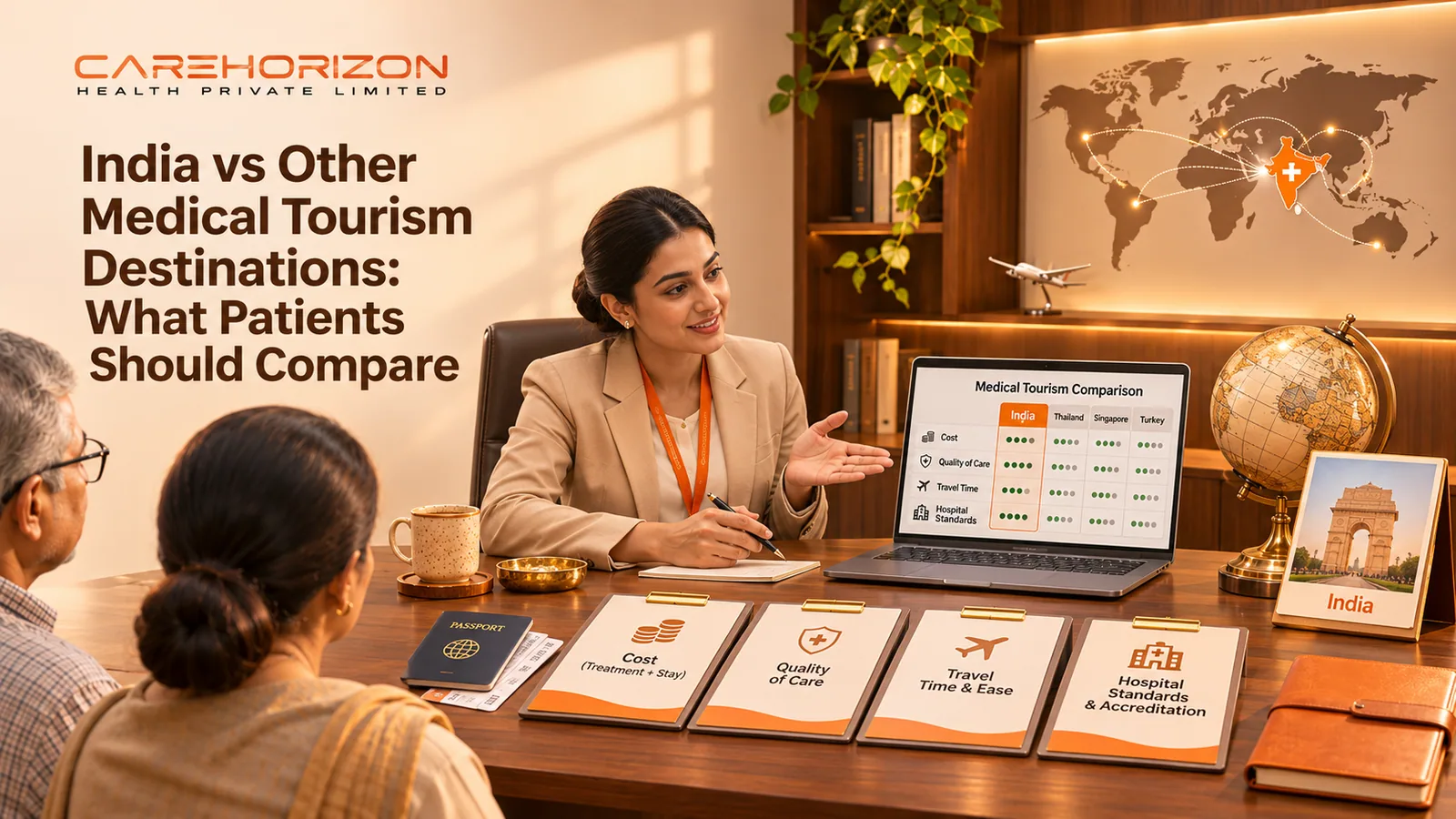
A meaningful India medical tourism comparison assesses the proposed treatment, hospital capabilities, complete costs, travel burden, insurance arrangements, recovery and continuity of care. Those factors change depending on the diagnosis, patient, origin country and hospital. A destination that is appropriate for one person may not be suitable for another.
This guide explains how to compare options responsibly without inventing country-wide success rates or declaring a universal winner. It provides a comparison framework, illustrative scenarios, questions to ask providers and a practical checklist. For the broader patient pathway, see Carehorizon's treatment-in-India overview.
Start With the Diagnosis, Not the Destination
Ask a qualified clinician to clarify the diagnosis, urgency, possible treatments and important risks before searching for hospitals abroad. An initial recommendation may change after new investigations or examination. If the patient is acutely unwell, immediate local care takes priority over comparative shopping.
Comparing a surgical quote in one country with a non-surgical recommendation in another is not a fair price comparison. The medical options must first be understood. The CDC Yellow Book recommends discussing medical tourism plans with healthcare professionals before travel.
Why Country Rankings Can Mislead
A country is not a single clinical provider. Different hospitals within India, Thailand or any other destination can vary in capability, staffing, infection prevention, records management and follow-up arrangements.
Some rankings use promotional surveys or undisclosed weights. Ask which data are verified, how current they are and whether the measures are relevant to the proposed procedure. Avoid inferring that every institution in a highly ranked destination delivers the same results.
Compare the Exact Hospital and Campus
Verify the actual facility where the patient would be seen, not merely the parent hospital group's name. Ask what diagnostic resources, operating facilities, intensive care and emergency services are available at that site.
If part of the pathway requires another campus or provider, establish who will coordinate the transfer and clinical handover. A renowned national healthcare sector does not prove that the chosen hospital has the necessary service.
Carehorizon's hospital-selection checklist provides additional questions about the named institution and its services.
Compare the Treating Specialist
Request the name, specialty, professional registration where applicable, actual institutional affiliation and role of the doctors expected to assess and treat the patient. Ask who will perform the procedure and manage complications.
A hospital brand or an online biography is not enough to confirm availability for a particular patient. Where several specialties are involved, identify the clinician responsible for integrating recommendations.
What Accreditation Can and Cannot Prove
Accreditation can show that a facility was assessed under a defined standards programme. Joint Commission International maintains a directory of accredited international organisations, while India has the National Accreditation Board for Hospitals & Healthcare Providers.
Check the current credential against the issuing body's original listing and the exact hospital campus. Accreditation is useful due diligence, but the CDC cautions that it cannot guarantee a particular patient's outcome.
Ask for Procedure-Specific Quality Information
If a hospital provides outcomes information, ask what is measured, the time period, the patient population and whether clinical risks are accounted for. An outcome percentage from relatively simple cases cannot fairly be compared with figures from a centre receiving more complex referrals.
Do not accept a guaranteed cure or a country-wide success statistic as a substitute for relevant clinical evidence. Where comparable outcome data are unavailable, record that uncertainty rather than inventing a ranking.
Compare Treatment Scope Before Prices
Request written proposals that identify the intended procedure, expected investigations, anaesthesia, devices or implants, hospital stay, medications and important exclusions. A quote may be conditional on new findings after arrival.
Only compare like-for-like services. A lower headline amount may exclude items included in a competing estimate, while two hospitals may have genuinely different clinical recommendations requiring further review.
See the guide to understanding treatment estimates for examples of variable charges and exclusions.
Why Universal Medical Tourism Price Tables Are Weak Evidence
Internet articles sometimes give fixed prices for major procedures across whole countries. Costs vary by clinical complexity, institution, room category, devices, investigations, duration and exchange rate.
India's government describes cost competitiveness as one feature of its medical tourism sector, but that does not prove India is always cheaper than other destinations. Request a current case-specific hospital estimate instead of relying on an unsourced national average.
Build the Total Journey Budget
Add flights, visa fees, accommodation, food, local transfers, attendants, specialist transport if needed, bank charges and follow-up costs to the medical estimate. Include possible additional nights if recovery or the treatment plan changes.
An expensive hospital closer to home may have a lower complete journey cost than a cheaper overseas procedure requiring a prolonged stay. Keep each provider's quotation separate so billing responsibilities remain transparent.
Travel Time Means Door-to-Door Burden
Compare the full journey from the patient's home to the receiving hospital, including road transfers, airport waiting, flight connections, immigration and movement between terminals.
Shorter flying time does not always mean an easier journey. A direct service with accessible arrangements may be more practical than multiple connections, depending on the patient's actual condition and medical assessment.
The arrival-in-India guide addresses airport and ground transfer coordination.
Medical Fitness for Travel
A specialist appointment does not prove that a patient is fit for commercial air travel. Recent surgery, medical instability, oxygen use or particular mobility requirements may require clinical and airline review.
The treating physician should assess suitability for the proposed journey, while airlines apply their own passenger acceptance requirements. Do not choose a destination that can only be reached by a medically unsuitable route.
Review the fitness-to-fly guide for additional medical travel questions.
Airport Assistance and Medical Escorts
Wheelchair support, a family attendant, a professional medical escort and an air ambulance are different arrangements. The appropriate level is determined by patient function, clinical needs and operator acceptance, not age or advertising.
Price only the assistance actually indicated and confirm what each provider supplies. A relative's support is not automatically equivalent to trained medical supervision.
Travel Health and Infection Risks
The CDC advises pre-travel medical review and attention to routine vaccinations, infection risks, complications and the possibility of antimicrobial-resistant infections following overseas healthcare exposure.
These risks cannot be reduced to a simple country ranking. Investigate the actual institution's practices and make sure the patient knows where to seek urgent care if symptoms arise after treatment.
Waiting Time and Scheduling
Some patients consider overseas care because local appointments are difficult to obtain. Ask whether the foreign hospital's initial consultation and proposed operation are confirmed, and which decisions remain conditional on tests.
A promised fast admission is not the same as a clinically appropriate treatment timetable. Availability, urgency and diagnostic uncertainty should be considered together rather than treating speed as an independent quality score.
Communication and Language
Clear communication is essential for history-taking, consent, prescribing and discharge instructions. Ask whether the treating specialist and relevant staff can communicate in the patient's preferred language or arrange qualified interpretation.
Do not assume that every hospital in an English-speaking tourism market provides adequate clinical language support. Confirm it for the actual institution and intended consultations.
Carehorizon's language support guide covers clinical interpretation planning.
Visa Requirements and Permitted Stay
Immigration rules vary by nationality, purpose, treatment documentation and expected duration. India offers medical-related entry routes for eligible travellers, while other destinations apply their own conditions.
Use the official immigration authority for each country. Hospital letters or facilitator assurances cannot guarantee approval. Include any attendant's visa and the possibility of extended recovery in the planning.
The medical visa resource explains additional planning considerations for entry to India.
Insurance and Direct Billing
International insurance may cover a particular hospital and procedure in one country but not another. Planned treatment, network restrictions, preauthorisation, deductibles and reimbursement methods may differ.
Seek written insurer confirmation identifying the treatment, facility and conditions. A general travel policy or international insurance card is not proof that elective surgery will be cashless.
The international patient payments guide can help distinguish direct billing from reimbursement.
Patient Rights and Legal Recourse
Consent procedures, complaints arrangements, professional oversight and available remedies can differ across jurisdictions. The CDC warns that patients may not have the same legal recourse for care received abroad as at home.
Ask each hospital for its consent process, record access and grievance channels. Obtain qualified advice where legal differences materially affect the decision rather than relying on a facilitator to interpret foreign law.
Recovery and the Return Flight
The expected hospital discharge date is not automatically the date the patient can safely fly home. The treating team may recommend additional observation, wound review, rehabilitation or other care.
Surgery and long periods of immobility can increase blood-clot risk in some patients. Discuss travel readiness with qualified clinicians and check relevant airline requirements before finalising a return date.
Consult the return-home guide for discharge and travel-readiness planning.
Continuity of Care After Returning Home
A lower overseas price is less useful if the patient cannot obtain necessary follow-up at home. Ask which clinician will review the discharge records, manage medications and assess complications.
Request a complete discharge summary and relevant procedure, pathology or imaging reports. Remote specialist consultations may help where available, but they cannot replace every physical examination or urgent local assessment.
The continuing-care guide describes a cross-border handover to local clinicians.
India Compared With Thailand
These are both destinations some patients evaluate for overseas care, but country names alone do not establish treatment suitability. Compare named hospitals and clinicians offering clinically equivalent services.
A patient with a direct flight to one destination may face a very different overall journey from someone travelling from another region. Compare full quotations, credentials, language requirements and aftercare rather than claiming a general winner.
India Compared With Singapore
Compare the specific specialist, facility capability, hospital charges, insurer network, travel burden and postoperative arrangements. A higher or lower national reputation should not determine care without examining the proposed clinical pathway.
Ask for dated estimates with clear inclusions and exclusions. Avoid comparing different types of hospitals or procedure packages as though they were identical.
India Compared With Turkey
If considering hospitals in India and Turkey, verify professional registration, current institutional credentials, the actual treatment plan and what the price includes.
Route length, visa rules, language support and recovery travel can influence the practical choice. Do not equate a promotional package with a clinically reviewed hospital quotation.
India Compared With Malaysia
Use the same criteria: appropriate clinician, hospital resources, clinical communication, complete costs, travel suitability, insurance and local follow-up.
Different patients may reach different decisions because their home airports, diagnoses and financial arrangements are different. An institution-specific comparison is more defensible than a sweeping country claim.
India Compared With the UAE
A patient living in the Gulf may compare nearby care with a referral to India. The relative convenience of treatment close to home can reduce disruption and facilitate follow-up.
Conversely, a particular specialist opinion or service may justify travelling if medically appropriate. Request actual quotations and consider insurance and family support in both locations.
Remember the Option Closer to Home
Patients should compare international treatment with reasonable services available locally, particularly when ongoing monitoring or frequent rehabilitation may be required.
An overseas second opinion can still be valuable even if the patient eventually decides to receive treatment at home. Choosing not to travel should remain a legitimate option.
Patients may also explore a second-opinion process before deciding whether travel is necessary.
Make a Hospital-Level Comparison Matrix
Create one row per specific hospital and record the proposed treatment, clinician, facility capability, current accreditation, costs and exclusions, travel route, visa requirements, language support, insurer status and follow-up arrangements.
Mark each answer verified, provisional or unanswered. Unknown information is a legitimate reason to pause an elective decision; do not disguise gaps with a numerical score.
Use the questions in Carehorizon's broader international-patient planning guide when organising the entries.
Do Not Overinterpret Weighted Scores
A family can use a structured scorecard, but any weights are personal planning choices rather than validated clinical prediction. The safety and medical appropriateness of the option must remain paramount.
A high total for convenience or cost cannot override a clinician's finding that the treatment or journey is unsuitable. Use scores to organise discussion, not automate clinical decisions.
Example: A Cheaper Quote With Exclusions
Imagine that Hospital A quotes less but excludes certain tests, devices and postoperative visits. Hospital B charges more but includes a broader scope. The family requests itemised explanations before comparing.
This fictional example shows why the lower headline number is not necessarily the lower eventual bill. It does not imply that a particular country or hospital uses either pricing model.
Example: A More Difficult Journey
A patient with limited mobility considers two otherwise appropriate hospitals. One flight is direct; the other has lengthy connections and an additional road transfer. The patient and clinician review the medical and practical impact.
The easier route may be relevant even if the procedure quotation is higher. Travel burden should be evaluated using the individual itinerary, not a generic flight-time table.
Example: Follow-Up Determines the Choice
A patient needs ongoing specialist monitoring after treatment. One hospital provides a detailed record-sharing and follow-up process; the second has not yet explained how local clinicians will receive necessary information.
The family seeks clarification before committing. This hypothetical example reinforces the need to compare continuity arrangements instead of focusing only on the operation date.
Questions to Ask Each Hospital
Who will treat this specific diagnosis, and what is still uncertain? Does the facility have the relevant operating, imaging, intensive-care and complication-management resources? Can it document current accreditation and professional credentials?
What is covered by the treatment estimate, what may change after arrival and who handles follow-up? Request written answers for critical issues instead of relying entirely on promotional brochures.
Questions to Ask Before Booking Travel
Is the patient medically fit for the route and does the airline require clearance? What visa, attendant and medical record requirements apply? What are the actual door-to-door journey and recovery arrangements?
Can the insurer confirm planned treatment coverage at this hospital? What costs and financial risks remain with the family if treatment changes or the return flight is delayed?
How Carehorizon Health Approaches a Destination Enquiry
Carehorizon Health Private Limited coordinates practical arrangements around clinical care. Depending on the enquiry, that can include organising records, communicating with hospitals and aligning appointments and travel logistics with the proposed care pathway.
Carehorizon does not determine clinical treatment, guarantee outcomes, rank countries as universally superior or control hospital quotations, visas, airline acceptance or insurance decisions. Each responsible institution and authority makes its own decisions.
Read how Carehorizon works for a summary of its practical coordination role.
For planned medical travel enquiries, use the Carehorizon enquiry page, call +91 6292041222 or email care@carehorizonhealth.com. Seek appropriate local medical attention for urgent symptoms.
Compare the Cost of Complications and Extended Care
A hospital's initial estimate may assume an uncomplicated stay. Ask whether intensive-care services, repeat operations, infection treatment, additional imaging and longer admissions are included or charged separately. No provider can predict every complication, but families should know how such costs are communicated and approved. Treatment abroad may create extra financial exposure if the insurer does not recognise all charges or if the patient must remain overseas longer than expected.
The relevant question is not whether one country has fewer complications in the abstract. It is whether the named hospital has the clinical capacity to manage the foreseeable risks and an understandable billing and escalation process. Request clear responsibility for emergency decisions and documentation, and do not treat a marketing guarantee as a substitute for actual safeguards.
Check Whether the Proposed Technology Is Relevant
Hospital brochures may highlight advanced imaging, surgical robots or specialised equipment. These capabilities can be appropriate for some conditions, but their presence alone does not establish that the patient needs or will benefit from them. Ask the specialist why a particular technique is recommended, what evidence supports it, which alternatives are available and whether the hospital has the qualified staff to use it.
The patient should compare clinically appropriate pathways rather than paying more for a technology label. If two specialists recommend different approaches, a second review may help clarify the trade-offs. It is reasonable to ask for the underlying recommendation in writing, including any uncertainty or limitations.
Inspect How the Hospital Handles Medical Records
Before choosing a destination, find out how medical records are submitted, reviewed, protected and returned to the patient. The receiving doctor may need full imaging files, pathology materials or a clear treatment chronology, not just a translated summary of an earlier appointment.
Ask whether the hospital can provide an English discharge summary, operative notes, key test results and a reliable contact for later questions. The CDC specifically recommends that medical travellers obtain their overseas records and share them with professionals responsible for follow-up. A low quoted price does not compensate for a missing handover plan.
Consider Family Support and Accessibility
Some patients have family or community connections in one destination, access to an interpreter or a trusted person who can accompany them. These factors can materially improve the practical experience, particularly during admission and recovery, but should be evaluated alongside medical suitability.
Compare whether the patient can access a suitable room, step-free accommodation, local transport and the daily support required after discharge. A family member's assistance is different from professional clinical care. Where the patient needs medical monitoring or specialist transport, the treating team should determine appropriate requirements before travel is booked.
Check the Terms of Any Coordinator Agreement
If an independent facilitator helps with the comparison, ask what the service includes and whether it receives fees or referral payments that could affect how options are presented. Confirm which organisation issues the hospital estimate, who receives each payment and which party is responsible for refunds or booking changes.
The facilitator should identify the actual hospitals being approached and must not promise clinical outcomes, visa approvals or insurance benefits outside its control. Patients can also communicate with a hospital directly. A transparent written scope helps families distinguish clinical decisions from administrative coordination, regardless of destination.
Use a Two-Stage Decision Process
Stage one is clinical screening: establish which named hospitals are genuinely suitable for the patient's condition, confirm the responsible professionals and understand the key medical risks. Options that cannot demonstrate the needed capability should not be advanced solely because they are convenient or inexpensive.
Stage two is practical comparison among clinically appropriate choices: itemised total cost, travel effort, entry requirements, communication, insurance and follow-up. This order prevents a cheaper flight or attractive hotel package from dictating a high-stakes medical decision. If essential details remain unverified, the safest administrative conclusion may be to gather more information before committing.
Frequently Asked Questions
Is India always cheaper than other medical tourism destinations?
No. Costs vary by the exact institution, care plan, included services, dates and exchange rates. Compare complete written estimates and all travel-related expenses.
Is India better than Thailand or Singapore for surgery?
There is no universally better country for every patient. Compare qualified specialists, the proposed procedure, specific hospital facilities and the practical journey.
How can I compare hospital quality between countries?
Verify each hospital's actual campus, relevant services, current accreditation and professional credentials, along with any interpretable procedure-specific outcomes information.
Does JCI accreditation guarantee safe treatment?
No. It shows assessment against a programme's standards, but cannot guarantee an individual result or replace clinical due diligence.
What additional costs should I compare?
Include flights, entry documentation, accommodation, meals, attendants, local transport, transaction charges, recovery and follow-up in addition to hospital charges.
How important is travel time?
It can be important for patients with medical or mobility needs. Consider the complete journey and ask qualified clinicians whether the route is appropriate.
Can the same insurance policy cover treatment in different countries?
Coverage may differ according to policy territory, provider networks, planned-care exclusions and preauthorisation. Confirm each specific hospital with the insurer.
Are medical tourism destination rankings reliable?
They vary in methodology and may omit patient complexity, consistent outcome definitions, aftercare or current prices. Use original institution-level evidence.
Should I choose a destination before obtaining a specialist opinion?
A qualified medical opinion can define the diagnosis and treatment options before the family compares overseas quotations. In urgent situations local care takes priority.
What happens after a patient returns home?
The patient should obtain complete discharge records and establish suitable local follow-up, including a plan for complications and any remote specialist consultation where appropriate.
Official References and Further Reading
- CDC Yellow Book 2026 — Medical Tourism and Risk Assessment: https://www.cdc.gov/yellow-book/hcp/health-care-abroad/medical-tourism.html
- Joint Commission International — Accredited International Organizations Directory: https://www.jointcommission.org/en/about-us/recognizing-excellence/find-accredited-international-organizations
- National Accreditation Board for Hospitals & Healthcare Providers — Programmes and Verification: https://nabh.co/
- Embassy of India in Dublin — India Medical Tourism Overview: https://www.indianembassydublin.gov.in/page/medical/
- Government of India — Official e-Visa Website: https://indianvisaonline.gov.in/evisa/
- CDC Yellow Book — Travel Insurance and Healthcare Abroad: https://www.cdc.gov/yellow-book/hcp/health-care-abroad/travel-insurance.html
Medical, travel, financial and publication disclaimer: This article is a neutral comparison framework, not an individual medical recommendation, hospital endorsement, treatment quote, clinical outcome guarantee, visa approval or insurance determination. Treatment suitability, hospital standards, costs and travel requirements vary. Obtain qualified clinical advice and verify direct information from hospitals, accrediting bodies, insurers, airlines and official authorities. Carehorizon coordinates practical arrangements around clinical care and does not replace treating clinicians. Carehorizon internal URLs are drawn from the supplied site inventory and require live verification before publication.
Carehorizon Health coordinates medical travel, patient transfers and related arrangements. The information here is educational; it does not diagnose, prescribe, guarantee an outcome or replace advice from your treating medical team. Service availability, costs and travel requirements are confirmed case by case.