This article provides general information to support better planning. Individual medical decisions and fitness for travel require assessment by qualified treating professionals.
A hospital website can make a strong first impression. It may display photographs of modern operating theatres, specialist biographies, international patient services and accreditation logos. None of those items, on its own, confirms that the particular hospital campus is currently accredited, that a doctor is registered, or that the facility is appropriate for the patient's medical condition.
International patients often make substantial commitments before meeting the treating doctor: they share medical records, pay deposits, apply for visas and arrange flights. A structured verification process helps distinguish independently checkable information from promotional claims and reduces the risk of dealing with an impersonator or the wrong hospital branch.
This guide explains how to verify hospital India international patient enquiries step by step. It covers official NABH and JCI directories, the National Medical Commission's doctor registers, hospital affiliation, clinical capabilities, authentic websites, financial instructions, second opinions and a final pre-travel evidence checklist. Verification supports an informed decision; it cannot promise a medical result. For broader planning, see Carehorizon's hospital selection guide.
Start With the Exact Legal and Location Details
Record the institution's full name, physical address, city, campus, department and the entity issuing the estimate. Large hospital groups may operate multiple facilities, and an accreditation or specialist appointment associated with one branch does not necessarily apply to another.
Compare the address across the hospital's official website, its written appointment confirmation and the independent accreditation listing. If these differ, obtain clarification directly from the hospital before booking travel.
Why Verification Must Be Independent
A hospital brochure, forwarded PDF or social media page can accurately describe an institution, but it is still supplied by the organisation being evaluated. Independent evidence comes from an accreditation body's directory, a professional registration authority or direct confirmation with the institution using separately located contact details.
Use the strongest source for each claim: NABH or JCI for their own accreditation, the relevant medical register for professional registration, and the hospital's official department for availability and payment instructions. No one source answers everything.
Step 1: Find the Real Hospital Website
Search for the hospital's official domain, then check its address, telephone number, hospital locations and current patient-services information. Be alert to search advertisements, websites with very similar spelling and messaging accounts that claim to represent a hospital.
If someone sends a payment link or letter, independently navigate to the hospital website rather than trusting the link in the message. Contact the institution through the independently sourced number and confirm the patient reference.
Step 2: Verify the Exact Campus
The institution may advertise specialists and technology across its entire group even when the intended campus does not provide all services. Ask whether the proposed consultation, operation, intensive care and follow-up will occur at the same site.
Check whether a doctor rotates between branches and which location will admit the patient. Record the address on the estimate, visa letter and appointment confirmation and resolve any discrepancies.
Step 3: Search NABH's Official Directory
The National Accreditation Board for Hospitals & Healthcare Providers maintains a searchable directory of healthcare organisations. Its interface allows searches by name, city, state, postcode or accreditation number, with entries showing the organisation's identity and status.
Search the exact hospital, compare the listed address and credential type, and check whether the result corresponds to the relevant campus. If a name is common, narrow the search with the address or certificate number. Save the result date for the file.
Use NABH's official healthcare organisation search rather than relying only on a copied hospital certificate: https://nabh.co/find-a-healthcare-organisation/
Read NABH Directory Status Carefully
The NABH directory can list accredited, certified and empanelled organisations. These terms do not mean the same thing. Its published note says the directory includes some organisations under renewal and that data migration may leave some entries temporarily incomplete or inconsistent.
Do not describe an empanelled or certified institution as fully accredited without verifying the actual programme and status. If the entry is ambiguous or missing, contact NABH or the hospital for clarification rather than declaring it fraudulent.
Check the NABH Programme and Scope
A healthcare organisation may be assessed under a programme for hospitals, smaller healthcare organisations, laboratories or another category. A certificate for a diagnostic service is not evidence that a separate surgical hospital is accredited.
Ask which standard, facility and services the credential covers. Compare the facility name and certificate number with the directory. This matters when the marketing materials list several entities under one corporate brand.
Step 4: Search JCI's International Directory
Joint Commission International publishes a directory of accredited international healthcare organisations. Search the institution and compare its exact name, location, programme and current decision. A hospital's logo alone is not sufficient verification.
If the directory shows a similarly named institution in another country or city, that does not validate the facility under consideration. Use the specific listing rather than a general statement that the group is internationally accredited.
Use JCI's directory of currently accredited organisations: https://www.jointcommission.org/en/about-us/recognizing-excellence/find-accredited-international-organizations
NABH and JCI Are Different Credentials
NABH is an Indian healthcare accreditation body; JCI operates an international accreditation programme. Hospitals may hold either, both or neither, depending on their circumstances. The programmes have different standards, definitions and assessment processes.
Neither credential automatically guarantees suitability for a particular procedure, specialist skill or a complication-free result. The CDC recommends checking accreditation, while also emphasising the need to evaluate the actual provider and treatment.
Accreditation Does Not Equal Procedure Approval
An accredited hospital may not offer every highly specialised operation, and individual clinicians may practise in more than one location. Accreditation is a systems-level signal, not a procedure-specific guarantee.
Ask whether the exact clinical service is available at the proposed campus and which team is responsible. If a complex intervention is planned, confirm the equipment, anaesthesia, critical-care and backup services relevant to that case.
Step 5: Request the Doctor's Full Registration Details
Ask the hospital or doctor for their full registered name, registration number, registration council and professional qualifications. Names alone may be shared by several practitioners, making number-based matching particularly useful.
The register search should be a verification step, not a personal performance ranking. Registration establishes professional status according to the applicable system; it does not prove expertise in every procedure.
How to Use the National Medical Register
The National Medical Commission's National Medical Register search supports fields such as doctor name, State Medical Council registration number, year of registration and council. Its broader register is intended to record licensed allopathic medical practitioners and recognised qualifications.
Use the official nmr.nmc.org.in domain. If a match appears, compare registration identifiers and relevant details rather than assuming that the first name match is correct. Retain the date and search terms.
Use the official National Medical Register doctor search: https://nmr.nmc.org.in/search-doctor
What if the Doctor Is Not Found Online?
An unsuccessful search is not conclusive evidence that a doctor is unregistered. The National Medical Commission's older Indian Medical Register page states that its data is being updated, and names or records may require verification with a State Medical Council.
Confirm the full registration number, check the appropriate council and ask the hospital for clarification. Do not publish an allegation about an individual based solely on a missing search result.
State Medical Councils and Specialist Credentials
The registration record may refer to a State Medical Council and professional qualifications. Verify any claimed advanced degree or specialist credential with the relevant official record or institution where feasible.
A registration in a relevant medical profession is distinct from hospital privileges to carry out a particular intervention. Ask the hospital which clinician will actually perform the proposed procedure and what specialist review is required.
Verify the Doctor's Current Hospital Affiliation
A specialist's old biography, conference page or third-party directory may show an affiliation that is no longer current. Confirm with the hospital's official medical department or appointment desk whether the doctor currently practises there.
Ask which days or campus the doctor is available and whether the consultation and later treatment are expected to involve the same clinician. Avoid inferring availability from a promotional photograph.
Confirm Who Will Perform the Operation
For a planned procedure, ask whether the named surgeon will operate and who else forms the clinical team. The treating hospital may have teaching, assisting or on-call arrangements that should be explained under its processes.
The patient should know the responsible consultant, relevant alternatives and consent process. A medical travel coordinator should not promise that a particular doctor will perform surgery unless the hospital has confirmed the arrangement.
Step 6: Match the Hospital to the Medical Need
The most important question is whether the institution can appropriately assess and manage the individual case. Relevant capabilities may include diagnostic imaging, pathology, anaesthesia, critical care, rehabilitation or other specialties, depending on the condition.
Ask the treating team which services are essential and whether they are available at the actual campus. Avoid assuming that a list of technology or specialties on a hospital group's homepage applies to the selected facility.
Carehorizon's treatment areas overview can help frame the relevant specialty enquiry.
Assess the Plan for Complications
Ask how foreseeable complications are managed, whether the relevant specialists and critical-care services are available, and what happens if transfer to another hospital is needed. This is especially important for medically complex patients.
No hospital can guarantee that complications will not occur. A credible provider should explain its care pathway and escalation responsibilities without requiring the patient to interpret clinical risks alone.
Check Emergency Services and Transfers
If the proposed hospital lacks a particular service, find out where the patient would be referred, who arranges clinical acceptance and which transport arrangements are medically appropriate. A nearby facility is not necessarily an agreed receiving hospital.
For high-risk travel, the clinician should advise on transport fitness. A coordinator can help with administrative communication but cannot replace a receiving doctor's decision or guarantee a bed.
Step 7: Request a Case-Specific Specialist Opinion
A generic treatment brochure cannot tell the family whether a certain operation is recommended for their relative. Submit the relevant clinical records to a qualified specialist and ask which findings support the proposed treatment.
The initial opinion may be conditional on updated tests or examination after arrival. If the plan is major or uncertain, another qualified opinion may help when medically appropriate.
Carehorizon's guide to obtaining a second opinion explains how to prepare a clinical question.
Understand the Limits of Remote Record Review
A specialist may identify likely treatment options from reports submitted abroad, but an examination or original imaging may change the diagnosis or procedure. Clarify which decisions are provisional and what further tests may be required.
An appointment to consult a surgeon does not mean surgery is guaranteed. The final recommendation, consent and timing remain clinical decisions.
Step 8: Examine the Written Treatment Estimate
Ask for a dated quotation identifying the proposed clinical scope, room category, diagnostic assumptions, major devices and inclusions or exclusions. Confirm which legal entity is billing and what might change after examination.
The hospital estimate should be compared with other quotations only when the clinical plans and included services are sufficiently similar. A low headline price may omit relevant costs.
Read the guide to understanding hospital treatment estimates for financial questions.
Verify Payment Instructions Without Following a Message Link
Before sending a deposit, independently call or write to the hospital using contact details found on its official website. Confirm the beneficiary, bank information, invoice reference, approved payment channel and deposit terms.
Be especially careful if account details change suddenly or a personal account is presented as the hospital's beneficiary. Keep receipts and do not share passwords, one-time codes or confidential financial access.
The payment planning guide explains bank transfer and hospital-billing checks.
Be Cautious of Fake Hospital Representatives
Fraudsters may copy logos, email signatures, letterheads or WhatsApp display pictures. A convincing-looking message does not establish that its sender is authorised to collect payments or clinical records.
Independently confirm official domains, telephone numbers and who will receive the transfer. If something is inconsistent, stop the transaction and resolve it through the hospital's verified billing department.
Check Cancellation and Refund Terms
A patient may decide not to proceed after specialist review, or a planned intervention may change. Ask what happens to advances when consultations or investigations have already occurred and which unused amounts are refundable.
Hospital, accommodation, airline and facilitator cancellation terms should be kept separate. A clinical change does not automatically create the same refund right with every provider.
Verify Any Medical Travel Facilitator Separately
If a coordinator is involved, ask for its legal entity name, defined services, fees, contacts and relationship with the hospital. NABH has a Medical Value Travel Facilitator empanelment programme that is separate from hospital accreditation.
A facilitator's credential does not establish a hospital's accreditation or guarantee a doctor's availability. It should not substitute its own opinions for medical recommendations.
Learn about Carehorizon's practical coordination model.
Do Not Confuse Reviews With Verification
Online ratings and patient stories may provide useful context but are not independent proof of qualifications, the complete clinical pathway or actual risk-adjusted outcomes. Reviews can be selective, dated or difficult to authenticate.
Use reviews as prompts for questions rather than the main decision criterion. More reliable primary checks concern registration, credential status, facility capabilities and written hospital communication.
Ask How Outcomes Are Measured
A hospital may provide outcome or complication data, but those figures need context: the time period, patient complexity, procedure definition, denominator and whether an independent audit exists.
A claimed 99% success rate without a clear clinical definition is not a meaningful guarantee. Where reliable comparable data are unavailable, record the uncertainty rather than inventing a benchmark.
Check Informed Consent and Patient Rights
Ask how the patient will receive information about the diagnosis, recommended treatment, material risks, alternatives and what will happen if they decline or seek another opinion. Interpretation support should be available where needed.
Accreditation does not replace individual informed consent. The treating clinicians must explain medical decisions under applicable law and professional requirements.
The language-support guide includes questions about interpretation of medical information.
Evaluate Communication Before Paying
A credible hospital team should be able to state what is confirmed, what is pending and whom the patient should contact for clinical versus administrative questions. Unexplained changes in the proposed doctor, location or deposit require clarification.
Slow correspondence alone does not prove a provider is unsafe, but repeated refusal to supply basic verifiable facts should make the family reconsider an elective commitment.
Check the Hospital's Actual International Patient Process
Find out whether the hospital has an official channel for receiving records, arranging consultations, issuing estimates and explaining admission requirements. Confirm that the person handling the enquiry is associated with the institution.
A dedicated international desk can help administratively, but it cannot guarantee visa approval, insurer payment or clinical results. The treating team remains responsible for medical decisions.
Plan the Visa Using Official Government Sources
A hospital invitation letter may support certain medical visa applications, but entry permission depends on nationality, purpose and current Indian government rules. Confirm the correct route through official government channels.
The hospital's name and address should match the documents used for the application. An agent's promise of a guaranteed visa is not an official decision.
The medical visa planning page gives additional document-related questions.
Check Insurance Network Status
The hospital may be accredited yet not part of a particular international insurer's direct-billing network. These are unrelated questions. Ask the insurer about the exact facility and planned treatment.
A policy may require preauthorisation or reimbursement rather than cashless payment. Obtain a case-specific written response before counting on insurer funds.
International patient services overview provides administrative context.
Verify the Return-Home Follow-Up Plan
A suitable hospital should explain which discharge records, medication instructions and follow-up recommendations it will provide. The patient also needs a local clinician willing to review the records and assess complications after returning home.
Remote consultations may help where available, but they do not replace all examinations and urgent care. The CDC advises planning continuity before travelling for treatment.
See the guide to continuing care with your doctor at home.
Keep a Verification Evidence Folder
Maintain a compact record containing the hospital's exact legal name and address, the date and result of NABH or JCI checks, doctor registration details, written opinion, estimate, official payment instructions and named contacts.
Label what is verified, provisional or not yet confirmed. Do not treat a spreadsheet or family summary as a substitute for the underlying source documents.
The medical records organisation guide offers a practical filing framework.
Use a Two-Stage Verification Method
First establish identity and legitimacy: verify the hospital, campus, credential, registration and authentic communications. Then evaluate suitability: the clinician, proposed procedure, complication-management resources, price and follow-up.
Passing the first stage does not automatically pass the second. A genuinely accredited hospital can still be unsuitable for a particular case or unavailable on the proposed dates.
When Verification Results Conflict
If the hospital website claims an accreditation that appears absent from an official directory, check whether the certificate uses a different legal name, campus or programme. Ask the issuing body or hospital for clarification rather than concluding fraud immediately.
Likewise, a doctor's older name spelling or incomplete register record may require State Medical Council confirmation. Preserve the discrepancy and do not pay a large deposit until material uncertainties are resolved.
Common Warning Signs
Exercise caution when someone promises a guaranteed cure, refuses to identify the treating clinician, uses a changing personal bank account, claims all visas are assured or says a particular procedure must be purchased before medical review.
Other concerns include copied certificates without verification numbers, a different campus appearing on admission documents, and pressure not to consult another doctor. A warning sign warrants investigation; it is not proof of misconduct.
Example: A Hospital Logo Cannot Be Confirmed
A family sees a JCI logo on a promotional page but cannot find the named campus in the current JCI directory. They ask the hospital whether the credential applies to another facility or a different legal entity.
Until the discrepancy is clarified, they do not describe the hospital as JCI-accredited or use that logo as the basis for choosing treatment. This fictional scenario illustrates careful verification.
Example: The Doctor Has a Common Name
A patient finds several entries with similar names in a medical register. Rather than selecting one on name alone, the family requests the registration number and council from the hospital and matches those identifiers.
If a clear record still cannot be found, they ask the relevant council for clarification. The example shows why a failed name-only search is not sufficient to judge the practitioner.
Example: An Unexpected Payment Change
A supposed billing representative sends a new account number shortly before admission. The family independently calls the hospital on a published number and asks the official finance department to confirm the beneficiary.
They do not send payment while the instructions are inconsistent. This fictional example illustrates an administrative safeguard that is independent of clinical quality.
The guide to arriving in India covers verified arrival contacts and administrative handover.
Questions to Ask Before Booking a Flight
Which hospital campus and doctor will assess the patient? What accreditation programme and registration details can be independently verified? Which clinical recommendations remain provisional?
What will the actual hospital estimate include? Who receives the deposit? What travel and visa documents are required, and who will manage follow-up after discharge?
How Carehorizon Health Approaches Verification
Carehorizon Health Private Limited coordinates practical arrangements around clinical care. Depending on the enquiry, this may include helping families organise medical records, communicate verified hospital requirements and track administrative confirmations.
Carehorizon does not itself issue NABH or JCI accreditation, license doctors, decide treatments, guarantee outcomes or authorise visas and insurance claims. Patients should check institutional and professional credentials directly with the relevant issuing authorities.
For planned treatment enquiries, contact Carehorizon through the enquiry page, telephone +91 6292041222 or email care@carehorizonhealth.com. Seek local emergency care for acute medical symptoms.
A Practical Verification Checklist
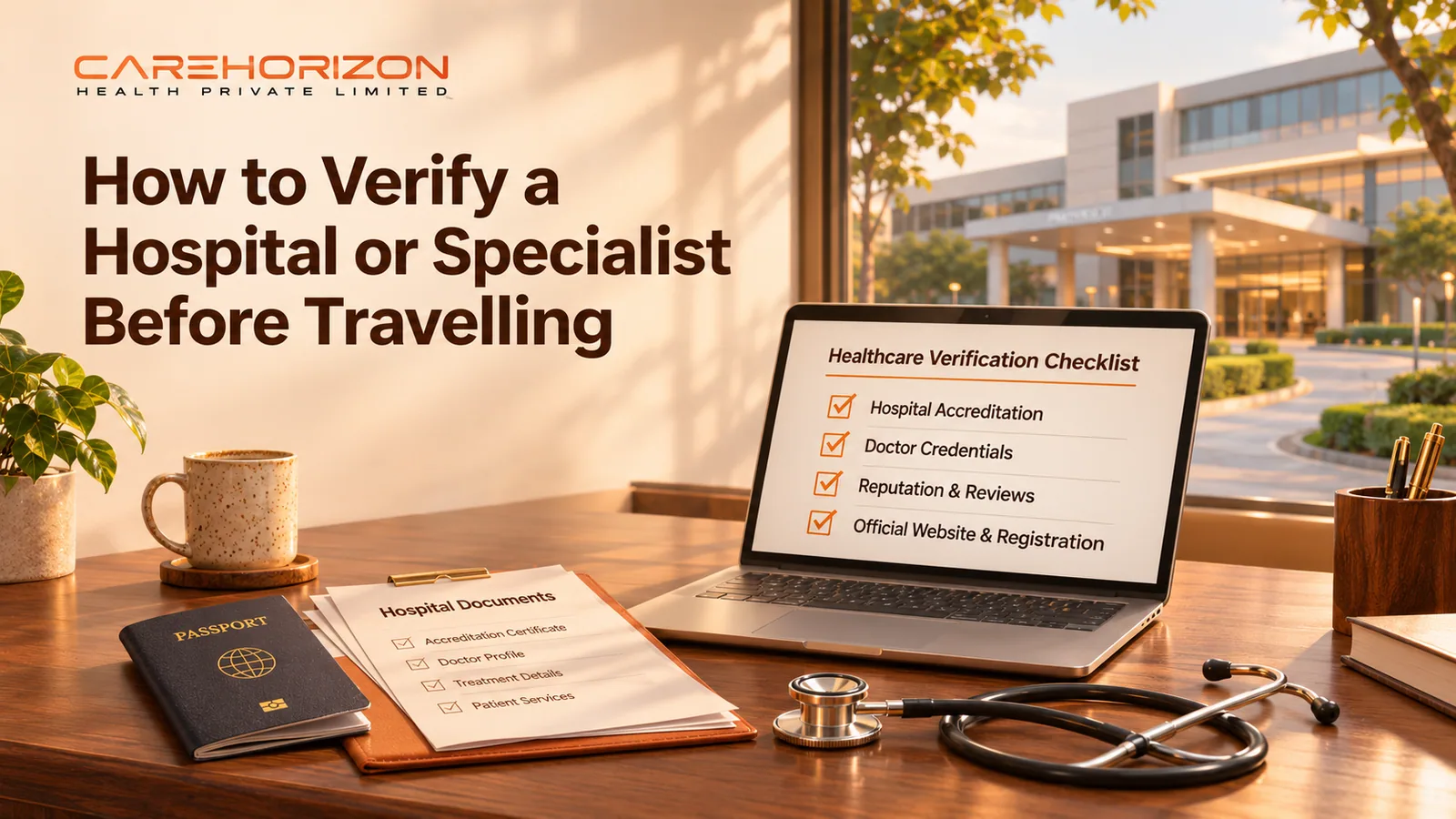
Hospital identity: exact legal name, campus address, independent telephone contact, correct website and treating department. Accreditation: relevant NABH or JCI programme, official current directory record, status and facility match.
Doctor: registered name, registration council and number, qualifications, specialty, current affiliation and whether the doctor will provide the proposed treatment. Clinical fit: diagnosis reviewed, services and emergency resources available, limitations and alternatives explained.
Financial: written estimate, exclusions, official bank beneficiary, deposit and refund terms. Continuity: authorised records sharing, consent process, airline and visa requirements where applicable, and named follow-up arrangements.
Frequently Asked Questions
How can I verify an Indian hospital before travelling?
Match the exact institution and campus against its official website, an applicable NABH or JCI listing, and direct hospital contact details. Also verify the services relevant to the patient's case.
How do I check NABH accreditation?
Use NABH's own healthcare organisation directory. Check the full facility name, address, programme and status, remembering that accredited, certified and empanelled are not interchangeable.
How can I confirm JCI accreditation in India?
Use Joint Commission International's official current directory and identify the exact organisation and programme, rather than relying on a logo in an advertisement.
How can I verify a doctor's registration in India?
Request the full name, registration number and council, then check the NMC National Medical Register and the relevant State Medical Council if needed.
What if the doctor is missing from the online register?
A missing result may reflect an incomplete or differently indexed record. Verify identifiers and contact the appropriate registration authority before drawing conclusions.
Does hospital accreditation guarantee safe surgery?
No. It indicates assessment against a programme's standards and does not replace an individual clinical assessment, qualified treating team or informed consent.
Can a hospital group have different accreditation at different branches?
Yes. Verify the specific legal entity, facility address, credential and services for the campus where the patient will actually receive care.
How do I know if a hospital website or payment link is genuine?
Find the official domain independently and confirm payment instructions using a published hospital billing contact, especially when account details unexpectedly change.
Should I rely on online ratings and patient testimonials?
They may provide context, but cannot replace independent registration, accreditation and clinical suitability checks.
Can a medical travel facilitator verify everything for me?
A coordinator may help organise questions and records, but official credential status must be checked with issuing bodies and the medical decision belongs to qualified clinicians.
Official References and Verification Links
- NABH — Find an Accredited Healthcare Organisation: https://nabh.co/find-a-healthcare-organisation/
- Joint Commission International — Find Accredited International Organizations: https://www.jointcommission.org/en/about-us/recognizing-excellence/find-accredited-international-organizations
- National Medical Commission — National Medical Register Search: https://nmr.nmc.org.in/search-doctor
- National Medical Commission — Indian Medical Register (data noted as being updated): https://www.nmc.org.in/information-desk/indian-medical-register/
- CDC Yellow Book 2026 — Medical Tourism and Provider Verification: https://www.cdc.gov/yellow-book/hcp/health-care-abroad/medical-tourism.html
- Government of India — Official e-Visa Portal: https://indianvisaonline.gov.in/evisa/
Medical, legal, financial and publication disclaimer: This article is general guidance for checking public information, not an accreditation decision, professional licence verification on behalf of any named individual, hospital endorsement, individual medical recommendation, guarantee of safety, visa approval or insurance determination. Registers can be updated or incomplete, so verify live status with the responsible issuing authority and the actual hospital before relying on a result. Qualified clinicians are responsible for diagnosis and treatment. Carehorizon coordinates practical arrangements around clinical care and does not issue regulatory credentials. Internal Carehorizon URLs come from the supplied site inventory and require live verification before publication.
Carehorizon Health coordinates medical travel, patient transfers and related arrangements. The information here is educational; it does not diagnose, prescribe, guarantee an outcome or replace advice from your treating medical team. Service availability, costs and travel requirements are confirmed case by case.