This article provides general information to support better planning. Individual medical decisions and fitness for travel require assessment by qualified treating professionals.
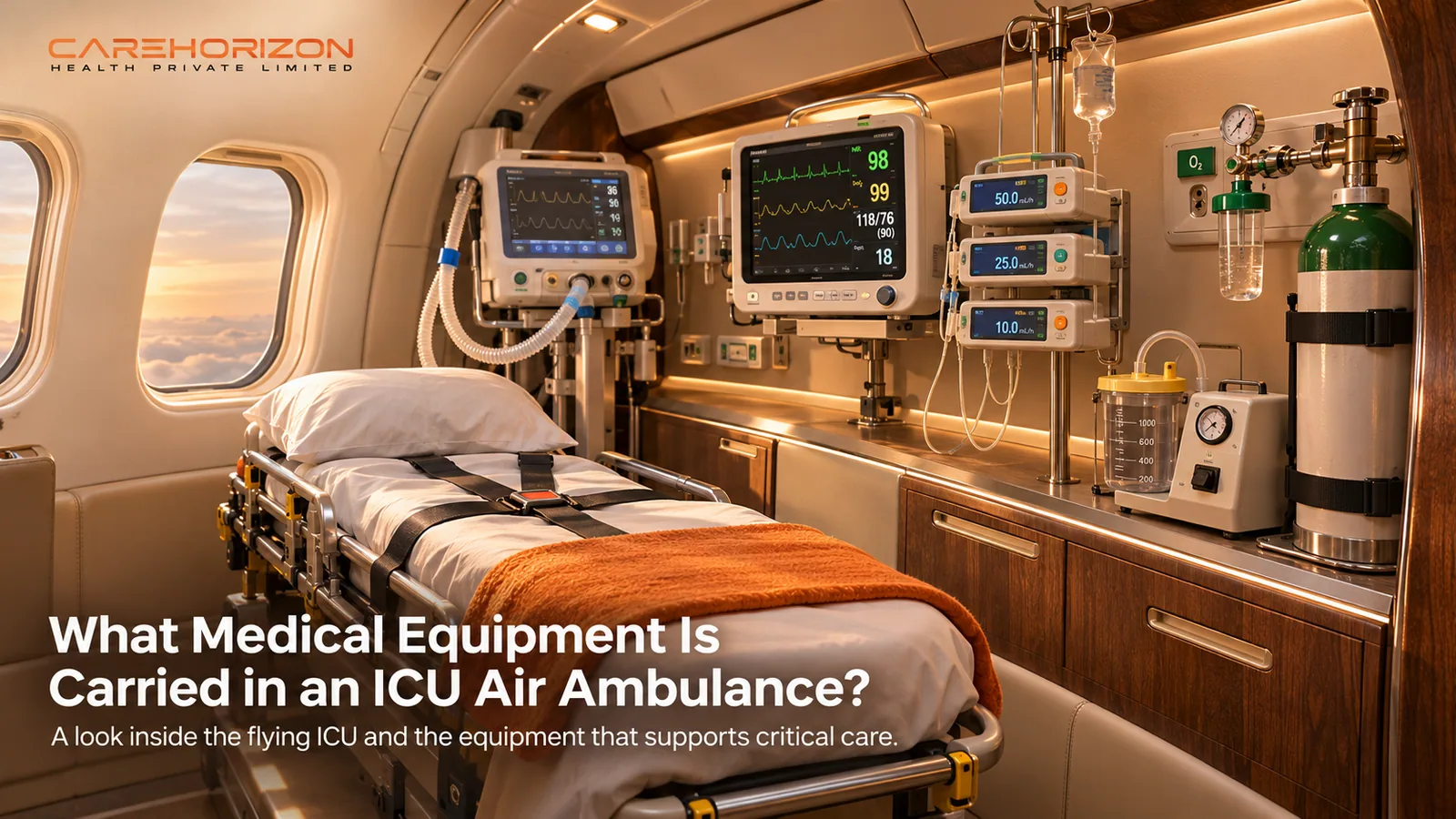
An ICU air ambulance is a medically configured aircraft intended to transport selected patients who need clinical supervision and, in some cases, advanced support during a journey. The air ambulance equipment used may include a transport ventilator, cardiac and vital-sign monitors, medical oxygen, infusion pumps, suction and emergency supplies. But the equipment carried is not identical on every flight: it depends on the patient's needs, the aircraft's capabilities and the qualified medical team assigned to the mission.
For a family arranging a transfer, knowing that an aircraft is described as a 'flying ICU' is not enough. The practical questions are which devices this patient requires, whether they are genuinely available and approved for use aboard that aircraft, and how the team will maintain treatment during loading, the flight and the ground ambulance journeys.
This guide explains the principal equipment categories, what they do, why aviation conditions matter and what to ask before booking a medical flight. It is not a universal packing specification or confirmation of equipment carried by any particular provider.
What Does 'Flying ICU' Actually Mean?
The phrase 'flying ICU' is commonly used for an aircraft equipped to provide selected functions associated with hospital critical care. An appropriate mission may support ventilation, continuous monitoring and intravenous medicines. It does not reproduce an entire intensive care unit: laboratories, imaging, operating theatres and additional specialist teams are generally unavailable during flight.
Aircraft size, power, oxygen capacity, cabin access and the qualifications of the transport team limit what can be done. The treating clinician and transport medical professionals should agree which interventions are necessary before choosing the aircraft. Families can see how these decisions fit into the full air ambulance transfer process.
1. Multiparameter Patient Monitor
A patient monitor displays selected vital signs so the clinical team can identify changes during movement and flight. A transport monitor may provide electrocardiogram (ECG) or heart-rhythm monitoring, pulse rate, oxygen saturation, non-invasive blood pressure and, where indicated and supported, invasive pressure measurements, temperature or end-tidal carbon dioxide.
The monitoring parameters depend on the patient's condition and devices already in use. For example, oxygen saturation and breathing observations may be particularly important for someone with respiratory illness, while a patient receiving certain cardiovascular medicines may need close attention to blood pressure and heart rhythm.
A monitor is only one component of care. The assigned professionals must understand its readings, recognise artefacts caused by movement or vibration, set appropriate alarms and respond to clinical changes. Families should ask which parameters will be monitored, whether alerts remain usable in the noisy aircraft cabin and who will interpret them.
2. Transport Ventilator for Patients Requiring Breathing Support
A transport ventilator can support breathing for selected patients who need mechanical ventilation. It may be used with an endotracheal tube, tracheostomy or certain non-invasive interfaces, depending on the patient's clinical plan and the ventilator's approved capabilities.
A ventilator air ambulance mission needs more than the ventilator itself. It requires appropriate oxygen and possibly air sources, a safe airway, compatible tubing, monitoring, battery or aircraft power, backup breathing arrangements and professionals trained in transport ventilation.
The team should confirm that the transport ventilator can deliver the prescribed support within its operating limits. A patient may need to be assessed on the transport system before departure. A hospital ventilator's settings and capabilities should not automatically be assumed transferable to any aircraft device.
Not every air ambulance carries every model or mode of ventilator, and not every ventilated patient is fit for air transport. Clinical stability and the team's ability to manage foreseeable problems remain central.
3. Medical Oxygen Supply and Backup Reserves
Medical oxygen can be essential for patients who need supplemental oxygen or respiratory support. An air ambulance may use approved aircraft oxygen systems or secured medical cylinders with appropriate regulators and delivery connections.
The required quantity depends on prescribed oxygen flow, ventilator consumption if applicable, journey length, loading and unloading time, ground legs and contingency allowances for delays or diversions. Oxygen planning should cover the entire clinical transfer, not merely the scheduled airborne time.
Cabin pressure and altitude considerations may also influence the patient's oxygen needs and the chosen flight profile. These decisions require clinical and aviation assessment. Families should ask whether sufficient primary and backup oxygen is available, who checks consumption and how oxygen support continues between vehicles.
4. Infusion Pumps and Syringe Pumps
Infusion pumps deliver prescribed fluids or medicines at a controlled rate. Syringe pumps are often used for smaller-volume, precisely regulated infusions. Depending on the patient, pumps may be needed for sedation, vasoactive medicines, pain management or other continuous therapies.
An ICU air ambulance may need several infusion channels for a medically complex patient, but a universal pump count should not be presumed. The number and type of pumps must match the prescribed treatments, and the team must have appropriate consumables and knowledge of their operation.
Pump safety includes correct programming, clearly labelled lines, battery capacity, secure mounting and an appropriate plan for changes during transfer. Aircraft vibration and movement make a loose device or poorly secured tubing a genuine safety concern. Families can ask whether all necessary infusions will remain uninterrupted from hospital to destination.
5. Portable Suction Equipment
Portable suction equipment can help remove secretions or fluids from the airway when clinically indicated. It may be particularly relevant for patients with an artificial airway or difficulty clearing secretions.
The team should have suitable catheters and collection systems, know the equipment's suction capability and ensure it works independently of hospital wall suction. Backup methods and power should be considered in case the primary unit is unavailable.
The need for airway suction is patient-specific. A family's role is not to select a suction model but to confirm that the required airway-care capability has been included in the agreed medical plan.
6. Defibrillator and Resuscitation Equipment
A portable defibrillator can deliver an indicated electrical shock for certain life-threatening cardiac rhythms. Some transport systems also combine defibrillation with monitoring or pacing functions, depending on the model and configuration.
An appropriately prepared transport team may carry resuscitation supplies such as a bag-valve-mask device, airway equipment, intravenous access supplies and selected emergency medicines. The exact kit reflects the scope of practice and patient population served.
Availability of equipment does not eliminate the challenges of resuscitation in flight. Aircraft space, securing equipment, clinical staffing and the ability to land or divert affect the response to a serious deterioration. These limitations should be part of the pre-flight assessment.
7. Airway Management Equipment
Airway equipment may include appropriately sized masks, breathing circuits, airway adjuncts, endotracheal tubes and tools for advanced airway management when required by the clinical mission. Teams managing patients with an established airway need supplies to secure and troubleshoot that airway.
Equipment should be matched to the patient's age, size and treatment needs. A paediatric patient, for example, may require different devices from an adult. The responsible clinicians should identify anticipated problems and whether the assigned team is trained and authorised to manage them.
8. Oxygen Saturation and Capnography Monitoring
Pulse oximetry estimates the oxygen saturation of blood and is commonly part of transport monitoring. Capnography measures exhaled carbon dioxide and can be valuable for selected patients receiving ventilation or sedation, according to clinical indications.
These devices provide information but have limitations. Motion, poor circulation and other conditions can interfere with readings. The clinical team must interpret them with the overall examination and other monitoring, rather than relying on a number alone.
A useful pre-transfer question is whether the proposed monitoring matches the patient's actual respiratory and airway risks, especially if ventilation or sedation will continue during transport.
9. Stretcher, Restraints and Patient Loading Systems
The patient's stretcher and the equipment used to secure it are part of medical transport safety. Aircraft-compatible stretchers, restraint systems, transfer mattresses and loading aids help the team position the patient and secure equipment during take-off, landing and turbulence.
A patient with spinal precautions, fractures, severe mobility limitations or pressure-injury risks may require special positioning and support. Loading arrangements should avoid dislodging lines, drainage tubes or the airway while maintaining necessary monitoring.
The full bedside-to-bedside pathway also includes ground ambulance stretchers and airport loading. See the guide to ground ambulances and airport coordination for why these changes between vehicles need advance planning.
10. Emergency Medicines and IV Supplies
A suitably equipped medical transport mission may require emergency medicines, prescribed ongoing treatment, intravenous fluids, cannulas, administration sets, dressings and other consumables. The selection should follow the care plan and the team's professional scope, not an assumption that every medicine is carried on every aircraft.
Medicines may require attention to labelling, storage, preparation and controlled administration. Temperature-sensitive or controlled medicines can introduce additional requirements. The transport team should understand which treatments continue, what must be available for emergencies and which medications have already been administered.
Families should not change doses or bring unapproved additional medicines for use in flight. The responsible professionals need accurate prescriptions and relevant medical records.
11. Portable Power, Batteries and Electrical Compatibility
Transport monitors, ventilators and infusion pumps can depend on electricity. The team's planning must account for each device's battery life, available approved aircraft power, adapters and the transition between hospital and ground transport power sources.
An aircraft does not necessarily support every hospital device or plug type. Electrical compatibility, aircraft approval and secure installation should be verified by the responsible providers. Backup power matters in a mission that includes loading, delays and possible diversions.
Families can ask whether the team's power calculation includes the full bedside-to-bedside duration, reasonable reserve and all prescribed devices operating at the same time.
12. Other Specialist Equipment: Only When Indicated
Some missions may require equipment beyond the commonly discussed monitoring and respiratory systems. Examples can include neonatal transport incubators, specialised patient warming, certain cardiac support devices or other high-acuity technologies. These are not universal air ambulance inclusions.
Complex devices such as extracorporeal support require specially qualified teams, appropriate aircraft integration and extensive clinical and operational planning. The existence of such technology in some transport programmes does not mean it is available for a particular journey.
The safest question is whether the proposed aircraft and team can support the patient's specific equipment and treatment—not whether a marketing brochure lists the most sophisticated possible devices.
How Equipment Requirements Change With the Patient's Condition
Respiratory illness or ventilation
Priority considerations may include airway care, oxygen supply, appropriate ventilation, suction, capnography and the team's ability to detect and respond to respiratory deterioration.
Cardiac or circulatory illness
Care may place particular emphasis on rhythm and blood-pressure monitoring, intravenous therapies and resuscitation readiness. Devices and medicines depend on the precise clinical condition and transfer plan.
Neurological illness or reduced consciousness
The team may need close observation of breathing, consciousness, airway protection, seizure risk and positioning. A diagnosis such as stroke does not automatically determine the equipment or whether flying is appropriate.
Neonatal or paediatric transport
Children and newborns may need age-appropriate equipment, specialised staffing, temperature support and carefully calculated medicines and oxygen. Suitable paediatric transport is a distinct capability that should be confirmed rather than assumed.
Why Aircraft Type and Cabin Conditions Affect Equipment
A helicopter and a fixed-wing medical aircraft have different cabin layouts, operating ranges, loading access and vibration or noise environments. Fixed-wing journeys may be longer and may involve additional ground transfers; helicopter operations are affected by suitable landing access and route constraints.
In either aircraft, medical devices must be secured and suitable for the environment. Monitoring screens and alarms need to remain usable, medical staff need enough access to the patient and the equipment must fit safely within the authorised configuration.
The choice between a domestic air ambulance mission and an international air ambulance mission also affects flight duration, refuelling, oxygen planning and the arrangements for handing over equipment at the destination.
How Are Equipment and Treatment Maintained During Ground Transfers?
The equipment plan must work outside the aircraft as well. At the sending hospital, some patients are transferred from fixed hospital devices onto portable monitoring and treatment systems. The team may then move the patient to a ground ambulance, load the aircraft, unload at the destination and transfer into another ambulance.
Every transition creates a possibility of interruption if oxygen, intravenous treatments or power supplies are not coordinated. WHO's interfacility transfer checklist emphasises securing attachments, checking monitoring and transport ventilation, ensuring adequate supplies and completing structured handover.
Families arranging a longer journey can review the documentation guide to understand which device settings, treatment details and patient observations should be communicated to the teams involved.
What Checks Should Be Completed Before Departure?
The responsible medical team should verify that the patient is suitable for the proposed transport and that prescribed devices are functional, adequately supplied and secured. Transport checklists may cover oxygen reserves, ventilator performance, monitor alarms, infusion therapies, suction, emergency medicines and battery charge.
Clinical handover from the sending hospital should include current status, treatment plan, important recent changes, allergies and contingencies. Staff should be familiar with the transport equipment and able to assess how it behaves in the aircraft environment.
The fitness-to-fly assessment and operational clearance remain separate decisions. Even fully prepared equipment does not guarantee that a patient is safe to move or that the flight can operate in the proposed conditions.
What Happens if a Device Fails in Flight?
Equipment failure is one of the foreseeable problems a competent transport plan should consider. The team may need backup oxygen, an alternative means of respiratory support, reserve batteries or replacement equipment, depending on the patient and the mission.
The exact response must be managed by qualified clinicians within the resources on board. An aircraft cannot immediately provide the same specialist response as a hospital. Serious changes may require diversion or landing, with flight decisions made by the aviation crew in coordination with the medical team.
Families should ask what contingencies are included for critical equipment, especially where a patient depends on continuous ventilation or infusions.
Is Air Ambulance Equipment the Same as Hospital ICU Equipment?
Some monitoring and treatment functions overlap, but transport equipment is designed to be portable, secured and usable during movement. It may have different performance limits and operating modes from larger hospital systems.
A hospital ICU can call on laboratory testing, imaging, bedside specialists and additional resources. These are not routinely available in flight. For this reason, clinical transport is an assessed transition between facilities, not a replacement for intensive-care treatment where the patient is currently hospitalised.
The correct aim is to maintain essential care during the necessary journey while managing foreseeable risk.
Does All This Equipment Affect the Cost of an Air Ambulance?
The medical configuration can affect the quote. A patient needing a transport ventilator, more extensive monitoring, additional infusions, specialist staff or equipment reserves may require a different mission setup from someone needing basic observation.
Flight distance, aircraft type, aircraft positioning, airport services, ground ambulances and timing are separate factors. A comparison should cover the complete bedside-to-bedside journey and specify which medical devices and team members are included.
For an international air ambulance transfer, longer sectors, technical stops and cross-border coordination may add complexity to oxygen, power and consumable planning.
Questions Families Should Ask About Air Ambulance Equipment
Ask for an equipment plan tailored to the patient's current condition: Which vital signs will be monitored? Is a ventilator required and suitable? How will prescribed oxygen be supplied during all stages? How many infusions must continue, and are appropriate pumps included? Who will operate the equipment and respond to changes?
Also ask about backup oxygen and power, airway or resuscitation capability, equipment security during loading, whether the same systems will be used in the ground ambulance and aircraft, and what happens if the journey is delayed.
The answers should come from the responsible clinical and transport professionals. An equipment list without the proposed team's skills and a confirmed care plan does not establish safe transport.
How Carehorizon Health Supports the Coordination Process
Carehorizon Health coordinates the journey around clinical care. For an air ambulance enquiry, this may include helping families collect medical information, understand the steps of a planned transfer and communicate practical requirements among healthcare and aviation providers.
The treating and qualified transport clinicians decide what equipment and staff are medically needed. The authorised aviation and medical transport providers remain responsible for the services and devices they operate. Read how Carehorizon works for the broader coordination approach.
For a transfer enquiry, use the Carehorizon enquiry page or contact +91 6292041222 or care@carehorizonhealth.com. In an immediate medical emergency, contact local emergency services and the treating hospital rather than waiting for a flight enquiry.
Frequently Asked Questions
Does every air ambulance carry a ventilator?
No universal onboard inventory should be assumed. The equipment and its capabilities depend on the provider, aircraft and patient. Confirm the prescribed respiratory support for the specific mission.
What is a patient monitor used for in an air ambulance?
A transport monitor displays selected vital signs such as heart rhythm, pulse, oxygen saturation and blood pressure so the medical team can observe changes during travel.
Are infusion pumps used during medical flights?
Yes, when prescribed treatments require controlled infusion. The number and type of pumps depend on the patient's care plan and the available transport setup.
How is oxygen supplied during a flight?
An authorised medical aircraft may use approved oxygen systems or secured cylinders with regulators. The team must plan enough oxygen for the complete journey and contingencies.
Can an ICU patient travel on a commercial airline with the same equipment?
Not automatically. Scheduled airlines impose separate medical-clearance, device and cabin restrictions. Some stable patients may qualify for an approved escort arrangement; others need a dedicated aircraft.
Does the air ambulance include defibrillation equipment?
Some configured medical transport missions carry a defibrillator or a combined monitor-defibrillator. Ask which resuscitation capabilities are provided for the patient's assessed needs.
How does equipment stay powered during ground transport?
Transport devices may use batteries or compatible approved vehicle power. The responsible team must manage power transitions and backups across every leg.
Are neonatal incubators available on all medical aircraft?
No. A neonatal transport incubator is a specialised capability requiring suitable aircraft and trained staff; it must be confirmed for the individual case.
Who decides which devices are required?
The treating doctor and relevant transport medical professionals determine the medical requirements, while the provider confirms whether its aircraft and personnel can meet them.
Is a flying ICU equivalent to a hospital ICU?
No. Some critical-care functions can be supported in transport, but an aircraft lacks many hospital resources. Transfer suitability requires case-specific clinical judgement.
Medical and Patient-Safety References
- Aeromedical Transport of Critically Ill Patients: A Literature Review (2021): https://pmc.ncbi.nlm.nih.gov/articles/PMC8180199/
- Indian Society of Critical Care Medicine, Position Statement on Intrahospital Transport of Critically Ill Patients (2025): https://pmc.ncbi.nlm.nih.gov/articles/PMC12045056/ — intrahospital guidance used for equipment and transfer principles, not an air-ambulance regulation.
- Transfer of the Critically Ill Adult Patient: https://pmc.ncbi.nlm.nih.gov/articles/PMC7807912/
- WHO, Interfacility Acute Transfer Checklist: https://cdn.who.int/media/docs/default-source/integrated-health-services-%28ihs%29/csy/prehospital/interfacility-transfer-checklist.pdf
- Air transport of patients with critical cardiac conditions requiring intensive care: https://pmc.ncbi.nlm.nih.gov/articles/PMC8412043/
- Aeromedical Society of Australasia, Aeromedical Standards (2020): https://www.aeromedsocaustralasia.org/img.ashx?f=f&p=standards_2020%2FASA_Aeromedical_Standards_Final_2020_.pdf
Medical and publication disclaimer: This article is for general information and is not a specification of Carehorizon-owned equipment, a guarantee of onboard capabilities or individual medical advice. The treating and transport clinicians determine fitness to fly and necessary equipment; the authorised operator must verify the aircraft's capabilities and aviation compliance. Carehorizon internal URLs came from the provided page inventory and require live-page verification before publication.
Carehorizon Health coordinates medical travel, patient transfers and related arrangements. The information here is educational; it does not diagnose, prescribe, guarantee an outcome or replace advice from your treating medical team. Service availability, costs and travel requirements are confirmed case by case.