This article provides general information to support better planning. Individual medical decisions and fitness for travel require assessment by qualified treating professionals.
International medical repatriation means arranging a medically appropriate return to a person's home country, or another agreed country of care, after illness or injury abroad. The paperwork is more than a passport and a doctor's letter. Families may need medical records, a documented transport plan, destination-hospital acceptance, travel and immigration documents, and flight-related approvals depending on the patient's condition, nationality, route and method of transport.
The exact medical repatriation documents are different for every case. A stable passenger returning with a nurse escort on a commercial flight may need airline medical clearance and approved equipment paperwork. A critically ill patient travelling on a dedicated air ambulance may require additional clinical handovers, aviation permissions, ground ambulance arrangements and specialist equipment information.
This guide groups the documents by purpose so families can understand which information is commonly needed, which may be conditional and who should prepare or approve it. Carehorizon's international air ambulance information explains the wider transport coordination process.
Four Categories of Documents to Prepare
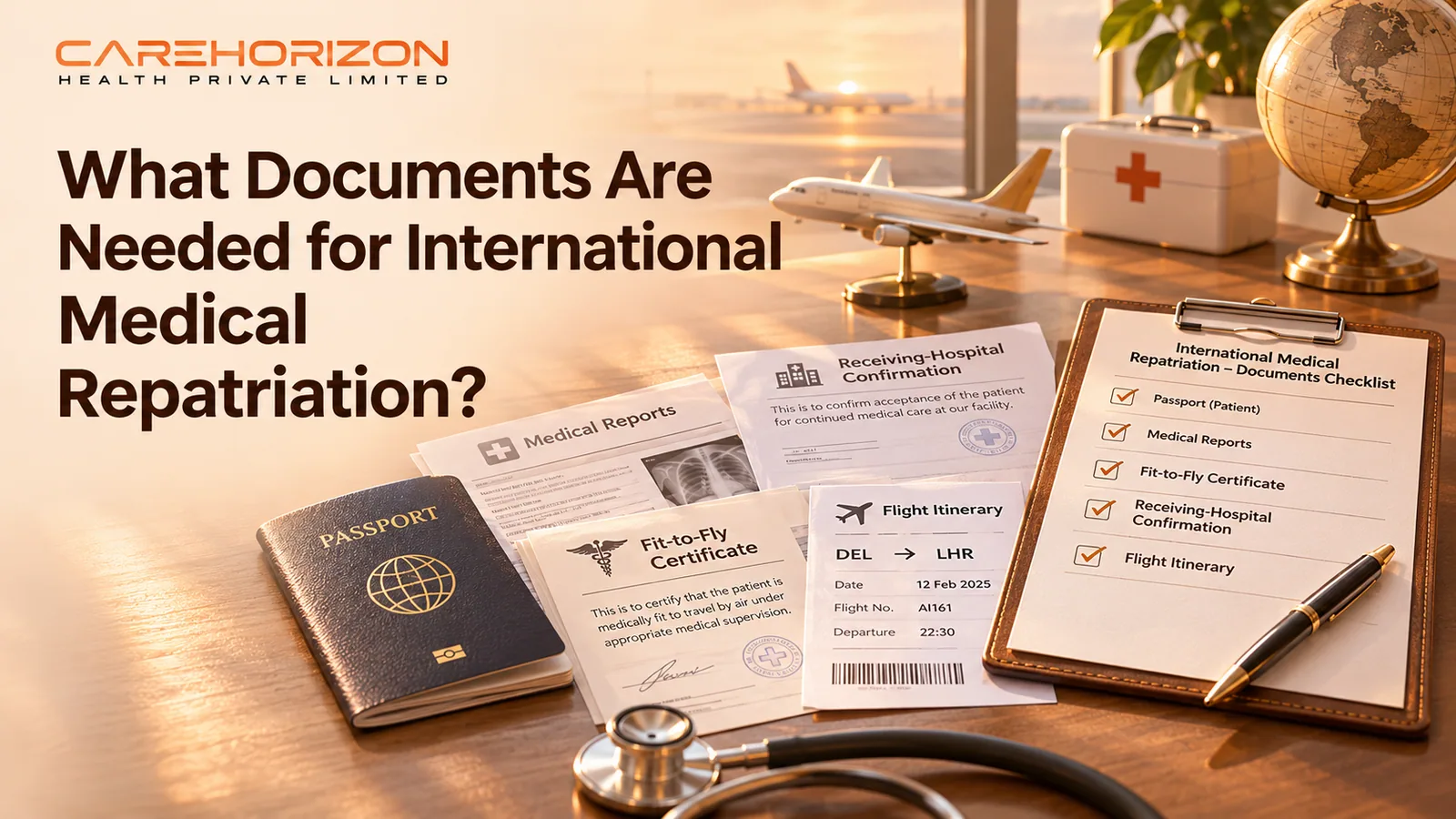
A practical repatriation file has four parts. Identity and immigration records establish who is travelling and whether they may depart, transit or enter the destination country. Clinical records explain the patient's condition and necessary care. Transport and aviation records establish how the journey will be operated. Receiving-care documents confirm where responsibility will pass at the destination.
Not every document is carried by the family. Aviation permits are generally arranged by the authorised operator, while some hospital papers are exchanged directly between clinical teams. Families should nevertheless know which confirmations are outstanding and keep contact details for the responsible party.
Most importantly, a complete file is not proof that a patient can safely fly. Fitness to travel and appropriate clinical support require current professional assessment.
1. Passport and Proof of Identity
For an international journey, a valid passport or other officially accepted travel document is usually fundamental. Check the patient's full name, date of birth, nationality, document number, expiration date and whether the document is physically available. The name used in medical records and reservations should be reconciled with the travel document where practical.
Passport validity requirements vary by nationality, destination and transit country. Do not assume one universal six-month rule. India’s official e-Visa portal, for example, sets a minimum six-month passport-validity requirement for eligible e-Visa applicants and requires a separate passport for each applicant.
If a passport has been lost, expired or cannot be collected from a hospital, contact the relevant embassy or consulate about an emergency travel document or replacement. An emergency passport may have different acceptance rules for transit and entry, so the full route must be checked before booking.
2. Visa, Residence Status and Permission to Enter
The patient and accompanying relatives or clinicians may require visas, valid residence documents, permits or other evidence of their right to enter the destination and transit countries. Requirements depend on passport nationality, immigration status and the proposed purpose of travel.
Repatriation to one's country of citizenship is not necessarily governed by the same visa rules as travelling to a foreign country for treatment. A foreign national travelling to India for planned treatment should check the relevant medical visa or other valid immigration category rather than assume that an emergency medical journey automatically waives entry requirements.
India's official e-Visa guidance describes an e-Medical category for eligible nationalities and calls for a letter from the receiving Indian hospital for certain applications. Eligibility and the exact supporting documents should be checked against the current government portal or Indian mission before applying.
For families arranging treatment in India for a non-Indian national, the medical visa information page in Carehorizon's site inventory provides a related planning pathway.
3. Treating Hospital Medical Report
A current clinical report from the sending hospital is one of the most important documents. It should explain the working diagnosis, reason for hospital admission, treatment already provided, recent clinical progress and present condition. Relevant information may include vital signs, oxygen needs, ventilation, infusions, allergies, mobility, infection precautions and foreseeable transfer risks.
The sending doctor should provide medical facts and a transport assessment to the qualified receiving and transport professionals. Older reports can supply background but may not reflect a recent deterioration or change in treatment.
The World Health Organization's interfacility acute transfer checklist emphasises current clinical condition, recent investigations, medicines and treatment plan, communication between clinical teams and confirmation that the receiving facility has agreed to accept the patient.
4. Discharge Summary or Transfer Note
The sending hospital may issue a discharge summary, referral letter or formal transfer note. The document should explain why the patient is leaving and what continuing care is expected. In some urgent transfers, a clinical transfer note may be prepared before ordinary discharge administration is complete.
Families should not insist on discharge before a safe transport plan is ready. The hospital's clinical and administrative process needs to align with the receiving facility and the transport team.
The guide to documents for hospital-to-hospital transfer offers a fuller explanation of the records that help maintain continuity of care.
5. Fit-to-Fly Assessment and Clinical Transport Clearance
A treating doctor's assessment should address whether the patient can tolerate the proposed journey, considering the route, cabin environment, current stability and medical support. A dedicated medical transport team may perform its own assessment to determine equipment, staffing and risk.
A generic note saying 'fit to fly' is not the same as airline approval or an assurance that every aircraft can support the patient. A person may be clinically suitable for a dedicated medical aircraft but not for a scheduled airline, or may require further stabilisation before any travel.
Carehorizon's fitness-to-fly assessment guide helps families understand how treating and transport clinicians consider patient-specific risk.
6. Receiving Hospital Acceptance Letter or Clinical Confirmation
When repatriation involves continuing hospital treatment, the destination hospital should confirm that the patient has been assessed for acceptance and that appropriate care can be provided on arrival. Depending on local practice, this may involve an admission letter, named physician confirmation, referral acceptance or documented communication between clinical teams.
The confirmation should identify the intended facility and relevant contact, the planned level of care, any admission conditions and whether the proposed timing is feasible. A tentative enquiry is not the same as a confirmed ICU bed or clinical acceptance.
For patients travelling to India for treatment, a receiving-hospital letter may also form part of the visa process. The official Indian e-Visa portal describes a medical visa support letter that includes the patient's name, nationality, passport number and tentative admission or treatment date. That immigration purpose is separate from a full clinical handover.
7. Recent Investigations, Imaging and Treatment Records
Transport and receiving clinicians may need recent blood tests, imaging reports, ECG findings, procedure notes or other information directly related to the patient's illness. Actual images can sometimes be more useful than a written report for specialist review, subject to secure transfer and local hospital processes.
The purpose is not to collect every record ever generated. It is to give the responsible teams enough reliable information to assess the patient and continue care safely. An organised chronology, current medication list and details of important changes can reduce repeated questions.
For a patient whose journey involves specialist treatment in India, the guide to sending medical records to hospitals in India offers related record-organisation principles.
8. Medication List, Prescriptions and Equipment Requirements
A current medication list should identify drug names, doses, routes and timing, alongside known allergies and relevant recent treatments. The transport team also needs details about oxygen requirements, ventilator settings if applicable, infusions, monitoring and any special devices.
Prescribed medicines crossing international borders may be subject to customs, security or controlled-substance requirements. Families should keep original prescriptions and medical explanations where appropriate and check the rules of departure, transit and destination countries. Do not assume that medicines accepted in one country can automatically be imported into another.
The medical team determines what drugs and supplies must travel with the patient. Families should not independently modify doses or substitute devices during the journey.
9. MEDIF for Commercial Airline Repatriation
If the patient is travelling on a scheduled commercial flight, the airline may require a Medical Information Form, or MEDIF, and additional physician documentation. The need depends on the medical condition and support requested, such as oxygen, a stretcher or a medical escort.
Air India's published requirements describe a signed and physician-certified MEDIF, a recent medical report and additional physician statements for specified oxygen, stretcher and device cases. Approval remains with the operating carrier and may require final verification at departure.
A MEDIF is generally not the same thing as a dedicated air ambulance operator's clinical assessment. The commercial-flight medical escort pathway explains how scheduled passenger travel differs from a dedicated medical mission.
10. Escort Details and Authorisation
A patient may be accompanied by a family member, nurse, doctor or other suitably qualified person depending on the clinical needs and carrier rules. The itinerary should name the accompanying people, identify their roles and ensure each has appropriate travel documents.
Some airlines require escort information as part of medical clearance, especially for stretcher cases. The escort's professional role, relevant skills and ability to manage the agreed care plan matter more than simply stating that 'medical staff' will travel.
Where a relative acts as the family contact or signs documents on the patient's behalf, the hospital or relevant authority may need evidence of the person's legal authority or an appropriate consent arrangement. A family relationship does not automatically establish power to make every clinical or financial decision.
11. Patient Consent, Family Authorisation and Data Sharing
Transport may require appropriate patient consent for the proposed transfer and the sharing of necessary medical information. If a patient cannot provide consent, the applicable law, hospital policy and authorised decision-making framework must be followed.
Families should ask the sending and receiving providers which consent or authorisation forms are needed and who is permitted to sign. Avoid treating an informal WhatsApp message from a relative as universally sufficient evidence.
Medical reports, identity documents and passport details are sensitive. Share them through secure, appropriate channels with people directly involved in assessment, transport and receiving care.
12. Air Ambulance Operator and Flight Permissions
A dedicated international medical flight may require aviation permits or authorisations for relevant overflight, landing, departure, arrival or technical stops, depending on the aircraft operator, countries and route. Other operational records can include aircraft and crew documentation, flight plan, insurance and airport handling arrangements.
These are usually the responsibility of the authorised aviation operator, not the patient's family. Families should ask what approvals have been obtained and what remains pending, but should not assume that a quotation or proposed departure confirms aviation clearance.
The requirements differ substantially between domestic air ambulance arrangements and cross-border missions. The domestic air ambulance information page offers a useful contrast.
13. Airport, Ground Ambulance and Handling Documentation
A fixed-wing air ambulance normally needs ground transport at the sending and receiving ends. The teams may need addresses, hospital contacts, transfer times, vehicle details, airport access arrangements and confirmation that suitable medical equipment can be used in each ambulance.
The receiving ground team needs to know the expected arrival and the level of care required. Equipment such as oxygen, monitoring or a transport ventilator cannot simply be assumed available because a vehicle has been labelled an ambulance.
The guide to ground ambulances and airport coordination explains why the airport-to-hospital stages are an essential part of the repatriation file.
14. Insurance, Assistance and Payment Records
If travel insurance, employer cover or an assistance company is involved, families may need a policy number, claim reference, medical reports, written approval, guarantee of payment or confirmation of who will cover the transport and receiving care.
Do not assume that a policy covers air ambulance transport, medical escort or repatriation. Coverage may depend on medical necessity, advance authorisation, exclusions, limits and the route. A family should seek confirmation from the insurer or assistance provider before relying on payment.
The guide to insurance for air ambulance and repatriation explains questions families can raise when reviewing the financial arrangements.
15. Death, Infectious Disease or Other Special Circumstances
Some situations involve additional public-health, documentation or legal requirements. For example, certain infectious-disease risks may affect transport eligibility, protective measures and border processes, while evacuation during a public-health emergency may involve special government procedures.
Transporting human remains is a different process from medical repatriation of a living patient and may involve death certificates, consular documents and permits. Those requirements should not be presented as standard paperwork for a living patient transfer.
Families should ask the appropriate clinical, consular and transport authorities whether any additional case-specific permissions are required.
Commercial Flight vs Dedicated Air Ambulance: Different Paperwork
Commercial airline with medical escort
Documents often centre on identity, valid immigration status, tickets, physician assessment, airline medical clearance, MEDIF if required, approved devices, escort information and relevant ground transport. The airline controls passenger acceptance and cabin equipment rules.
Commercial airline stretcher
A stretcher request can add medical and operational approval, compatible aircraft availability, seating and escort conditions, and supporting physician information. It is not automatically offered on every flight.
Dedicated international air ambulance
In addition to clinical and travel documentation, the operator may need route-specific aviation permits, crew and aircraft arrangements, airport handling and specialist medical equipment planning. Families should verify clinical acceptance and bedside-to-bedside coordination separately.
Repatriation to India: What Changes?
An Indian citizen returning to India generally follows the travel-document rules applicable to Indian nationals, while a foreign national entering India may require an appropriate visa or entry status. Eligibility for India's e-Medical visa depends on nationality and the applicable official scheme.
The official Indian e-Visa portal states that e-Medical applications for eligible travellers include a hospital letter showing details such as the patient's passport number and tentative admission or treatment date. It also explains passport validity and other application conditions. These requirements concern a particular visa category, not every return journey by an Indian citizen.
If a patient is returning from abroad after hospital treatment, the guide to bringing a patient home to India from abroad can help the family plan the receiving-care arrangements.
A Practical Document Checklist for Families
Identity: Confirm the patient's passport or accepted travel document, nationality, visa or entry status, and corresponding travel documents for each companion or escort.
Clinical: Collect a current medical summary, relevant investigations, medicine list, treatment and equipment details, transport fitness assessment, and the sending clinician's contact information.
Destination: Obtain receiving-hospital acceptance where hospital care is needed, the destination address, responsible clinical contact and a handover plan.
Transport: Confirm aircraft or airline details, approved medical assistance, ground ambulances, any required MEDIF, route permissions and the appropriate team's responsibilities.
Administration: Identify consent or legal-authorisation documents where necessary, insurance and payment confirmations, and one family contact who can respond to questions without delaying the clinical team.
This checklist is a planning aid, not a claim that every item is legally mandatory in every country.
How to Organise the File Without Losing Important Information
Create a concise document index with the patient's name and case reference, the latest version of each clinical report and a contact list for the sending hospital, transport team, airline or aircraft operator, receiving hospital and family coordinator.
Keep original identity documents readily accessible, and maintain secure copies of relevant reports where lawful and appropriate. Label each medical document with its date so the transport team can distinguish current observations from older information.
Use the guide to what families should know on transfer day to prepare for the final confirmation and handovers.
What Most Commonly Delays the Document Process?
A missing or expired passport, unclear visa status, outdated medical summary, incomplete physician assessment, unconfirmed receiving bed or missing aviation permission can delay the proposed journey. The effect depends on which step is incomplete.
Differences in spelling across passport, ticket and hospital records may also need correction. Where the patient cannot consent, uncertainty about legal authority to sign forms can create additional questions.
The most effective approach is to identify the responsible person for each document and distinguish papers already issued from approvals that remain pending. Never substitute an informal assurance for a required clinical or government decision.
Who Should Prepare Each Document?
The patient or authorised representative supplies identity and relevant personal travel information. The sending clinicians prepare current medical reports and treatment information. The receiving hospital confirms acceptance and intended care. Airline medical teams review MEDIF requests, while the authorised air ambulance operator arranges applicable aviation permissions.
An insurer or assistance provider assesses coverage under its own rules. A coordination company can help organise communication and logistics, but does not replace the professional or statutory authority of those parties.
Families should request one consolidated status summary while keeping clinical and personal information limited to the people who need it.
How Carehorizon Health Helps Coordinate International Repatriation
Carehorizon Health coordinates the practical journey around clinical care. For international medical repatriation enquiries, that may include helping families organise relevant information and align communication among sending and receiving hospitals, transport professionals, aviation or airline providers and ground teams.
Treating and transport clinicians determine medical suitability and required support. Airlines and aviation operators manage their own safety and approvals; immigration authorities make entry decisions. See how Carehorizon works for more about its coordination role.
For a potential transfer, use the Carehorizon enquiry page, call +91 6292041222 or email care@carehorizonhealth.com. If a patient needs immediate medical treatment, seek local emergency medical assistance rather than waiting for travel arrangements.
Frequently Asked Questions
What are the most important medical repatriation documents?
Usually a valid travel document, current medical summary, relevant transport assessment, appropriate entry or transit documentation and receiving-care confirmation are central. The full set depends on the case.
Does an Indian citizen need a medical visa to return to India?
An Indian citizen normally does not need an Indian medical visa to enter India, but must have appropriate travel documentation and comply with departure or transit requirements.
Is a fit-to-fly certificate enough for international repatriation?
No. The patient may also need airline or transport-provider approval, immigration documents, receiving-hospital acceptance and ground coordination.
Is MEDIF required for a dedicated air ambulance?
MEDIF is commonly used by scheduled airlines for medically assisted passengers. A dedicated medical aircraft may instead use its own clinical assessment and operator documentation.
Does the receiving hospital need to accept the patient?
For a hospital-to-hospital transfer, receiving acceptance and appropriate care arrangements should be confirmed before departure.
Who arranges overflight and landing permits?
The authorised aviation operator or its permitted representative normally handles required aviation permissions; the family should request status updates.
Can relatives submit medical records for the patient?
That may be possible where the patient has authorised sharing or another lawful basis applies. The hospital and relevant laws determine what permissions are needed.
What if the patient's passport is lost abroad?
Contact the relevant embassy or consulate about replacement or emergency travel documentation, and confirm acceptance for all transit and destination countries.
Are insurance documents compulsory?
Not universally, but they are important when an insurer or assistance provider is expected to approve or pay for the transfer.
Can documents be reused if the flight is delayed?
Some records remain useful, but medical assessments, airline approvals, permits and destination arrangements may need updating if the patient's condition or itinerary changes.
Official and Clinical References
- Government of India, Official e-Visa Portal and e-Medical Visa Requirements: https://indianvisaonline.gov.in/evisa/
- World Health Organization, Interfacility Acute Transfer Checklist: https://cdn.who.int/media/docs/default-source/integrated-health-services-%28ihs%29/csy/prehospital/interfacility-transfer-checklist.pdf?sfvrsn=577281dc_2
- Air India, Medical Needs and Clearance Requirements: https://www.airindia.com/content/air-india/in/en/travel-information/health-medical-assistance/medical-needs-clearance.html
- UK Civil Aviation Authority, Getting Medical Clearance to Fly: https://www.caa.co.uk/air-passengers/about-your-trip/health-and-medical/getting-medical-clearance-to-fly/
- Airports Authority of India, Aeronautical Information Publication: https://aim-india.aai.aero.in/
- International Air Transport Association, Timatic (travel-document requirements information): https://www.iata.org/en/services/compliance/timatic/
Medical, immigration and publication disclaimer: This article is general information, not patient-specific medical, legal or immigration advice. Treating and transport clinicians determine medical suitability; authorised aviation operators and airlines handle their approvals; immigration authorities decide entry eligibility. Requirements differ by nationality, route, carrier and current regulations. Carehorizon internal URLs are drawn from the supplied inventory and should be verified as live before publication.
Carehorizon Health coordinates medical travel, patient transfers and related arrangements. The information here is educational; it does not diagnose, prescribe, guarantee an outcome or replace advice from your treating medical team. Service availability, costs and travel requirements are confirmed case by case.