This article provides general information to support better planning. Individual medical decisions and fitness for travel require assessment by qualified treating professionals.
A commercial airline stretcher allows an eligible passenger who cannot sit upright for an ordinary flight to travel lying down in an approved stretcher installation on a scheduled aircraft. The cost is not comparable to a single economy ticket. It can involve an airline-specific stretcher fare, cabin space reserved for the installation, medically necessary escorts, medical clearance, oxygen or approved devices, airport handling and ground ambulances at both ends.
There is no reliable fixed commercial airline stretcher cost for every route, airline or date. Even where an airline publishes service rules, the payable fare and additional charges depend on availability, the number of flight sectors, staffing, the patient's condition and the scope of the arrangement. A quote that covers only the airline stretcher is not the same as an estimate for a complete hospital-to-hospital transfer.
This guide explains the cost drivers, what airlines may require, why quotations differ and when a dedicated air ambulance may be more appropriate. For a broader comparison of transport options, see Carehorizon's guide to air ambulance versus commercial medical escort.
What Is a Commercial Airline Stretcher?
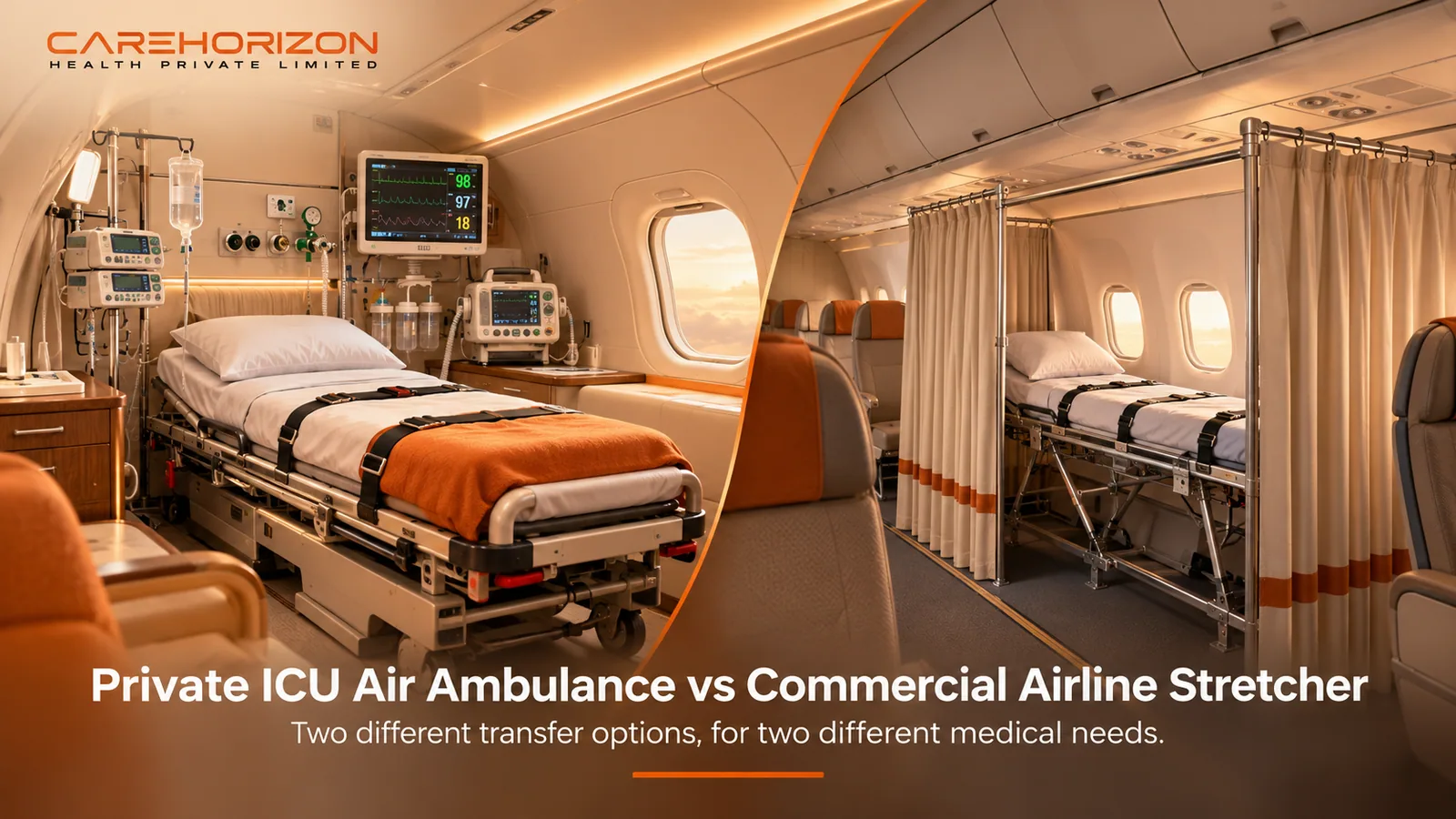
A commercial airline stretcher is an airline-approved arrangement for a passenger to remain lying down during a scheduled flight. It is different from an ordinary reclining seat or extra-legroom purchase, and a passenger may need continuous assistance or medical supervision according to their condition and the airline's requirements.
The airline controls whether the request is accepted, which aircraft and sectors can accommodate the installation and how it is booked. The arrangement does not make the cabin equivalent to an intensive care unit. A critically ill patient who needs complex organ support may require dedicated medical transport or further stabilisation instead.
Air India's published stretcher policy, for example, states that the service is subject to availability and medical clearance and is permitted on Air India-operated sectors only. These are Air India rules, not a universal international standard. The medical escort service page explains a related but distinct form of assisted travel.
Why Is a Stretcher Flight More Expensive Than a Regular Ticket?
A stretcher occupies more cabin space than one passenger seat and involves special aircraft preparation, approval and handling. Airlines may charge a particular stretcher fare or account for several seats in their commercial pricing. The exact calculation is airline-specific; families should not assume one fixed number of seats or a universal seat-multiplier formula.
Additional costs can arise from the escort's flight ticket, professional fees, approved oxygen, the patient's ground transport and assistance at the airport. A transfer involving multiple flight sectors may require separate stretcher charges and approvals.
The family should request an itemised proposal showing the airline's stretcher component separately from medical services and ground logistics. Comparing only the airfare can conceal a material part of the total cost.
1. The Airline's Stretcher Fare and Cabin Space
The first cost driver is the carrier's fare for accommodating a stretcher. The charge reflects its specific rules, available cabin configuration and flight-sector pricing. Different airlines can use different commercial models, and some may not offer a stretcher service on the requested flight or aircraft.
Air India states that its stretcher fares are charged per flight segment, that bookings are one-way, and that the stretcher must be reserved through Air India offices. It also states that only one stretcher case is permitted per flight and that stretcher installation is limited to economy class on eligible services.
These restrictions matter commercially because the family cannot assume that an online economy fare represents the stretcher price or that a cheaper connection is automatically available for a stretcher passenger.
2. Route, Flight Sectors and Connections
A direct flight may involve one stretcher service arrangement; an itinerary with a connection may require separate airline approval and sector charges. Each aircraft must be capable of accommodating the stretcher under the operating carrier's rules.
Longer routes, additional sectors, available flights and changes in travel date can alter airfare and other service costs. A connection can also introduce transfer logistics that are physically demanding for a patient who must remain lying down.
Ask for the actual flight numbers, operating airlines, airports and sectors covered by the quote. Codeshare flight numbers do not guarantee that the operating airline will accept the stretcher or another carrier's medical clearance.
3. Aircraft Availability and Stretcher Configuration
A proposed airline may offer stretcher travel in principle but not on every departure. Cabin layout, maintenance, route configuration and existing confirmed medical requests can affect availability.
Where only one stretcher case is permitted per flight, availability is a distinct constraint from ordinary economy seats remaining for sale. The airline may need to confirm special arrangements before issuing a booking.
If availability changes, the family might need a different date, route or medical transport option. That can affect accompanying professional fees, ground ambulances and expected hospital admission timing.
4. The Medical Escort's Professional Fees
The escort is the qualified professional responsible for the prescribed assistance within their agreed scope. Whether a nurse, physician or another appropriately trained professional is needed depends on clinical assessment and airline rules.
An escort fee may reflect preparation, medical review, the time spent accompanying the patient, international travel, waiting periods and return travel where applicable. The escort's own airline ticket can be a separate item.
A professional title does not automatically determine suitability. Ask what medical observations, medicines, mobility support or foreseeable interventions the escort can manage and what support they cannot provide in a commercial cabin.
5. Accompanying Family Member or Adult Attendant
Some airlines require an accompanying adult for stretcher passengers. Air India, for example, states that a non-disabled adult passenger must accompany the stretcher traveller and attend to their medical needs. Its rules allow the accompanying adult to be booked on the same reservation or separately, subject to applicable fares.
The required arrangement may differ from a medically qualified escort and must be clarified with the airline. A relative is not automatically a substitute for clinically necessary professional support.
The quotation should identify each accompanying traveller, their fare, whether they travel in the same cabin and who is responsible for hands-on medical care.
6. Airline Medical Clearance and MEDIF
Medical clearance is an essential operational step rather than a price that can simply be paid to bypass clinical restrictions. Airlines may require a Medical Information Form, commonly called MEDIF, completed by the treating physician and reviewed by the airline's medical department.
Air India states that stretcher travellers must submit a MEDIF with physician certification and a passenger declaration. Its medical information guidance requests recent, relevant documents up to five days before departure, and its stretcher page says separate MEDIF forms are required for separate flight sectors.
Additional reports or specialist statements may be needed, particularly where oxygen or devices are involved. Airlines retain the decision whether to accept the passenger even after a booking request is made.
7. Oxygen, Medical Devices and Consumables
Some passengers need additional oxygen or approved medical equipment throughout the journey. Charges depend on the airline's service, the prescribed needs, consumables and whether an escort or provider brings permitted devices.
Air India's published medical assistance page, for example, lists separate charges for certain oxygen masks and cylinders, and requirements for approved portable devices and sufficient battery capacity. Those figures are specific to the airline's published terms and should not be treated as a universal stretcher package price.
The treating doctor and airline must agree on how necessary care will be provided. Families should never assume that a personal oxygen cylinder or any hospital device can simply be carried onto a flight without permission.
8. Ground Ambulances and Bed-to-Bed Transfer
A patient who needs to remain lying down may require a suitably equipped ground ambulance from the sending hospital to the departure airport and another from the arrival airport to the receiving hospital or other care setting.
These road legs can involve medical professionals, stretcher handling, oxygen, monitoring and access to airport loading areas. They may be quoted separately from the airline's stretcher fare.
The guide to ground ambulances and airport coordination explains why transport quality depends on the complete journey, not only on the time in the air.
9. Airport Handling, Loading and Special Assistance
The airport process can require advance instructions for wheelchair or stretcher movements, access to approved loading equipment and coordination with airline ground staff. The patient may have limited ability to wait, transfer seats or tolerate repeated movement.
Handling and special assistance charges depend on the airport and carrier. Families should establish who manages the physical transfer, whether any special handling is included and how long the patient may need to remain at the airport.
A scheduled airline has security, check-in and boarding requirements that differ from a dedicated medical aircraft. These steps should be incorporated into the patient's medical and logistics plan.
10. Domestic Versus International Stretcher Flights
International itineraries add passport, entry and transit rules, possible changes of airline, travel for escorts and sometimes extra ground arrangements. Immigration documents and medical clearance are separate approvals.
A domestic flight may still require a suitable aircraft and advance medical acceptance. International distance alone does not tell the whole story: available nonstop routes and each carrier's stretcher eligibility may be more important.
For cross-border journeys, Carehorizon's international air ambulance pathway describes the related repatriation planning considerations when a dedicated aircraft is needed.
11. Timing, Urgency and Booking Lead Time
A stretcher arrangement is rarely as simple as buying the next available seat. The airline needs information about the patient's condition, the proposed flight, medical equipment and required escort. A formal review may be necessary before ticketing can be finalised.
Medical urgency does not obligate a commercial airline to accept a passenger or waive safe operating rules. Air India's published advice asks for a MEDIF and supporting medical documents in advance; families should verify the current process with the operating carrier.
A change in the patient's condition can make an earlier assessment obsolete. The family should avoid non-refundable arrangements until the relevant parties clarify their approval and cancellation terms.
12. Cancellation, Rescheduling and Refund Conditions
Stretcher reservations may be subject to special cancellation terms distinct from ordinary tickets. Air India's public stretcher guidance, for example, describes specific cancellation conditions for domestic, SAARC and international sectors.
An escort or ambulance provider may separately have mobilisation, rescheduling or cancellation provisions. Airline refunds, professional fees and ground transport costs should not be combined into a vague assurance of a full refund.
Before paying, ask which items are refundable, what happens if medical clearance is refused, and whether a new MEDIF or equipment review is required after changing flights.
How Is the Total Stretcher Flight Cost Calculated?
A useful quotation separates airline stretcher carriage, accompanying passenger tickets, professional escort fees, approved oxygen or devices, departure ground ambulance, airport handling, arrival ambulance and additional services. Taxes, currency conversion and waiting expenses may also matter.
There is no single universal formula for these costs because airlines and providers define their products differently. A quotation may include some elements and omit others, so two totals should only be compared after confirming their actual scope.
A written quote should show what is confirmed by the airline and what is conditional on subsequent medical clearance, seat configuration or ground-service availability.
A Worked Example Without Invented Prices
Consider a patient who cannot sit upright following hospital treatment but whose doctors believe a scheduled commercial flight could be appropriate with medical assistance. The airline confirms that a stretcher installation might be available on one nonstop sector, subject to its medical review.
The family's final budget would need to cover the airline's stretcher fare, the approved accompanying arrangement, the medical escort's professional fee and tickets where relevant, and suitable road ambulances at departure and arrival. Oxygen, devices or specialist handling may add to the scope.
Now imagine the same route requires a connection. Additional approval and potentially additional sector charges, patient handling and escort time could change the total. This illustrates cost drivers, not a specific fare or medical recommendation.
When Is an Airline Stretcher Appropriate?
The treating doctor and relevant transport clinicians should assess the patient's ability to tolerate the proposed cabin environment, transfer movements, flight duration and available assistance. The operating airline must then review and accept the request.
A stretcher may be considered for selected patients who need to remain lying down but can safely receive the level of care available on a scheduled airline. It should not be chosen solely because it appears cheaper than a dedicated aircraft.
The fitness-to-fly guide explains why a diagnosis alone does not determine whether a patient can take a particular kind of flight.
When Might a Dedicated Air Ambulance Be More Suitable?
A dedicated aircraft may be considered where the patient needs a more intensive clinical configuration, greater access for medical professionals or support that the scheduled airline cannot approve or accommodate.
Not every critically ill patient is suitable for transfer, even in a dedicated aircraft. The clinical team must weigh the risks and benefits, and the aviation operator must confirm feasibility.
The guide to who should use an air ambulance and the air ambulance process can help families understand how dedicated medical transport differs from standard airline arrangements.
Commercial Stretcher vs Dedicated Air Ambulance: A Cost Comparison
A commercial stretcher uses an existing passenger service with the airline's special installation and approvals. A dedicated air ambulance may require chartering an entire aircraft, paying for aircraft positioning, the transport medical team, equipment, route permissions and additional airport arrangements.
For a medically suitable passenger, an airline stretcher can sometimes have a lower overall cost than a dedicated aircraft. But this is not assured, particularly when several sectors, escorts, oxygen and complex ground transfers are required.
The correct order is clinical suitability first, airline or operator approval second, full-cost comparison third. Comparing a commercial stretcher against an ICU mission for a patient who needs intensive care is not a fair or safe economic comparison.
Does Insurance Cover a Commercial Airline Stretcher?
Some health or travel policies may cover medically necessary transport, escorts or repatriation under specified conditions, but coverage is not universal. Insurers can limit destinations, transport methods, reimbursement amounts or require advance authorisation.
Do not assume that a policy providing air ambulance benefits also pays for commercial airline stretchers, or vice versa. Seek a written insurer or assistance-company decision on the actual proposed itinerary and supporting care.
The guide to insurance for air ambulance and repatriation explains how to review benefit wording, approval requirements and reimbursement documents.
What Documents Are Usually Needed?
The operating airline may request a completed MEDIF, current medical report, physician certification, equipment details and information on accompanying adults or clinicians. Travel documents for the patient and escort must also meet entry and transit rules.
The sending and receiving clinical teams may need a transfer summary, medication list, investigations and confirmation that an appropriate destination is prepared. The necessary paperwork depends on the patient and route.
The guide to hospital-to-hospital transfer documents offers a useful clinical information checklist.
Questions to Ask Before Accepting a Stretcher Quote
Which airline actually operates each sector? Is its stretcher configuration available and approved for this flight? How is the stretcher fare calculated, and which additional passenger tickets are required?
What MEDIF and medical reports are needed, when is the airline's final decision expected, and what conditions apply to oxygen, equipment or escorts? Which qualified professionals will accompany the patient and what is their role?
Are airport handling, two ground ambulance legs, hotel or travel expenses for escorts, taxes and cancellation fees included? If the airline refuses clearance or changes the aircraft, what happens to the booking and payments?
Avoid These Common Quotation Mistakes
Do not compare one provider's airline stretcher fare with another provider's entire bed-to-bed package. Do not assume that normal airline tickets can simply be purchased and converted later into a stretcher booking.
Avoid treating an airline's general policy as a confirmed offer for the specific route. Availability may be limited, and medical clearance can be refused. A coordinator's estimate is not the carrier's formal approval.
Do not ignore the arrival ambulance or receiving-hospital plan. A flight may be affordable but clinically impractical if ground care and the receiving setting are not prepared.
What Families Can Prepare to Obtain a Reliable Quote
Collect a recent clinical summary, treating doctor's contact, intended departure and arrival cities, travel dates, need to remain lying down, oxygen or other equipment requirements and the proposed receiving hospital.
Identify who might accompany the patient and confirm the travel documentation of all travellers. Share sensitive medical records through appropriate secure channels with the responsible medical and airline teams.
Ask whether a medical escort on a regular seat could be suitable if the treating clinician and airline agree, but do not independently substitute an ordinary ticket for a clinically indicated stretcher.
How Carehorizon Health Helps Coordinate Medically Assisted Flights
Carehorizon Health coordinates the practical journey around clinical care. For a potential commercial stretcher transfer, coordination may involve organising the required information and aligning communication among medical professionals, the operating airline, ground ambulance teams and receiving care providers.
Treating and transport clinicians assess medical suitability. Airlines decide whether the proposed stretcher, escort and equipment arrangements can be accepted, and the relevant service providers operate the travel and care they supply. Read how Carehorizon works for an overview of its coordination role.
For a potential medically assisted transfer, use the Carehorizon enquiry page, call +91 6292041222 or email care@carehorizonhealth.com. In an immediate medical emergency, seek local medical assistance rather than waiting for airline clearance.
Frequently Asked Questions
How much does a commercial airline stretcher cost?
There is no standard price across airlines. The full cost may include the airline's stretcher fare, escorts, oxygen, equipment, airport handling and ground ambulances.
Is a stretcher charged as multiple seats?
Airlines use their own pricing arrangements. Cabin space and seat displacement can affect the fare, but there is no universal seat multiplier that applies to every carrier.
Does Air India offer stretcher flights?
Air India publishes stretcher service rules for eligible Air India-operated sectors, subject to availability, MEDIF and medical clearance. Confirm the actual route and current terms with the airline.
Does each connecting flight incur another stretcher charge?
It can. Air India explicitly describes per-sector stretcher fares. Other operating carriers may have different policies and each sector may need approval.
Is a nurse or doctor required?
The required escort arrangement depends on the patient's assessed needs and airline rules. A companion adult and a qualified clinical escort are not always interchangeable.
Can I book a stretcher online like an ordinary ticket?
Do not assume so. For example, Air India requires stretcher bookings through its offices and special medical clearance.
Is airline MEDIF mandatory?
Where the carrier requires MEDIF for a stretcher passenger, it must be completed and approved. Requirements and timing are airline-specific.
Are oxygen and ground ambulances included?
Not automatically. Request separate confirmation of oxygen, equipment, airport handling and both ground transfer legs.
Is an airline stretcher cheaper than a dedicated air ambulance?
Sometimes for a medically suitable passenger, but not invariably. Compare complete, clinically appropriate transport arrangements rather than headline prices.
Does travel insurance reimburse stretcher flight costs?
Coverage depends on the actual policy and approval conditions. Obtain written confirmation from the insurer or assistance provider before relying on reimbursement.
Official Airline and Medical References
- Air India, Travellers Requiring Stretchers — eligibility, per-segment fares, booking and MEDIF: https://www.airindia.com/in/en/travel-information/health-medical-assistance/medical-needs-clearance/stretcher-requirement.html
- Air India, Medical Needs and Clearance Requirements — medical reports, devices and oxygen: https://www.airindia.com/content/air-india/in/en/travel-information/health-medical-assistance/medical-needs-clearance.html
- Air India, Medical Information Form (MEDIF) — submission and approval: https://www.airindia.com/content/air-india/in/en/travel-information/health-medical-assistance/medical-information-form.html
- Air India, Health and Medical Assistance FAQ — advance submission and stretcher restrictions: https://www.airindia.com/in/en/frequently-asked-questions/health-and-medical-assistance.html
- UK Civil Aviation Authority, Getting Medical Clearance to Fly — airline decision-making: https://www.caa.co.uk/air-passengers/about-your-trip/health-and-medical/getting-medical-clearance-to-fly/
- World Health Organization, Interfacility Acute Transfer Checklist — receiving care and transfer readiness: https://cdn.who.int/media/docs/default-source/integrated-health-services-%28ihs%29/csy/prehospital/interfacility-transfer-checklist.pdf
Medical, pricing and publication disclaimer: This article is general educational information, not an airline quotation, insurance coverage decision or patient-specific medical clearance. Airline services and charges can change; confirm terms directly with the operating airline. Clinicians decide care needs, and carriers make the final passenger acceptance decision. Carehorizon internal URLs come from the supplied website inventory and should be checked for live availability before publication.
Carehorizon Health coordinates medical travel, patient transfers and related arrangements. The information here is educational; it does not diagnose, prescribe, guarantee an outcome or replace advice from your treating medical team. Service availability, costs and travel requirements are confirmed case by case.