This article provides general information to support better planning. Individual medical decisions and fitness for travel require assessment by qualified treating professionals.
Yes, some people who use prescribed oxygen can travel on commercial flights, provided their medical condition is suitable for the journey and the operating airline approves the required arrangements. Oxygen use alone does not automatically prevent flying. Equally, carrying an oxygen device does not make a patient fit to fly. The treating medical team must consider the patient's respiratory status, the cabin environment and the support available during the complete journey.
Families planning an oxygen dependent patient flight often need to solve several different questions: whether additional oxygen will be needed in the cabin, whether an approved portable oxygen concentrator can be used, whether the airline supplies oxygen, whether a MEDIF is required and whether a qualified medical escort should accompany the patient.
These decisions are connected but distinct. Medical fitness, airline acceptance, equipment approval and ground transport all need to be confirmed for the actual route. This guide explains the differences, including what to prepare before booking, without assuming one airline's rules apply to every carrier.
Why Flying With Oxygen Requires Advance Planning
Commercial aircraft cabins are pressurised, but the available oxygen pressure is generally lower than at sea level. This can matter for people with lung or heart disease, especially when their blood oxygenation is already limited. The British Thoracic Society advises clinical assessment for people at risk of reduced oxygen levels during flight.
Some stable oxygen-dependent travellers can use scheduled flights with prescribed, airline-approved oxygen arrangements. Others need a more extensive assessment, a medical escort or a different transfer method. An acute deterioration, unresolved respiratory problem or need for advanced interventions may make commercial travel inappropriate until the treating team reassesses the case.
The guide to fitness-to-fly assessment explains why a person's current condition and the exact proposed itinerary matter more than a general statement that they regularly use oxygen.
What Does Oxygen-Dependent Mean?
An oxygen-dependent patient is someone who has been prescribed supplemental oxygen because of a medical condition. Some people require oxygen continuously, while others use it during sleep, exercise or other specified periods. The need and prescribed delivery method vary considerably.
Oxygen may be delivered through nasal cannulae, an approved mask or another medical interface. Some devices provide continuous flow, while others deliver oxygen in pulses triggered by breathing. These modes are not necessarily interchangeable, and a device suitable for one person may not meet another person's prescription.
The term does not identify a single diagnosis or level of illness. Patients with different respiratory or cardiac conditions may have different stability, equipment and monitoring requirements, so assessment must be individual.
Who Decides Whether an Oxygen-Dependent Patient Is Fit to Fly?
The treating clinician assesses whether the person can tolerate the cabin environment and full journey with the support that can actually be provided. Depending on the illness, clinicians may examine recent symptoms, oxygen needs at rest or activity, history of exacerbations, cardiovascular status, recent hospitalisation and the expected length of travel.
For selected people with respiratory disease, a specialist may recommend further evaluation, potentially including a hypoxic challenge test to estimate how the patient could respond to reduced inspired oxygen. That test is not routinely necessary for every passenger, and its interpretation should remain with the clinical team.
The airline makes a separate decision about carriage, permitted equipment and any special assistance. A doctor's recommendation is important but does not override the carrier's safety and operational restrictions.
What Is the Difference Between Airline Oxygen and a Portable Oxygen Concentrator?
Airline-supplied oxygen
Some airlines can arrange supplemental oxygen from an approved onboard supply, subject to request procedures, medical clearance, availability, permitted flow arrangements and charges. Families must confirm exactly what the airline supplies, where it is usable and how the patient's prescribed need will be met.
For example, Air India describes separately charged oxygen mask and bottle arrangements, together with advance medical documentation. The airline's stated charges and conditions are specific to that carrier and can change; do not assume an equivalent service on another airline.
Portable oxygen concentrator (POC)
A portable oxygen concentrator is an electrically powered device that concentrates oxygen from the surrounding air rather than operating as a conventional oxygen cylinder. Approved models may be used on certain commercial flights under carrier-specific conditions.
The device must be able to deliver the patient's prescribed support in the intended conditions. A pulse-dose concentrator cannot automatically replace continuous-flow oxygen, and device flow-setting numbers should not be assumed equivalent to litres per minute across models.
Air India's guidance identifies equipment acceptance criteria, physician statements and battery arrangements; Singapore Airlines publishes a separate policy for FAA-approved portable oxygen concentrators. Families must check the operating carrier and exact device model.
Can Passengers Bring Their Own Oxygen Cylinder?
Do not assume that a personal compressed or liquid oxygen cylinder can be brought onto a commercial aircraft. Airline and dangerous-goods rules can restrict personal oxygen cylinders, and some carriers require oxygen to be arranged through their own authorised process.
Air India's guidance states that passengers requiring onboard oxygen must obtain medical clearance and, in its frequently asked questions, that passengers cannot bring their own cylinders under the relevant service arrangement. A portable oxygen concentrator is a different type of device and has its own approval rules.
Families should not substitute an unapproved cylinder or device at the airport. If the required oxygen cannot be arranged under the airline's policy, the travel plan must be reconsidered with the medical team.
What Is MEDIF and Why Is It Important?
MEDIF stands for Medical Information Form. Airlines may request it when a passenger's medical condition, oxygen use, equipment or assistance needs require review. The patient and treating doctor provide relevant information so the airline can assess whether it can safely accept the proposed arrangement.
Air India's published medical guidance asks for a physician-certified MEDIF, a recent medical report and a specialised physician statement in cases involving oxygen or portable oxygen concentrators. The airline also requires medical information for certain recent illnesses, operations and medically assisted travel.
The airline may need details such as the condition, prescribed oxygen requirement, device model, batteries, escort arrangements and the intended flight. The MEDIF should accurately reflect the patient's current status. Approval for one sector should not be assumed to apply to another operating carrier.
How Early Should Families Contact the Airline?
Early contact is important because oxygen arrangements, medical review and device approval may take time. Air India's MEDIF page asks for relevant documents up to five days before departure, and its guidance notes that final authorisation follows document verification. Singapore Airlines advises contacting it at least 48 hours ahead for use of approved portable oxygen concentrators or certain respiratory devices.
These are carrier-specific published requirements, not universal booking deadlines. Other airlines may have different notice periods, and a medical case can require longer review. A booked ticket is not proof that an oxygen request has been accepted.
Where the passenger's condition changes before departure, the treating team and airline should be informed and suitability reassessed.
How Much Battery Power Does a POC Need?
Approved portable concentrators generally need sufficient independent battery power, because aircraft outlets may not be available or suitable for medical devices. Air India strongly recommends batteries for 150% of expected flight time, while Singapore Airlines requires power capacity for at least 150% of flight time under its published POC guidance.
A person on a ten-hour flight should therefore not assume that a battery rated for ten hours is sufficient. Battery performance varies by device, mode and flow setting. Families must calculate the actual required duration with the device provider and airline, including the carrier's conditions and contingency allowance.
Spare batteries must be transported under relevant lithium-battery and short-circuit protection rules. Never rely on an unverified aircraft power socket or packed batteries that the airline has not approved.
Does the Device Need Specific Aviation Approval?
Many airlines require that a portable oxygen concentrator meet recognised aviation acceptance standards. Manufacturer documentation or a compliance label may be relevant, and the airline may have its own list or process for approving the model.
Air India describes FAA-related acceptance criteria and the required device marking for certain POCs. Singapore Airlines allows listed FAA-approved devices under its published policy. The model, battery type, stowage requirements and operating conditions should be checked directly.
Being sold as a 'travel oxygen machine' does not establish that a device is acceptable for use on an aircraft or clinically suitable for the passenger. Equipment selection and airline acceptance are separate questions.
Can a POC Be Used During Take-Off and Landing?
Device use during taxi, take-off, approach and landing is subject to the operating airline's restrictions and the approved equipment arrangement. Some carriers impose limitations on certain categories of medical devices, and stowage requirements can apply throughout the flight.
Air India publishes restrictions involving authorised medical equipment during certain phases of flight and separate POC-specific instructions. Families should have the airline clarify the exact rules for the prescribed equipment rather than interpreting a general device policy as permission to stop essential oxygen.
If the patient requires uninterrupted respiratory support, the treating and transport teams must ensure that the airline-approved plan can meet that need for the entire journey. An unresolved conflict between necessary care and airline restrictions means the proposed flight is not ready to proceed.
When Is a Medical Escort Helpful?
A qualified medical escort may be considered when the passenger is fit for scheduled travel but needs professional observation, help with prescribed medicines, mobility support or assistance with approved oxygen equipment. A nurse or doctor escort can also support coordination at the sending and receiving care settings.
The escort cannot waive airline medical clearance or provide hospital ICU facilities inside a passenger cabin. Their scope depends on qualifications, current competence, the agreed care plan and what is permitted on the flight.
The Carehorizon medical escort pathway describes how nurse or doctor accompaniment differs from dedicated medical aircraft transport.
Does Every Oxygen-Dependent Passenger Need an Escort?
Not necessarily. Some medically stable travellers are able to operate an approved concentrator independently and manage their prescribed treatment with airline acceptance. Others need assistance because of mobility limitations, medication requirements, difficulty using the device or the potential for clinical deterioration.
A companion or family member is not automatically a substitute for a qualified professional. Conversely, appointing a nurse or doctor does not make a patient fit for an otherwise unsuitable commercial flight.
The decision should reflect what care is realistically required, which tasks the passenger can safely manage and what resources will be available during the journey.
What if the Patient Needs a Stretcher?
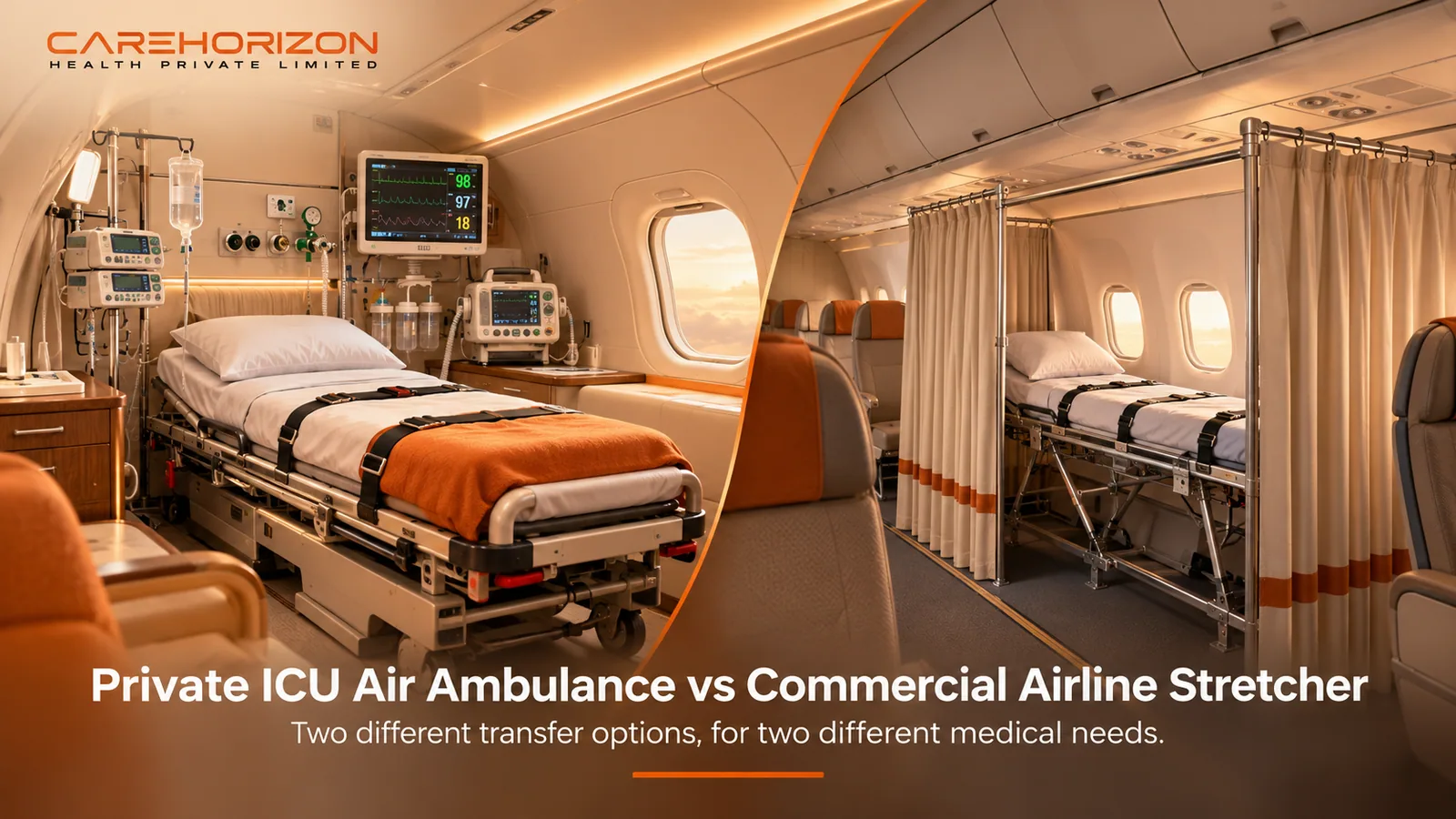
An oxygen-dependent patient may also be unable to remain seated safely. A commercial airline stretcher may be considered only when the airline supports it and the medical and escort arrangements meet the patient's needs.
A stretcher provides a lying-down position; it does not create intensive-care capacity or guarantee approval for oxygen equipment. Stretcher requests often involve additional forms, booking lead time, seating restrictions and accompanying-person requirements.
If the proposed stretcher and oxygen arrangement cannot safely meet the patient's needs, the medical team should consider another transport format.
When Might a Dedicated Air Ambulance Be More Appropriate?
A dedicated medical aircraft may be considered when the patient needs more complex respiratory support, intensive monitoring, other continuous treatments or a level of medical supervision that cannot be safely provided on a scheduled commercial service.
Patients who are rapidly deteriorating may need treatment and stabilisation before any journey. A dedicated air ambulance is not an automatic answer to every respiratory problem, nor can it duplicate all hospital intensive-care resources.
For medically appropriate intercity journeys, the domestic air ambulance pathway explains the additional equipment, ground transport and clinical coordination involved.
Planning Oxygen Across the Entire Journey
A flight booking covers only part of a patient's trip. Someone requiring oxygen may need support while leaving the hospital or home, in the ground ambulance, through airport check-in and security, while boarding and after landing.
Airline oxygen arrangements may not cover every ground or airport segment. Families must clarify where oxygen comes from at each stage and how any transition between systems will be managed. The guide to ground ambulances and airport coordination explains why these connections need careful planning.
Long airport waits, delayed flights and missed connections can increase the required support time. The care plan should include reasonable contingencies rather than depending solely on the scheduled flight duration.
Can Patients With COPD, Fibrosis or Other Lung Diseases Fly?
Some people with stable chronic respiratory disease can use commercial flights with appropriate assessment and oxygen support. But specific diagnoses such as COPD or interstitial lung disease do not tell the whole story; recent worsening, resting oxygenation, exertional symptoms and comorbid conditions can change the advice.
The British Thoracic Society's clinical statement discusses screening, tests to estimate in-flight hypoxaemia and individual oxygen requirements. It recommends a patient-specific approach rather than using a single everyday oxygen reading to make every travel decision.
A patient with severe symptoms, recent exacerbation or an uncertain oxygen prescription should seek medical review before making non-refundable travel arrangements.
Does Being on Oxygen at Home Mean the Same Prescription Works in Flight?
Not necessarily. Conditions in the aircraft cabin differ from those at home, and the prescribed oxygen arrangement may need review for the intended flight. The clinician must decide what oxygen support is needed and whether an available approved device can provide it.
Do not independently increase or decrease flow settings, substitute a pulse-dose device for continuous flow, or switch equipment without medical advice. A concentrator that works well at home may have different performance limits or practical restrictions in the aircraft.
The medical plan should identify the device, prescribed use, relevant monitoring and contingency arrangements, rather than assuming 'oxygen' is one interchangeable product.
Domestic Flights Within India
For travel between Indian cities, families should check the actual operating airline, route, airport transfer requirements and oxygen arrangements. A direct flight may reduce travel complexity, but a patient may still spend a substantial amount of time away from clinical support.
A qualified escort or appropriate ground transport may be useful in selected cases. If the patient needs intensive clinical support or cannot safely use the approved airline equipment, a dedicated domestic medical transfer may need to be considered after medical assessment.
Airport wheelchair service is an accessibility arrangement, not a substitute for prescribed oxygen, medical monitoring or an appropriate clinical escort.
International Flights and Medical Repatriation
International journeys can involve longer flight sectors, different operating airlines, layovers, immigration procedures and medication documentation. Every carrier involved should confirm its oxygen and equipment conditions rather than assuming the first airline's approval covers the entire itinerary.
A patient returning to India after illness abroad may require an organised receiving-care plan, ground transport and medical support throughout the journey. The international air ambulance and repatriation pathway provides context where dedicated transport is being considered.
Families should also confirm how prescriptions, medical reports and any required equipment are handled across borders, and whether the destination care team is prepared to receive the patient.
Step-by-Step: Preparing for an Oxygen-Assisted Flight
1. Ask the treating clinician for a travel assessment
Explain the full itinerary, including flight duration, connections and expected ground transfers. Obtain guidance on suitability, prescribed oxygen and whether further tests or professional accompaniment are needed.
2. Contact each operating airline
Ask whether oxygen or a specific portable concentrator is permitted, what documentation is required, which lead times apply and whether a medical escort or particular seating arrangement is necessary.
3. Complete MEDIF or other required documents
Submit the physician's information, current reports, device details and any other requested forms. The documents for a hospital-to-hospital transfer guide may help when the patient is travelling between healthcare facilities.
4. Confirm device and battery readiness
Verify that the exact model is accepted, batteries meet the airline's capacity rules and spare-battery transport complies with safety instructions. Keep required documents accessible.
5. Organise airport and ground assistance
Clarify wheelchair support, ground oxygen arrangements, any needed ambulance, boarding assistance and how the patient will reach the final destination.
6. Reconfirm the plan before departure
Check the patient's current condition, airline approval, flight details, oxygen support and arrangements for delays. Notify the responsible professionals if symptoms or equipment requirements change.
What Should a Written Quote Include?
Where professional escort, airline oxygen or ground medical transport is arranged, ask for a written itemisation of the patient ticket, escort ticket and fees, oxygen services or approved device support, applicable equipment charges and ground transfer arrangements.
Confirm taxes, waiting or cancellation terms, requirements for a new medical assessment, what happens if an airline refuses clearance and responsibility for connection delays. A standard airline fare is not the complete cost of oxygen-assisted medical travel.
Insurance may cover some services under a specific policy, but medical necessity, exclusions, limits and prior authorisation must be checked with the insurer. The guide to air ambulance and repatriation insurance offers related questions to consider.
Mistakes Families Can Avoid
A common mistake is buying an airline ticket before checking whether the patient's oxygen requirement can be approved. Others include assuming personal cylinders are permitted, confusing pulse-dose settings with continuous-flow oxygen, relying on aircraft electricity or overlooking battery capacity.
Families may also fail to plan oxygen support while waiting at the airport or during ground transfers. A nurse or doctor escort cannot resolve an absent approved oxygen supply on departure day.
The safer approach is to obtain medical advice first, confirm airline requirements for every flight sector and use a written plan that explains how prescribed support continues from origin to destination.
How Carehorizon Health Supports Medical Travel Coordination
Carehorizon Health coordinates the practical journey around clinical care. For someone exploring oxygen-assisted airline travel, that may mean helping organise medical information, understand potential transfer formats and align communication among the treating team, relevant transport professionals, airlines and receiving care providers.
Clinical suitability and oxygen prescriptions remain decisions for the treating clinicians, while the airline controls medical acceptance and permitted devices. To understand the coordination approach, see how Carehorizon works.
For an enquiry about a potential patient transfer, use the Carehorizon enquiry page, call +91 6292041222 or email care@carehorizonhealth.com. In an immediate medical emergency, seek local emergency medical services or contact the treating hospital rather than waiting for a travel arrangement.
Frequently Asked Questions
Can someone using oxygen fly on a commercial airline?
Some people can, after medical assessment and with airline-approved oxygen arrangements. Suitability depends on their condition, equipment and the proposed journey.
Do oxygen-dependent passengers always need MEDIF?
Requirements vary by carrier, but oxygen or medical-equipment requests commonly trigger medical clearance and documentation. Confirm the exact airline's policy.
Can passengers carry their own oxygen cylinders?
Do not assume personal oxygen cylinders are allowed. Some airlines provide oxygen through their own approved service and prohibit passenger cylinders.
Is a portable oxygen concentrator the same as a cylinder?
No. A concentrator is an electrically powered device that processes ambient air. It has different approval, battery and operating requirements.
How many batteries are needed for a POC?
The answer depends on actual battery performance, flight duration and airline rules. Air India and Singapore Airlines publish guidance around 150% of flight time for suitable devices.
Can a medical escort help with oxygen on the flight?
A qualified escort may assist with the approved plan, but cannot bypass airline restrictions or provide care outside their professional scope.
Can oxygen be used during take-off and landing?
The rules depend on the operating carrier and equipment. The prescribed support plan must be compatible with the airline's approved arrangements across all flight phases.
Does a patient with COPD always require oxygen when flying?
No. The treating clinician determines whether oxygen is indicated after considering the individual's condition and, where appropriate, additional assessment.
What if the airline refuses oxygen clearance?
The patient should not proceed under an unapproved plan. The treating and travel teams may review further stabilisation, another appropriate arrangement or dedicated medical transport.
Can an oxygen-dependent person fly internationally?
Potentially, if medically suitable and if each operating airline approves the required equipment and support, with appropriate ground and destination care arranged.
Medical and Airline References
- British Thoracic Society, Clinical Statement on Air Travel for Passengers with Respiratory Disease (2022): https://www.brit-thoracic.org.uk/clinical-resources/clinical-statements/air-travel-for-passengers-with-respiratory-disease/
- Air India, Medical Needs and Clearance Requirements: https://www.airindia.com/content/air-india/in/en/travel-information/health-medical-assistance/medical-needs-clearance.html
- Air India, Medical Information Form: https://www.airindia.com/in/en/travel-information/health-medical-assistance/medical-information-form.html
- Air India, Health and Medical Assistance FAQs: https://www.airindia.com/in/en/frequently-asked-questions/health-and-medical-assistance.html
- Singapore Airlines, Medical Information and Personal Medical Equipment: https://www.singaporeair.com/en_UK/nz/travel-info/special-assistance/medical-information/
- US Department of Transportation, Assistive Device Stowage and POC Guidance: https://www.transportation.gov/resources/individuals/aviation-consumer-protection/assistive-device-guides/assistive-device-stowage
Medical and publication disclaimer: General information only, not individual advice, an oxygen prescription or confirmation of airline acceptance. A qualified treating clinician must assess fitness to fly and prescribe appropriate oxygen; each operating airline must independently approve the passenger and equipment. Specific airline rules can change. Carehorizon links are based on the supplied website inventory and should be verified before publication.
Carehorizon Health coordinates medical travel, patient transfers and related arrangements. The information here is educational; it does not diagnose, prescribe, guarantee an outcome or replace advice from your treating medical team. Service availability, costs and travel requirements are confirmed case by case.